

Is It Normal to Have Pain Months After Hernia Surgery?

Is It Normal to Have Pain Months After Hernia Surgery?
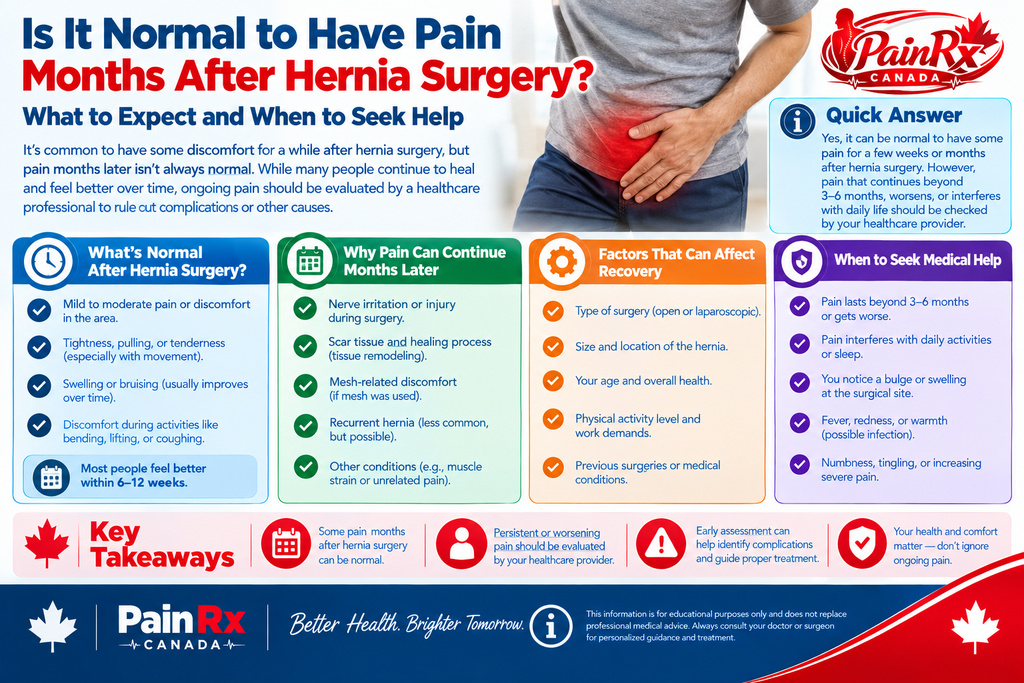
Most people expect hernia surgery pain to resolve within a few weeks, so discomfort that continues for months afterward can feel confusing and worrying. The honest answer depends heavily on timing and the type of pain involved. This guide explains where the line between normal healing and a complication that needs evaluation actually sits.
The General Definition Doctors Use
Clinicians generally consider groin or abdominal pain within the first three months after hernia surgery to fall within the normal acute healing window, even though it should be gradually improving rather than staying constant. Pain that continues at three months or beyond, particularly if it hasn’t meaningfully improved, moves into a category doctors call chronic postoperative pain, or chronic groin pain specifically for inguinal hernia repairs.
Some clinical definitions use six months rather than three as the threshold for labelling pain truly chronic, and terminology varies somewhat between sources. The consistent theme across clinical guidance is that pain persisting well past the expected healing period, and not clearly on a downward trend, warrants medical evaluation rather than continued waiting.
Why Pain Can Persist for Months in Some Patients
Chronic pain after hernia repair, particularly inguinal hernia repair, is a recognized and reasonably common complication, not a rare or mysterious occurrence. Cleveland Clinic identifies it as the most common long-term complication of inguinal hernia surgery specifically, and some sources describe it as affecting as many as one in ten patients, though estimates vary depending on the study, surgical technique, and how researchers define chronic pain.
Several underlying causes can explain this persistent pain.
Nerve injury or entrapment. Several small nerves run through the groin and lower abdominal area, and surgery in this region can injure, compress, or entrap one of these nerves, sometimes within scar tissue that forms during healing. Nerve-related pain often has a distinctive burning, stabbing, or shooting quality rather than the duller ache typical of normal healing.
Mesh-related issues. Many hernia repairs use synthetic mesh to reinforce the repair. In some patients, the mesh can press against tissue or a nerve, or trigger an inflammatory or foreign-body-type sensation that persists beyond normal healing.
Scar tissue. As the body heals, scar tissue naturally forms, and in some patients this tissue can encase or irritate nearby nerves or restrict normal tissue movement, contributing to ongoing discomfort.
Hernia recurrence. In some cases, a new or recurrent hernia at or near the original site causes pain that might initially be mistaken for lingering post-surgical discomfort.
What Normal Lingering Discomfort Tends to Feel Like
Even within the expected recovery period, some patients notice occasional mild soreness, pulling sensations with certain movements, or intermittent tenderness around the incision for a few months. This type of discomfort should generally trend toward improvement over time, even if that improvement isn’t perfectly linear week to week.
Discomfort that comes and goes, responds at least somewhat to rest or over-the-counter pain relief, and doesn’t significantly limit daily activities more often falls within a range doctors consider part of an ordinary, if occasionally prolonged, recovery.
What Points Toward a Complication Instead
Certain characteristics distinguish concerning pain from typical prolonged healing.
Pain described as burning, stabbing, shooting, or electric-shock-like often points toward nerve involvement rather than routine post-surgical soreness. Pain that’s clearly worsening rather than improving over time, or that suddenly spikes after a period of feeling better, also differs from the expected pattern and pain significant enough to interfere with work, sleep, exercise, or daily activities deserves attention regardless of how much time has passed since surgery. A new lump, bulge, or visible swelling at or near the surgical site could indicate hernia recurrence and needs prompt evaluation.
How Doctors Investigate Ongoing Pain
A doctor evaluating persistent post-hernia-surgery pain typically starts by ruling out other unrelated causes, such as hip or back issues that could produce similar symptoms in the same general area.
A diagnostic nerve block, using a local anesthetic injected near a suspected nerve, can help confirm whether a specific nerve is contributing to the pain; meaningful, even if temporary, relief from the block supports a nerve-related diagnosis. Imaging may help identify mesh-related complications or hernia recurrence in some cases.
Treatment Options for Chronic Post-Hernia-Surgery Pain
Treatment depends on the underlying cause, and several approaches exist depending on what an evaluation reveals.
Medication. Anti-inflammatory medications or nerve-pain-specific medications may help manage symptoms, particularly while the underlying cause is being investigated.
Nerve blocks or injections. Beyond their diagnostic role, nerve blocks and certain injections can sometimes provide longer-term relief for nerve-related pain.
Physical therapy. In some cases, targeted physical therapy can help with pain related to scar tissue or muscle tension around the surgical site.
Surgical revision. For pain clearly linked to nerve entrapment or a problematic mesh, procedures such as targeted nerve removal (neurectomy) or mesh removal or revision can provide significant relief for some patients, particularly when performed by a surgeon experienced in this specific complication.
Specialized chronic groin pain programs exist at some major hospital systems specifically because this complication, while not universal, is well recognized and often benefits from a multidisciplinary evaluation rather than a single quick fix.
Frequently Asked Questions
How long is it normal to have some pain after hernia surgery? Many clinicians consider pain within the first three months to fall within the normal acute healing window, provided it’s gradually improving. Pain persisting well beyond that, especially without improvement, warrants evaluation.
Does chronic pain after hernia surgery always mean something went wrong with the mesh? Not necessarily. Nerve injury, scar tissue, and hernia recurrence can all cause persistent pain independent of the mesh, and a proper evaluation helps identify the actual underlying cause in a specific case.
Is burning or stabbing pain months after hernia surgery a bad sign? This type of pain often points toward nerve involvement rather than ordinary healing discomfort and is worth discussing with a doctor, since nerve-related pain sometimes responds well to specific treatments once identified.
Can chronic pain after hernia surgery be treated successfully? Often, yes. Depending on the cause, treatments ranging from medication and nerve blocks to targeted surgical revision have helped many patients achieve significant or complete relief, particularly with evaluation by a specialist familiar with this specific complication.
When should I see a doctor about pain months after hernia surgery? If pain hasn’t clearly improved by around three months, has a burning or shooting quality, is worsening rather than easing, or significantly limits your daily activities, it’s worth scheduling an evaluation rather than continuing to wait it out.
The Bottom Line
Some lingering discomfort within the first few months after hernia surgery can fall within a normal, if occasionally prolonged, healing process. Pain that persists at three months or beyond, particularly if it isn’t improving or has a distinctive burning or stabbing quality, moves into a category doctors recognize as chronic postoperative pain, a known and reasonably common complication tied to nerve injury, mesh-related issues, scar tissue, or occasionally hernia recurrence.
This isn’t something to simply endure indefinitely. A proper evaluation can often identify the specific cause, and effective treatments exist for many of the underlying reasons behind this kind of persistent pain.
This article is for general informational purposes only and is not a substitute for professional medical advice. Recovery experiences vary significantly between individuals. Contact your surgical team or a doctor promptly if you have concerns about pain that persists or worsens after hernia surgery.