

How Long Will I Have Pain After Rotator Cuff Surgery?

How Long Will I Have Pain After Rotator Cuff Surgery?
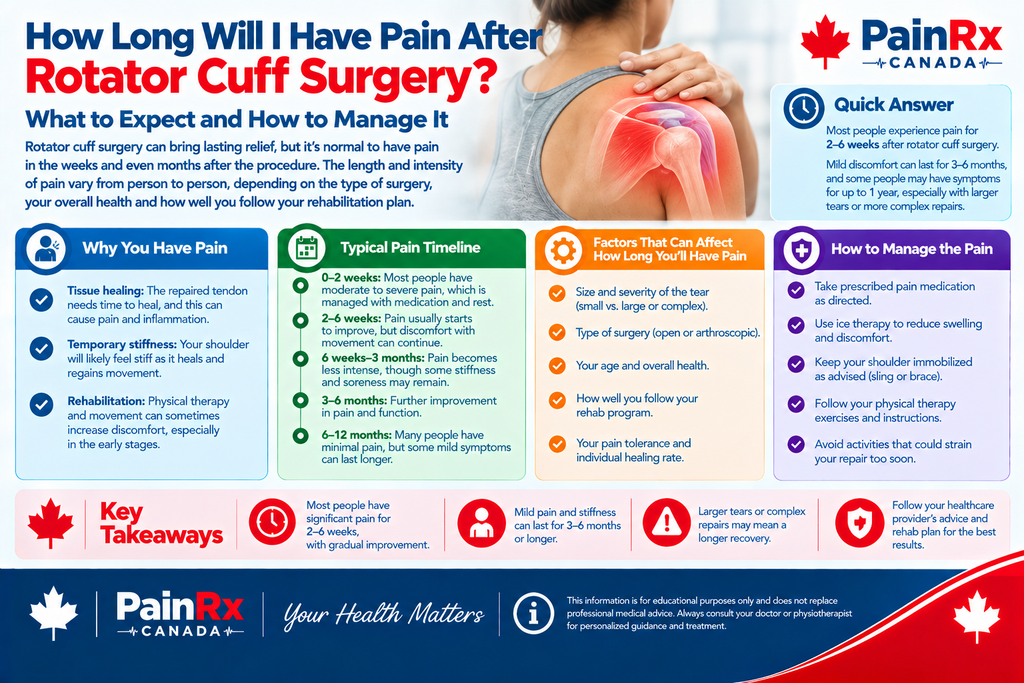
Rotator cuff surgery repairs torn tendons in the shoulder, and the recovery that follows involves a genuinely gradual process, both for the tendon itself and for the pain that comes with healing it. Patients heading into surgery, or already recovering from it, often want a realistic sense of what to expect and when. This guide covers the general pain timeline, what shapes it, and when discomfort crosses into something worth calling a doctor about.
Why Pain After This Surgery Takes Time to Resolve
Rotator cuff surgery involves reattaching torn tendon tissue to the upper arm bone, and that tissue needs real time to heal, not just for pain to fade but for the repair itself to hold. The tendon typically forms an initial attachment to the bone within about six weeks, builds a relatively strong connection by around three months, and reaches full healing to the bone somewhere between six and nine months after surgery.
Pain generally improves faster than the tendon fully heals, but the two processes are related. Some soreness during the months after surgery reflects the tendon and surrounding tissue still actively remodelling, even as day-to-day discomfort continues to ease.
The General Pain Timeline
The first few days. Pain is typically at its most intense during this window, and doctors commonly prescribe pain medication specifically to manage this initial period.
The first two weeks. Discomfort remains significant for many patients during this stretch, though it usually starts trending downward. Ice, prescribed medication, and proper arm support all play an important role in managing pain during these early weeks.
One to two months. Many patients notice a meaningful decline in pain during this period, alongside the start of physical therapy. Some discomfort during specific movements, particularly reaching overhead or behind the back, often persists even as overall pain improves.
Three to six months. Pain generally continues to ease substantially during this stretch for most patients, though this varies with the extent of the original tear and the type of surgery performed. Physical therapy typically shifts toward rebuilding strength and range of motion during this phase.
Six to twelve months. For many patients, pain becomes minimal by this point, and the shoulder regains most or all of its strength and mobility. Full recovery, including complete tendon healing, can extend toward the later end of this window or slightly beyond it for more extensive repairs.
Factors That Influence How Long Pain Lasts
Recovery timelines vary meaningfully between patients, shaped by several factors.
Tear size and severity. Smaller, partial tears generally heal faster and involve less prolonged pain than larger or full-thickness tears requiring more extensive repair.
Surgical approach. Arthroscopic surgery, performed through small incisions, generally produces less post-operative pain and a somewhat faster recovery than open surgery, which involves a larger incision and more surrounding tissue disruption.
Age and overall health. Older patients and those with certain health conditions sometimes experience a longer recovery timeline than younger, otherwise healthy patients.
Adherence to rehabilitation. Following a physical therapy plan consistently plays a significant role in both reducing pain and restoring function efficiently, while skipping or rushing through rehabilitation can extend the timeline.
Smoking status. Smoking has been associated with slower healing and longer recovery times after rotator cuff surgery, related to its effect on tissue healing generally.
Common Approaches to Managing Pain During Recovery
Doctors generally combine several strategies to manage pain throughout the recovery process, adjusting the approach as healing progresses.
Prescribed pain medication. Doctors sometimes prescribe an opioid for short-term relief immediately after surgery, alongside or followed by acetaminophen and anti-inflammatory medications as pain decreases.
Ice therapy. Regular icing, particularly during the first couple of weeks, helps manage swelling and pain alongside medication.
Proper positioning. Many patients find sleeping in a partially upright or reclined position, with the operated arm supported and the elbow pointed downward, more comfortable than lying flat during the early recovery weeks.
Sling use. Wearing a sling as directed protects the healing repair and can reduce pain associated with unsupported arm movement.
Physical therapy. While therapy itself can feel uncomfortable at times, especially early on, following the prescribed program is central to both reducing long-term pain and restoring shoulder function.
When Pain Signals a Possible Complication
Some pain and stiffness are an expected part of this recovery, but certain patterns warrant contacting a doctor rather than waiting them out.
Contact a doctor if pain doesn’t improve with rest or prescribed medication, if pain suddenly worsens rather than gradually easing, or if swelling around the shoulder doesn’t decrease over time. Redness, warmth, or drainage around the incision site, along with a fever above 38°C (100.4°F), can indicate infection and need prompt evaluation. Any new numbness, significant weakness, or a sudden change in shoulder function should also prompt a call to the surgical team, since these can sometimes signal a complication like re-tearing or nerve involvement.
Frequently Asked Questions
Is it normal to still have some pain three months after rotator cuff surgery? Yes, for many patients. Pain generally continues improving well past the three-month mark, though it should show a clear overall downward trend rather than staying flat or worsening.
Why does my shoulder still feel stiff even though the pain has improved? Stiffness can persist separately from pain and sometimes lasts anywhere from several weeks to closer to a year in some patients, related to the shoulder’s reduced movement during the healing process. Physical therapy plays a central role in addressing this.
Does open surgery hurt more than arthroscopic surgery? Generally, yes. Open surgery involves a larger incision and more tissue disruption, which tends to produce more post-operative pain and a somewhat longer initial recovery compared to arthroscopic techniques.
When can I expect to stop needing pain medication after this surgery? Many patients transition off stronger prescribed medication within the first couple of weeks, moving to over-the-counter options as pain decreases, though this varies based on the extent of the repair and individual recovery.
How do I know if my pain means something went wrong with the repair? Pain that suddenly worsens after a period of improvement, or that comes with new weakness, numbness, or signs of infection, differs from typical recovery discomfort and should prompt a call to your surgical team.
The Bottom Line
Pain after rotator cuff surgery is typically most intense during the first few days and gradually eases over the following weeks and months, generally becoming minimal within six to twelve months as the shoulder heals and regains strength. The tendon itself continues healing on a somewhat longer timeline than pain resolution alone, often reaching full attachment to the bone between six and nine months after surgery.
Tear severity, surgical approach, age, and how consistently a patient follows their rehabilitation plan all shape this timeline. Pain that worsens rather than improves, or that comes with signs of infection or new weakness, warrants prompt attention from the surgical team rather than waiting it out.
This article is for general informational purposes only and is not a substitute for professional medical advice. Recovery experiences vary significantly between individuals. Always follow your surgeon’s specific post-operative instructions, and contact your surgical team promptly with any concerns about pain, healing, or possible complications.