
What Is Stronger Than Dilaudid?

What Is Stronger Than Dilaudid? A Canadian Patient Guide
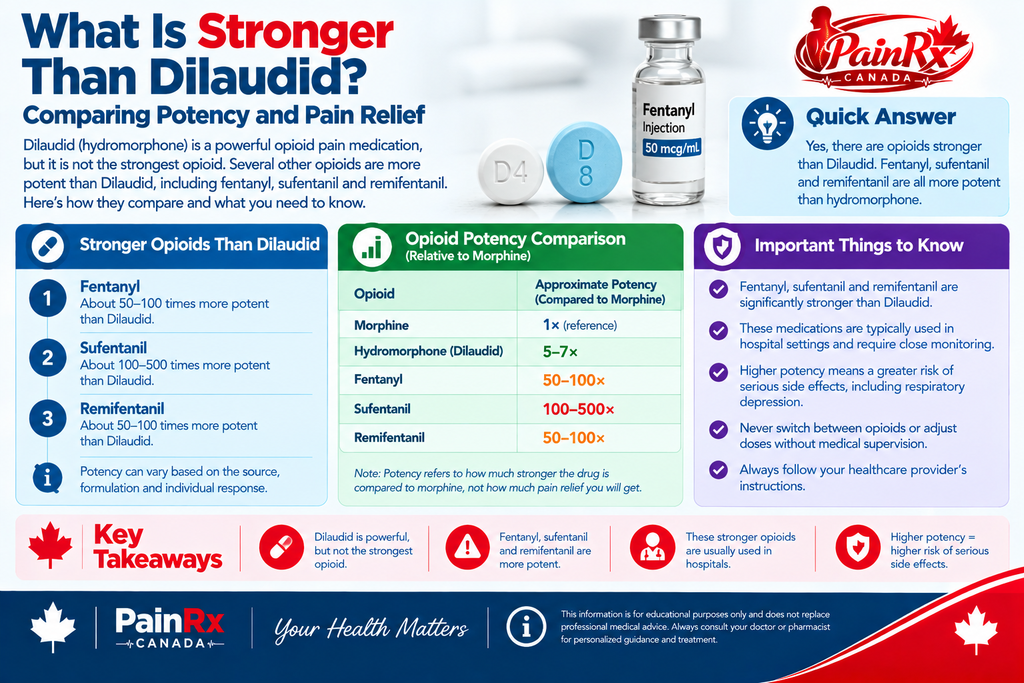
Dilaudid ranks among the more potent opioids in everyday clinical practice, but it doesn’t sit near the top of the overall opioid potency scale. This guide covers which opioids surpass hydromorphone in strength, where doctors use them, and a serious, current Canadian safety issue: substances far more potent than Dilaudid have entered the illicit drug supply, including inside counterfeit pills.
Opioids Used Clinically That Are Stronger Than Dilaudid
Several opioids used in legitimate medical settings rank above hydromorphone on standard potency comparisons.
Fentanyl. Hospitals, palliative care teams, and chronic-pain patches all use fentanyl widely. Experts generally consider it 50 to 100 times more potent than morphine, putting it well above hydromorphone’s potency. Doctors use it under close supervision, since its strength leaves little margin for error.
Sufentanil. Anesthesiologists use sufentanil primarily during major surgery. Research generally places it several times more potent than fentanyl itself, and its use stays essentially limited to controlled hospital settings.
Remifentanil. Anesthesia teams also rely on remifentanil, valuing its extremely short duration of action for precise control during surgical procedures. It ranks highly potent relative to hydromorphone as well.
Alfentanil. Surgical teams use alfentanil too. It sits above hydromorphone in potency, though below fentanyl and sufentanil, and shares their short-acting, tightly controlled clinical role.
Oxymorphone. This close chemical relative of hydromorphone shows similar receptor-binding strength and produces broadly comparable clinical effects. It sits in roughly the same potency range as Dilaudid rather than clearly above it.
Carfentanil. No opioid used in human medicine comes close to carfentanil’s potency. Researchers developed it exclusively to sedate large animals like elephants, and it has no approved human use. Estimates place it at roughly 100 times more potent than fentanyl.
Why Stronger Doesn’t Mean Better
None of these more potent opioids improve on Dilaudid for typical pain management. Potency and safety margin generally move in opposite directions among opioids: the more potent the drug, the smaller the gap between an effective dose and a dangerous one.
This is exactly why fentanyl, sufentanil, remifentanil, and alfentanil see use almost exclusively in tightly supervised medical settings, such as an operating room or an ICU. Staff can monitor a patient continuously there and respond immediately to any complication. Doctors match a medication’s potency to the clinical situation, rather than defaulting to the strongest available option.
A Serious Canadian Safety Issue: Illicit Ultra-Potent Opioids
Beyond legitimate medical use, Canada’s unregulated drug supply has increasingly included synthetic opioids far more potent than Dilaudid. This issue connects directly to the counterfeit pill risk covered in a separate guide on this site.
Nitazenes, a class of synthetic opioids that regulators never approved for human use, have appeared in Canada’s illicit drug supply since 2019. Health Canada continues to detect them in analyzed samples today. Experts consider some nitazene compounds significantly more potent than fentanyl, and public health alerts have specifically flagged their presence in counterfeit pills sold as Dilaudid, oxycodone, and Percocet in provinces including Ontario.
This matters enormously for anyone who encounters a pill claiming to be Dilaudid outside a licensed pharmacy. A tablet that looks identical to a real prescription could actually contain a substance many times more potent, with no way to tell the difference by appearance alone.
Why These Substances Are Especially Dangerous
A few specific characteristics make nitazenes and similar ultra-potent opioids particularly hazardous compared to more familiar opioids like Dilaudid.
Standard test strips often can’t detect them. People increasingly use fentanyl test strips as a harm-reduction tool, but these strips don’t reliably detect nitazenes. A negative test result therefore doesn’t guarantee safety.
Overdoses can happen faster and more severely. Given their potency, ultra-strong synthetic opioids can cause life-threatening respiratory depression very quickly after use.
Standard naloxone doses may not be enough. Public health alerts note that nitazene-related overdoses can be harder to reverse. Responders sometimes need multiple doses of naloxone, along with immediate emergency medical care.
What This Means for Patients and Families
For patients with a legitimate Dilaudid prescription, this information underscores why medication should only ever come from a licensed Canadian pharmacy. Anyone who might encounter opioids outside that context, whether personally or through a family member, benefits from understanding this risk, since it supports safer decisions and faster recognition of an emergency.
Carrying naloxone, knowing the signs of an overdose, and understanding that a single dose may not reverse an overdose involving an ultra-potent substance can make a genuine difference in an emergency. If an overdose seems likely, call 911 immediately, give naloxone, and continue rescue breathing or CPR as needed. Repeat naloxone doses every few minutes until help arrives or the person responds.
Frequently Asked Questions
Is fentanyl ever prescribed alongside or instead of Dilaudid? Yes, particularly for severe cancer pain, palliative care, or hospital and surgical settings. Doctors choose between them based on the specific clinical situation rather than potency alone.
Why would anyone use a more dangerous, more potent opioid instead of Dilaudid? In legitimate medical settings, more potent opioids like fentanyl or sufentanil suit situations that need extremely precise, fast-acting pain control under close supervision. Outside medical settings, ultra-potent substances typically appear unintentionally, mixed into other drugs without the user’s knowledge.
Can I tell if a pill contains a more potent substance than Dilaudid just by looking at it? No. Manufacturers of counterfeit pills design them specifically to resemble legitimate prescription tablets, and no reliable way exists to detect a more potent or different substance through appearance alone.
Does one dose of naloxone always reverse an overdose from a more potent opioid? Not necessarily. Public health sources note that overdoses involving ultra-potent synthetic opioids like nitazenes can require multiple naloxone doses. Every suspected overdose should also involve an emergency call, since naloxone’s effects can wear off before the opioid’s effects do.
Is carfentanil something a person could ever encounter outside veterinary use? While rare, investigators have occasionally detected carfentanil in illicit drug supplies in some regions, underscoring why any substance obtained outside a licensed pharmacy carries real, unpredictable risk.
The Bottom Line
Several opioids, including fentanyl, sufentanil, remifentanil, and alfentanil, exceed Dilaudid’s potency considerably, though their use in legitimate medicine stays confined to closely supervised settings because of that potency. Carfentanil sits far beyond any of these and has no approved human use at all.
The more urgent concern for most Canadians involves illicit ultra-potent synthetic opioids like nitazenes, which have turned up mixed into counterfeit pills sold as Dilaudid and other prescription opioids. Treat any pill not obtained directly from a licensed pharmacy as unverified and potentially far more dangerous than its appearance suggests.
This article is for general informational purposes only and is not a substitute for professional medical advice. Dilaudid and hydromorphone are prescription-only controlled substances in Canada. Always consult a doctor or pharmacist with questions about your specific medication, dosing, or symptoms, and seek emergency medical help immediately for any signs of an opioid overdose.