

Is Dilaudid the Same as Morphine?

Is Dilaudid the Same as Morphine? A Canadian Patient Guide
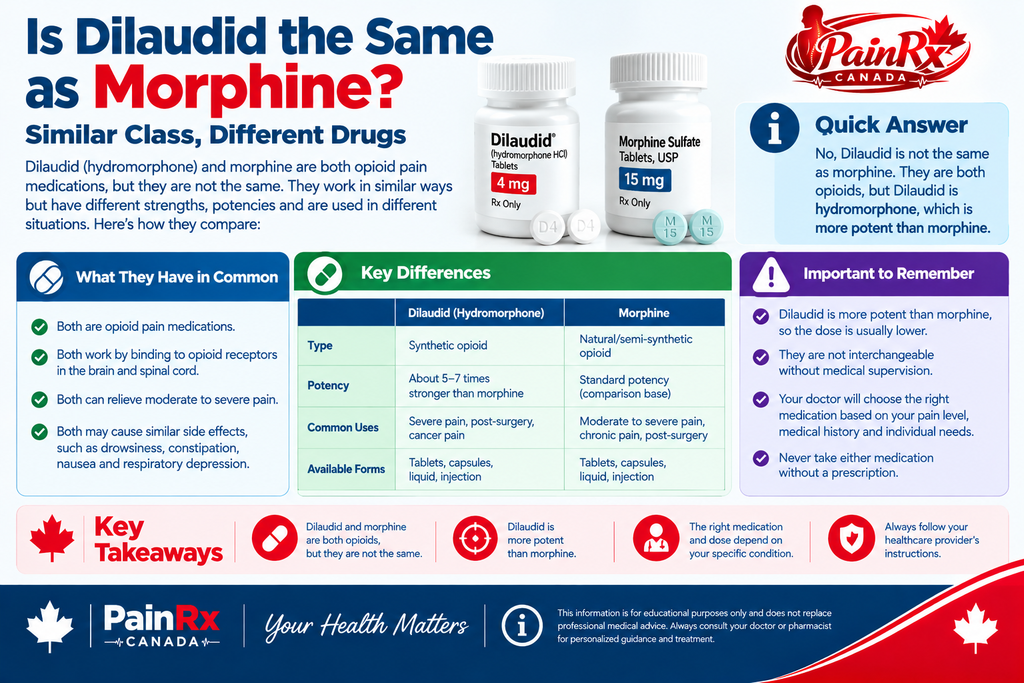
Patients sometimes assume Dilaudid and morphine are simply two names for the same medication, especially after hearing both mentioned in the same hospital stay or pain management conversation. They’re closely related, but they aren’t the same drug. This guide explains exactly how Dilaudid (hydromorphone) relates to morphine, where they differ, and why a doctor might choose one over the other.
The Relationship Between the Two
Hydromorphone is a semi-synthetic opioid derived directly from morphine through a chemical modification process. This close relationship explains why the two medications share a similar mechanism of action, both binding to mu-opioid receptors in the brain and spinal cord to block pain signals.
Despite that shared origin, hydromorphone and morphine are distinct medications with different potency, different side effect profiles, and different roles in typical prescribing. Health Canada regulates them as separate controlled substances, each with its own product monograph, indications, and dosing guidance.
Comparing Potency
The clearest difference between the two is strength. Standard clinical equianalgesic dosing tables, which compare how much of one opioid produces pain relief equal to another, consistently rank hydromorphone as considerably more potent than morphine by weight.
This means a smaller milligram dose of hydromorphone typically produces pain relief comparable to a larger milligram dose of morphine. The exact ratio varies somewhat across clinical studies and differs between oral and injectable forms, which is why doctors and pharmacists use precise conversion calculations rather than a single fixed number when switching a patient between the two.
Comparing Side Effect Profiles
Beyond potency, the two opioids differ somewhat in their typical side effect patterns, largely due to differences in how they interact with the body.
Morphine tends to trigger more histamine release than hydromorphone in many patients, which can produce more noticeable itching, flushing, or mild allergic-type reactions. Patients who experience bothersome itching or other histamine-related side effects on morphine sometimes tolerate hydromorphone better, though individual response varies considerably.
Both medications share the core opioid side effects, including drowsiness, constipation, nausea, and the risk of respiratory depression, since these effects stem from opioid receptor activity common to both drugs rather than a difference specific to one or the other.
Why Kidney Function Often Favours Hydromorphone
One of the more clinically significant differences involves how each medication behaves in patients with reduced kidney function.
Morphine produces an active metabolite called morphine-6-glucuronide, which can accumulate in patients with impaired kidney function and potentially intensify sedation and respiratory depression. Hydromorphone’s primary metabolite doesn’t carry the same analgesic activity, which is part of why doctors sometimes prefer hydromorphone over morphine for patients with significant kidney impairment, though hydromorphone still requires careful dose adjustment in this population as well.
When Doctors Choose Hydromorphone Over Morphine
Several situations commonly lead a doctor toward Dilaudid instead of morphine.
Reduced kidney function. As noted above, hydromorphone sometimes carries a more favourable profile for patients whose kidneys don’t clear medications as efficiently.
Morphine intolerance. A patient who experiences significant itching, nausea, or inadequate relief from morphine may respond better to hydromorphone.
Need for a more potent option. Severe pain that morphine doesn’t adequately control may call for a switch to a more potent opioid.
Formulation needs. Both medications come in multiple forms, and a doctor’s choice sometimes depends on which specific formulation, dose strength, or delivery method best suits a patient’s situation.
When Morphine Remains the Preferred Choice
Greater potency doesn’t make hydromorphone the automatic choice for every patient.
Morphine remains one of the most extensively studied and widely used opioids in medicine, particularly in palliative and cancer care, where decades of clinical experience support its use. Its lower cost and broad familiarity among prescribers also support its continued widespread use for moderate to severe pain that doesn’t require hydromorphone’s higher potency.
Safety Considerations for Both Medications
Both Dilaudid and morphine carry the same core opioid risks, since both act on the same receptor system.
Respiratory depression, the most serious risk associated with either medication, increases when a dose exceeds what’s prescribed, when doses come too close together, or when either opioid combines with alcohol, benzodiazepines, or other central nervous system depressants. Patients and caregivers should learn the signs of an opioid emergency: extreme drowsiness that’s hard to rouse from, slow or shallow breathing, blue-tinged lips or fingertips, and unresponsiveness. Call 911 immediately if these appear, and use naloxone if it’s available.
Frequently Asked Questions
If I’m allergic to morphine, will I also react to Dilaudid? True opioid allergies are uncommon; many reactions attributed to morphine actually reflect histamine-related side effects rather than a genuine allergy. A doctor can help determine whether a prior morphine reaction suggests caution with hydromorphone specifically, since this varies by individual and by the nature of the original reaction.
Why did my doctor switch me from morphine to Dilaudid? Common reasons include inadequate pain relief on morphine, bothersome side effects like itching, reduced kidney function, or a need for a more potent option to manage escalating pain.
Is Dilaudid more addictive than morphine? Both carry a genuine risk of dependence and addiction as opioids. Risk depends heavily on dose, duration of use, and individual factors rather than being inherently higher for one medication over the other.
Can I take Dilaudid and morphine together? Combining two opioids without explicit medical direction significantly raises the risk of dangerous respiratory depression and should never happen outside a doctor’s specific instructions.
Does Dilaudid work faster than morphine? Onset depends more on the form used than the specific opioid. IV forms of both medications act within minutes, while oral forms of both generally take fifteen to thirty minutes to produce noticeable relief.
The Bottom Line
Dilaudid and morphine share a close chemical relationship, since hydromorphone is derived from morphine, but they aren’t the same medication. Hydromorphone is considerably more potent by weight, tends to cause less histamine-related side effects like itching, and sometimes carries a more favourable profile for patients with reduced kidney function. Morphine remains a well-established, widely used option with decades of supporting clinical experience.
Neither medication is universally better. The right choice depends on pain severity, kidney function, prior response to either opioid, and a doctor’s overall assessment of the safest and most effective path to pain relief.
This article is for general informational purposes only and is not a substitute for professional medical advice. Dilaudid and morphine are prescription-only controlled substances in Canada. Always consult a doctor or pharmacist with questions about your specific medication, dosing, or symptoms, and seek emergency medical help immediately for any signs of an opioid overdose.