

How Much Dilaudid Can You Take a Day?

How Much Dilaudid Can You Take a Day? A Canadian Patient Guide
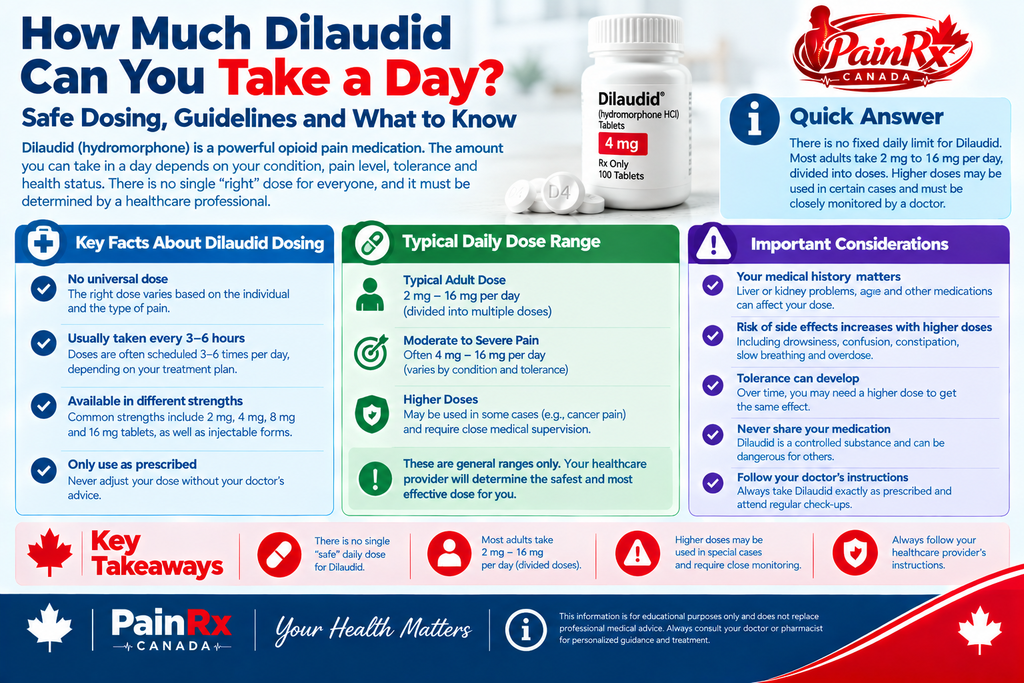
This question doesn’t have a single universal answer, and that’s actually an important safety point in itself. Unlike an over-the-counter medication with a printed daily maximum that applies to everyone, Dilaudid’s safe daily amount depends entirely on an individual patient’s specific prescription, calculated by a doctor based on that patient’s pain, tolerance, and overall health. This guide explains why that’s the case, what factors go into an individualized dose, and why exceeding a prescribed amount carries real danger.
Why There’s No Single “Safe” Daily Amount
Hydromorphone is a potent opioid with a genuinely narrow margin between an effective dose and a dangerous one, and that margin shifts significantly from patient to patient. A dose that provides safe, effective relief for one patient could pose a serious risk for another, depending on factors like opioid tolerance, kidney and liver function, age, and other medications.
This is precisely why Health Canada’s prescribing guidance for hydromorphone describes dosing as something a doctor titrates, or gradually adjusts, based on an individual patient’s response, rather than publishing one fixed daily ceiling that applies universally. A doctor calculates a starting dose and adjusts it over time based on how well it controls pain and what side effects appear.
What Doctors Consider When Setting a Dose
Several factors shape the specific dose and daily total a doctor prescribes for an individual patient.
Opioid tolerance. A patient who has taken opioids regularly typically needs a higher dose to achieve the same pain relief a first-time opioid user would feel from a much smaller amount. Doctors calculate starting doses very differently for opioid-naive patients versus opioid-tolerant ones.
Pain severity and type. More severe pain, or pain from certain conditions, may require a higher total daily amount than milder pain, always balanced against safety.
Kidney and liver function. Since these organs clear hydromorphone and its metabolites, reduced function often means a doctor prescribes a lower dose or extends the interval between doses to avoid dangerous accumulation.
Age. Older adults often need more conservative starting doses, since medications can clear more slowly and side effects can hit harder.
Other medications. Sedatives, certain antidepressants, and other central nervous system-affecting drugs can change how a given dose of hydromorphone affects a patient, sometimes requiring a lower overall dose.
Formulation. Immediate-release and extended-release Dilaudid follow different dosing structures entirely, since extended-release tablets deliver medication gradually across a full day rather than through several smaller doses.
Why Doctors Increase Doses Gradually
When a dose needs adjustment, doctors typically increase it in gradual steps rather than large jumps, and they base each adjustment on how the patient actually responded to the previous dose. This gradual approach, sometimes called titration, exists specifically to find the lowest dose that controls pain effectively while minimizing risk.
Patients sometimes feel frustrated by this gradual process, especially when pain relief still feels inadequate. Raising this directly with a doctor allows for a safe adjustment, rather than a patient deciding independently to take more than prescribed.
Why Taking More Than Prescribed Is Dangerous
Taking a higher dose than prescribed, taking doses closer together than instructed, or combining Dilaudid with alcohol or other sedatives all raise the risk of dangerous respiratory depression, meaning breathing that becomes too slow or shallow to sustain the body’s oxygen needs.
This risk exists specifically because a prescribed dose already reflects a careful, individualized calculation. Exceeding it doesn’t simply provide proportionally more pain relief; it moves outside the safety margin that calculation was designed to protect. This applies even to a patient who has taken Dilaudid safely before, since tolerance and organ function can shift over time.
What to Do If Your Prescribed Dose Doesn’t Feel Like Enough
If pain relief feels consistently inadequate at a prescribed dose, this is a genuine medical concern worth raising promptly, rather than something to solve independently.
A doctor can evaluate whether the current dose needs adjustment, whether the pain itself has changed in a way that needs investigation, or whether a different medication or formulation might work better. This conversation matters even more if a patient feels tempted to take extra doses to manage pain between scheduled ones, since that temptation itself is worth discussing openly with a prescriber.
Recognizing Warning Signs of Taking Too Much
Understanding the signs of an opioid emergency matters regardless of how a dose came to be too high, whether through an error, a miscommunication, or taking more than prescribed.
Extreme drowsiness that’s hard to rouse someone from, confusion, slow or shallow breathing, blue-tinged lips or fingertips, and unresponsiveness all signal a potential opioid emergency. Call 911 immediately if any of these appear, and use naloxone if it’s available, since these signs can progress quickly without intervention.
Frequently Asked Questions
Why won’t my doctor just tell me the maximum amount of Dilaudid I could take? A maximum safe amount genuinely depends on individual factors like tolerance, organ function, and other medications, which is why a doctor calculates a specific number for your situation rather than citing a universal figure that wouldn’t accurately apply to everyone.
Is it true that a dose that’s safe for one person could be dangerous for another? Yes. Differences in opioid tolerance, kidney and liver function, age, and other medications can make an identical dose safe for one patient and dangerous for another.
Can I take extra Dilaudid if my pain gets worse on a particular day? No, not without talking to a doctor first. Taking more than prescribed raises overdose risk significantly, even during a period of worse pain, and a doctor can help find a safer way to manage a temporary increase in pain.
Does needing a higher dose over time mean something is wrong? Not necessarily. Tolerance naturally develops with regular opioid use, and pain conditions themselves can change over time. Either situation calls for a conversation with a doctor about adjusting the dose safely, not an independent decision to take more.
What should I do if I accidentally took an extra dose? Contact a doctor, pharmacist, or poison control centre promptly for guidance, and watch closely for signs of an opioid emergency. Call 911 immediately if any warning signs of overdose appear.
The Bottom Line
There’s no single “safe daily amount” of Dilaudid that applies to everyone, because dosing depends on tolerance, organ function, age, other medications, and the specific pain being treated. A doctor calculates an individualized dose and adjusts it gradually based on how a patient actually responds.
Taking more than a prescribed dose, for any reason, moves outside the careful safety calculation behind that prescription and significantly raises the risk of a dangerous or fatal overdose. Any concern about whether a current dose is adequate belongs in a direct conversation with a doctor or pharmacist, never in an independent decision to take more.
This article is for general informational purposes only and is not a substitute for professional medical advice. Dilaudid and hydromorphone are prescription-only controlled substances in Canada. Always consult a doctor or pharmacist with questions about your specific medication, dosing, or symptoms, and seek emergency medical help immediately for any signs of an opioid overdose.