

How Long Does IV Dilaudid Last?

How Long Does IV Dilaudid Last? A Canadian Patient Guide
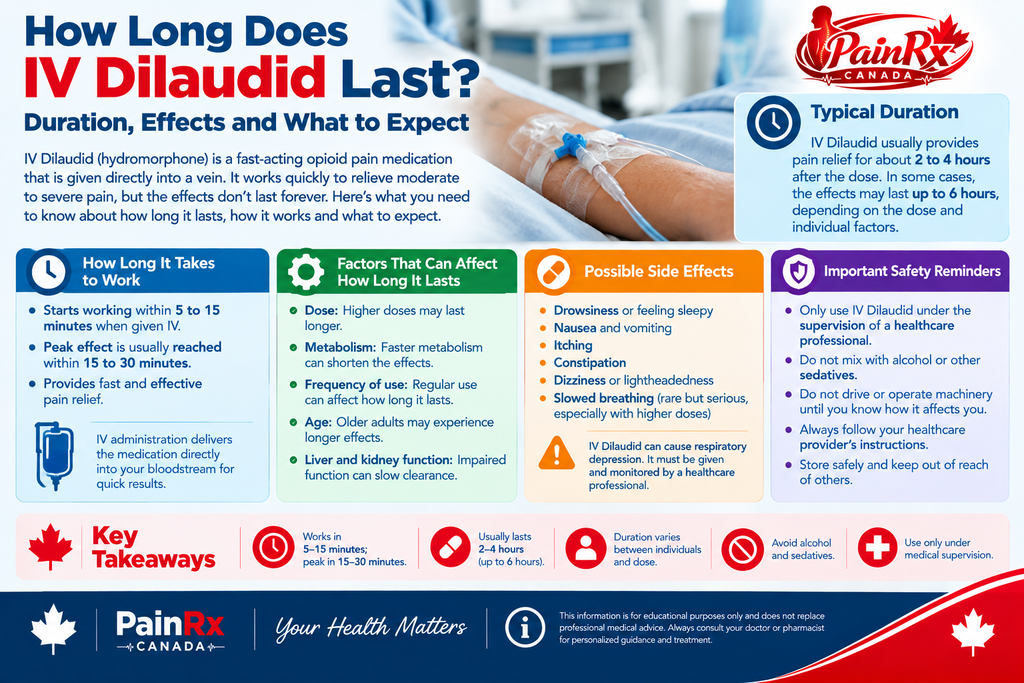
Patients receiving Dilaudid through an IV line in a hospital or emergency department often want to know how long the relief will actually last before the next dose becomes due. This guide covers IV hydromorphone’s typical onset, peak, and duration of pain relief, what changes that timeline, and why this form works differently than the tablets a patient might take at home afterward.
The Typical Timeline for IV Dilaudid
Clinical references consistently describe a fast, predictable pattern for IV hydromorphone.
Onset of pain relief typically begins within about five minutes of administration. Peak analgesic effect, meaning the point of strongest pain relief, usually occurs within about 10 to 20 minutes after that. The overall duration of pain relief from a single IV dose generally runs about three to four hours, though some clinical sources describe a slightly wider range depending on the dose and the patient.
This fast, direct action explains why hospitals and emergency departments rely on IV hydromorphone specifically for situations that call for rapid pain control, such as after major surgery, a serious injury, or an acute pain crisis.
Why IV Administration Works So Quickly
An IV dose enters the bloodstream directly, bypassing the digestive system entirely. This is the core reason IV Dilaudid acts faster than an oral tablet, which must first pass through the stomach, absorb through the intestine, and travel through the liver before reaching general circulation.
Hydromorphone also crosses into the central nervous system somewhat more slowly than some other opioids, due to its chemical properties, which is part of why its peak effect takes a bit longer to arrive than its initial onset. Even so, the full sequence from administration to peak relief still happens within about 20 to 30 minutes for most patients.
Why Duration Matters for Hospital Dosing Schedules
Because IV Dilaudid’s pain-relieving effect generally lasts three to four hours, hospital dosing schedules for repeat IV doses commonly fall somewhere in that range, though the exact interval always depends on an individual doctor’s assessment. This differs from a fixed rule and instead reflects ongoing clinical judgment based on the patient’s pain level, response to previous doses, and overall condition.
Some hospital patients receive hydromorphone through patient-controlled analgesia, a system that allows a patient to safely self-administer small preset IV doses within limits programmed by medical staff. This approach accounts for hydromorphone’s duration by building in a lockout period between allowed doses, which prevents doses from stacking too closely together.
Factors That Can Shorten or Extend the Duration
Individual factors shift how long IV Dilaudid’s effects actually last for a specific patient, sometimes meaningfully.
Dose size. A larger IV dose generally produces a longer duration of pain relief than a smaller one, within the limits a doctor considers safe for that patient.
Opioid tolerance. A patient who takes opioids regularly may notice a shorter or less pronounced duration of relief from the same dose that would affect an opioid-naive patient more strongly.
Pain severity and type. Some types of pain respond more fully and for longer to a given dose than others, independent of the medication’s underlying pharmacology.
Kidney and liver function. While these organs affect how long hydromorphone remains in the bloodstream overall, significant impairment can also influence how a dose’s clinical effects play out over time.
Other medications. Sedatives or other central nervous system-affecting drugs given alongside hydromorphone can change how a patient experiences the duration and intensity of its effects.
How IV Duration Compares to Other Forms
Patients transitioning from IV Dilaudid to an oral form after leaving the hospital often notice a different rhythm to their pain control.
| Form | Onset | Duration of Relief |
|---|---|---|
| IV | About 5 minutes | About 3 to 4 hours |
| Oral immediate-release | About 15 to 30 minutes | About 3 to 4 hours |
| Extended-release tablet | Slower, gradual onset | Spread across roughly 12 hours per dose |
Interestingly, the duration of pain relief for IV and oral immediate-release Dilaudid falls in a similar range, even though the IV form acts considerably faster. The main practical difference lies in how quickly relief begins and how directly a hospital team can adjust dosing in response, not in how long a single dose ultimately lasts.
Safety Considerations Specific to IV Use
IV hydromorphone carries meaningfully higher risks than oral forms and is intended strictly for use in a supervised medical setting, where trained staff can monitor a patient closely and respond immediately if needed.
Respiratory depression, breathing that becomes dangerously slow or shallow, represents the most serious risk associated with IV opioids, and this risk is part of why hospital staff monitor patients closely after each dose, particularly in opioid-naive patients or those receiving a dose increase. Combining IV hydromorphone with other sedating medications, including certain anesthetics or benzodiazepines sometimes used during the same hospital stay, further increases this risk and is managed carefully by the medical team.
Patients and family members should feel comfortable telling hospital staff about any unusual drowsiness, confusion, or breathing changes they notice, since this kind of direct communication supports the close monitoring built into IV opioid administration.
Frequently Asked Questions
Why does my pain come back before my next scheduled IV dose? This can happen if the interval between doses runs longer than the medication’s typical three-to-four-hour duration for that individual patient, or if pain severity temporarily increases. Tell hospital staff, since the schedule or dose may need adjustment.
Does IV Dilaudid last longer than the oral tablets I’ll take at home? Generally not by much. Both forms typically provide a similar three-to-four-hour duration of relief for immediate-release dosing, even though the IV form begins working considerably faster.
Why do I feel the effects of IV Dilaudid so much faster than the pills I took before surgery? An IV dose enters the bloodstream directly, skipping the digestive process entirely, which explains the faster onset compared to an oral tablet that must be absorbed through the stomach and intestine first.
How does patient-controlled analgesia account for how long each dose lasts? The system includes a programmed lockout period between allowed doses, which is set with the medication’s duration and safety margin in mind, preventing a patient from receiving doses too close together.
Will I feel groggy for the entire three to four hours a dose lasts? Not necessarily. Sedation often peaks earlier than the full pain-relief duration and can ease somewhat as the dose wears off, though this varies between patients and doses.
The Bottom Line
IV Dilaudid generally provides pain relief within about five minutes, reaches peak effect within 10 to 20 minutes, and lasts roughly three to four hours per dose for most patients. Dose size, opioid tolerance, pain type, and organ function can all shift this timeline somewhat in either direction.
This fast, predictable pattern is exactly why hospitals rely on IV hydromorphone for situations requiring rapid, closely monitored pain control. Any concern about pain returning too soon, dosing intervals, or unusual side effects during IV treatment should go directly to the hospital team providing care.
This article is for general informational purposes only and is not a substitute for professional medical advice. Dilaudid and hydromorphone are prescription-only controlled substances in Canada, and IV administration should only occur in a supervised medical setting. Always consult a doctor or pharmacist with questions about your specific medication, dosing, or symptoms, and seek emergency medical help immediately for any signs of an opioid overdose.