

How Long Does 1 mg of Dilaudid Last?

How Long Does 1 mg of Dilaudid Last? A Canadian Patient Guide
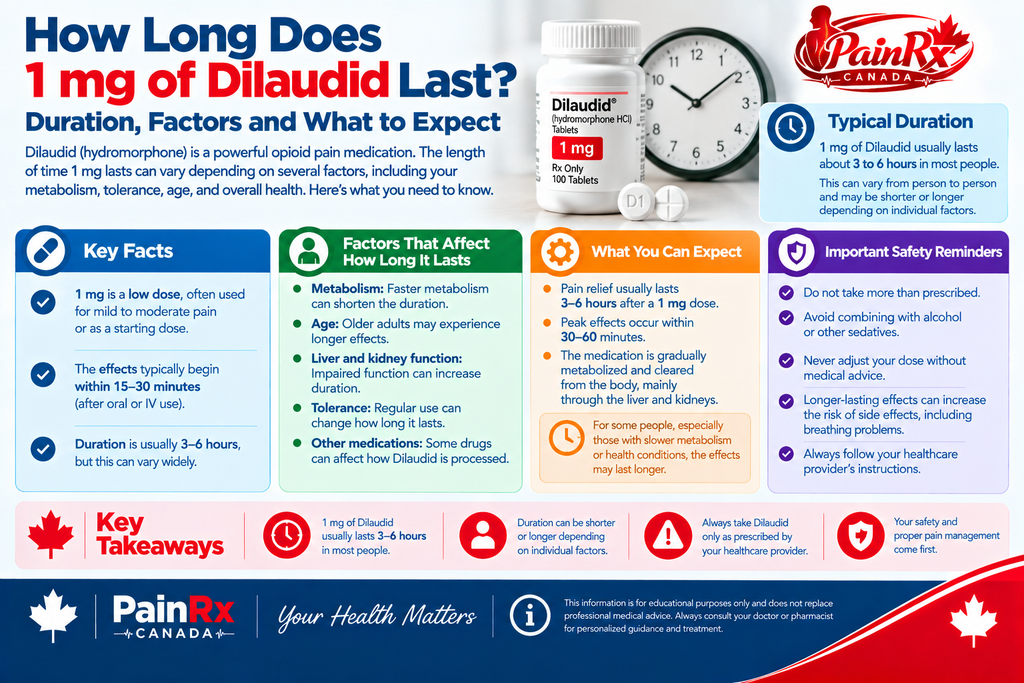
A 1 mg dose is one of the lowest available strengths of Dilaudid (hydromorphone) in Canada, and doctors often start opioid-naive patients or those with milder pain at this level. Patients beginning treatment at this dose often want to know exactly what to expect, both in terms of how long relief lasts and how that compares to higher doses. This guide covers the typical duration for a 1 mg dose and what shapes it.
The General Duration for a Low-Dose Tablet
Dilaudid’s duration of pain relief comes primarily from its pharmacological half-life rather than the specific milligram amount taken. For immediate-release oral tablets, including the 1 mg strength, clinical references generally describe pain relief lasting about three to four hours per dose.
This duration applies broadly across the range of immediate-release tablet strengths, since the medication’s half-life, roughly 2.3 to 4 hours for immediate-release formulations, drives how long it remains active in the bloodstream regardless of the exact dose size.
Why a Lower Dose Can Still Feel Different Than a Higher One
While the overall duration window stays similar across immediate-release strengths, the intensity and completeness of relief often differs at 1 mg compared to a higher dose.
A 1 mg dose typically produces milder peak pain relief than a 4 mg or 8 mg dose, since a smaller amount of the medication reaches opioid receptors. For a patient with mild to moderate pain, or a patient new to opioids, this milder relief may still adequately manage the pain. For more severe pain, a 1 mg dose might provide only partial relief, even though it remains active in the body for a similar length of time as a larger dose.
This distinction matters: a dose “not lasting long enough” and a dose “not being strong enough” describe two different problems, and understanding which one applies to a specific situation helps guide the right next step with a doctor.
Why Doctors Often Start at This Dose
A 1 mg starting dose commonly reflects a cautious, standard approach to beginning opioid therapy, particularly for patients who haven’t taken a strong opioid before.
Starting at a lower dose allows a doctor to observe how a specific patient responds, both in terms of pain relief and side effects, before considering any increase. This approach reduces the risk of an unexpectedly strong reaction in a patient whose tolerance and sensitivity aren’t yet known. Older adults and patients with reduced kidney or liver function often start at this level for the same cautious reasoning.
What Happens If 1 mg Doesn’t Feel Like Enough
If a 1 mg dose consistently provides inadequate relief, this reflects a normal part of the dose-finding process rather than something to manage independently.
A doctor may increase the dose gradually, adjust the frequency within safe limits, or explore whether a different medication or approach might work better for the specific type of pain involved. Patients should report a pattern of inadequate relief clearly and promptly, describing exactly what “not working” means, whether that’s minimal effect, relief that fades quickly, or relief that never fully controls the pain.
Factors That Can Shift the Duration at Any Dose, Including 1 mg
A few individual factors affect how long even a small, low dose lasts for a specific patient.
Opioid tolerance. A patient with any prior opioid exposure may notice a shorter or milder effect from 1 mg than someone taking an opioid for the first time.
Food intake. Taking an oral dose with food can slightly delay and sometimes soften the peak effect compared to taking it on an empty stomach.
Kidney and liver function. Reduced organ function can extend how long the medication and its metabolites remain active, even at a low starting dose.
Individual metabolism. Age, body composition, and genetic variation in drug-processing enzymes all contribute to differences in how long a given dose feels effective.
Why Patients Shouldn’t Take an Extra 1 mg Dose Independently
If pain returns before the next scheduled dose, taking an additional dose without medical guidance isn’t a safe way to close that gap, even at a low individual strength like 1 mg.
Doses can accumulate faster than the body clears them if taken too close together, and this risk applies at any dose strength, not just higher ones. A doctor calculates the interval between doses specifically to balance pain relief against this accumulation risk. Any pattern of pain returning early belongs in a conversation with a doctor about adjusting the dose or schedule safely, rather than a decision to take more on one’s own.
Recognizing Warning Signs at Any Dose
Even at a low dose like 1 mg, patients and caregivers should know the signs of an opioid emergency, since individual sensitivity varies.
Extreme drowsiness that’s hard to rouse from, slow or shallow breathing, blue-tinged lips or fingertips, and unresponsiveness all warrant an immediate call to 911. Use naloxone if it’s available while waiting for emergency help.
Frequently Asked Questions
Does 1 mg of Dilaudid last a shorter time than a higher dose? Not dramatically. The overall duration window, roughly three to four hours, stays fairly similar across immediate-release strengths, though a higher dose typically produces stronger, more complete relief during that window.
Why did my doctor start me on such a low dose? Starting at a lower dose, such as 1 mg, lets a doctor observe how you respond to the medication before considering an increase, which is a standard, cautious approach, especially for patients new to opioids.
Is 1 mg strong enough for significant pain? This depends entirely on the individual and the pain involved. Some patients find 1 mg adequate for milder pain, while others with more severe pain may need a higher dose, which a doctor can assess and adjust.
Can I take a second 1 mg dose if the first one wears off early? Not without checking with a doctor first. Taking doses closer together than prescribed raises the risk of dangerous accumulation, even at a low individual strength.
Will 1 mg eventually stop working as well over time? Regular opioid use can lead to some tolerance, meaning a previously effective dose may feel less potent over time. This is a normal pharmacological response that a doctor can address by reassessing the dose.
The Bottom Line
A 1 mg dose of immediate-release Dilaudid typically provides pain relief for about three to four hours, similar in duration to higher immediate-release doses, though generally milder in intensity. Doctors often choose this starting dose specifically to gauge an individual patient’s response safely before considering any adjustment.
Any concern about whether 1 mg provides adequate relief, whether it’s wearing off too quickly, or whether a higher dose might suit the situation better belongs in a conversation with a doctor rather than an independent decision to take more.
This article is for general informational purposes only and is not a substitute for professional medical advice. Dilaudid and hydromorphone are prescription-only controlled substances in Canada. Always consult a doctor or pharmacist with questions about your specific medication, dosing, or symptoms, and seek emergency medical help immediately for any signs of an opioid overdose.