
Can You Smoke Dilaudid?

Can You Smoke Dilaudid? A Canadian Safety Guide
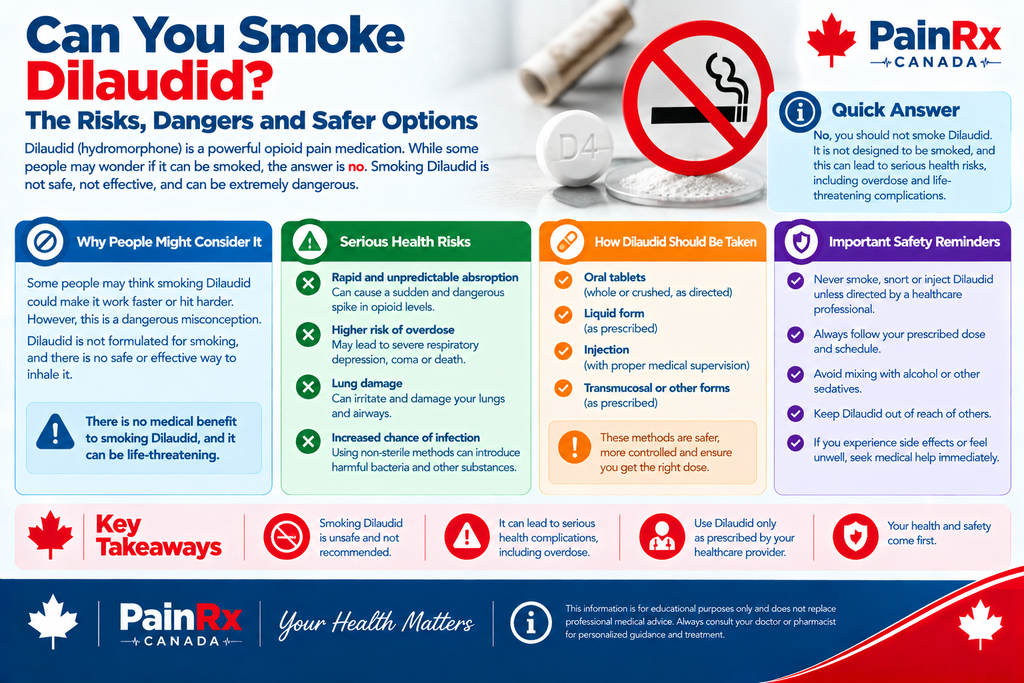
Health Canada approves Dilaudid (hydromorphone) only as an oral tablet, oral liquid, or injectable solution. No approved inhaled or smoked form exists, and altering a tablet to use it this way carries serious, well-documented risks. This guide explains why smoking Dilaudid is dangerous, why it doesn’t work the way people attempting it might expect, and where to find real support if this question comes from personal struggle rather than curiosity.
Why This Isn’t a Safe or Approved Use
Every approved medication form goes through testing specifically for that route of administration. This testing covers how much of the drug reaches the bloodstream, how quickly, and at what safety margin. Dilaudid’s approved oral and injectable forms reflect this kind of testing. No inhaled form exists because Health Canada has never approved hydromorphone for that route, and no clinical testing supports a safe, predictable dose through smoking.
Attempting to alter a tablet to smoke it moves entirely outside any tested or predictable dosing framework. This is a central reason the practice carries such serious risk.
Why Altering a Tablet Is Especially Dangerous
Manufacturers build immediate-release and extended-release Dilaudid tablets with specific mechanisms that control how the medication releases into the body. Extended-release tablets in particular use a formulation designed to release hydromorphone gradually over many hours.
Damaging a tablet, through crushing, heating, or any other alteration, can destroy that release mechanism. For an extended-release tablet, this can cause the entire day’s dose to become available almost immediately rather than gradually. That shift dramatically raises the risk of a life-threatening overdose, and the risk exists no matter which method someone uses to alter the tablet.
Why Smoking Doesn’t Deliver the Drug Reliably
Beyond the danger of altering the tablet itself, heating hydromorphone through combustion doesn’t reliably deliver a predictable dose into the bloodstream. Heat can break down or destroy a significant portion of the active drug rather than letting the body absorb it, which makes the amount of medication actually reaching the body highly unpredictable.
This unpredictability cuts in a dangerous direction. An unpredictable, inconsistent dose can just as easily produce a far larger, more dangerous exposure as it can a smaller one. Inactive tablet ingredients, never meant for inhalation, add their own separate risks when someone heats and inhales them.
Health Risks Specific to Smoking Any Substance Not Meant for Inhalation
Smoking a tablet formulated for oral use introduces risks beyond the opioid itself.
Inhaling the combustion byproducts of tablet binders, fillers, and coatings can cause direct lung irritation and damage, since manufacturers never designed or tested these ingredients for inhalation. Repeated use through this route can contribute to chronic respiratory problems over time, separate from any opioid-related risk. These substances dissolve safely in the digestive system or bloodstream; burning and inhaling them is a different matter entirely.
The Combined Overdose Risk
Smoking Dilaudid combines several serious risk factors at once: an unpredictable, potentially much larger effective dose than intended, the destruction of any extended-release safety mechanism, and all of the standard risks that come with any opioid, especially respiratory depression.
Anyone attempting this, or present when someone else does, should know the signs of an opioid emergency: extreme drowsiness that’s hard to rouse from, slow or shallow breathing, blue-tinged lips or fingertips, and unresponsiveness. Call 911 immediately if these appear, and use naloxone if it’s available. Given the unpredictable dosing involved, the situation may need more than one dose of naloxone.
If This Question Comes From Personal Struggle
Searching this question sometimes reflects a genuine, difficult struggle with opioid dependence rather than simple curiosity, and that’s worth acknowledging directly. If you or someone close to you is considering or already using Dilaudid this way, real support exists. Reaching out for it is a reasonable, safe next step rather than something to face alone.
A family doctor, pharmacist, or addiction medicine service can provide confidential support without judgment. Canada also offers provincial and national helplines specifically designed to connect people with treatment and harm-reduction resources quickly.
Frequently Asked Questions
Is it ever safe to smoke a prescription opioid tablet? No. No approved prescription opioid tablet, including Dilaudid, is designed or tested for inhalation. Altering a tablet for this purpose introduces serious, unpredictable risks regardless of the specific opioid involved.
Does smoking a drug make it act faster and more safely than swallowing it? Not with Dilaudid tablets. Altering and smoking a tablet destroys any built-in release mechanism and introduces highly unpredictable dosing, which raises overdose risk rather than improving safety or control.
Why is this considered more dangerous than taking the tablet as prescribed? Taking a tablet as prescribed relies on tested, predictable absorption and a release mechanism designed for safety. Altering and smoking it bypasses all of that, producing an unpredictable dose and additional lung-related risks that a normal prescribed dose doesn’t carry.
What should I do if I’m worried about someone who might be doing this? Learn the signs of an opioid overdose, keep naloxone accessible if possible, and encourage the person to speak with a doctor or addiction service. If you witness signs of an overdose, call 911 immediately.
Where can I find confidential help if I’m struggling with this myself? A family doctor, pharmacist, or provincial addictions helpline can connect you with confidential support and treatment options. Reaching out is a safe, judgment-free first step.
The Bottom Line
Dilaudid has no approved smoked or inhaled form. Attempting to alter a tablet for this purpose introduces serious, compounding risks: an unpredictable and potentially much larger dose, the loss of any extended-release safety mechanism, and additional lung damage from inhaling substances never meant for that route. These risks exist regardless of the specific method someone uses.
If this question relates to your own situation or someone else’s, help is available and worth reaching out for. A doctor, pharmacist, or addiction service can provide safe, confidential support.
This article is for general informational purposes only and is not a substitute for professional medical advice. If you’re struggling with substance use, help is available, and a doctor, pharmacist, or addiction medicine service can support you in finding a safe path forward. Dilaudid and hydromorphone are prescription-only controlled substances in Canada. Seek emergency medical help immediately for any signs of an opioid overdose.