

What Is Dilaudid Used For?

What Is Dilaudid Used For? A Canadian Patient Guide
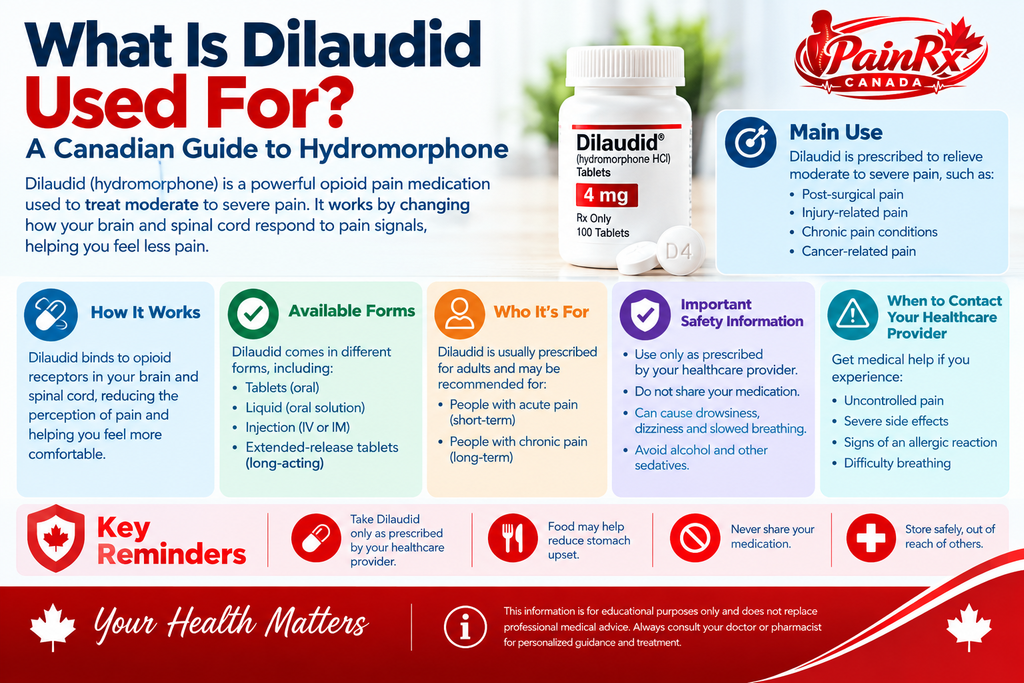
A new prescription for Dilaudid often arrives with more questions than answers. Patients want to know exactly what this medication treats, why a doctor chose it over another option, and what makes it different from other pain medications.
This guide explains what Dilaudid (hydromorphone) treats, who typically receives a prescription for it, and the safety considerations every Canadian patient should understand before taking it.
What Dilaudid Is
Dilaudid is the brand name for hydromorphone, a prescription opioid analgesic. Health Canada classifies it as a controlled substance because of its strength and potential for misuse. Doctors prescribe it specifically to manage pain that other, less potent medications can’t control effectively.
Hydromorphone belongs to the same drug class as morphine, oxycodone, and fentanyl. Like those medications, it works by binding to opioid receptors in the brain and spinal cord, which changes how the nervous system processes and responds to pain signals.
The Core Use: Moderate to Severe Pain
Doctors prescribe Dilaudid primarily to treat moderate to severe pain that hasn’t responded well to non-opioid options. This single purpose covers several different clinical situations.
Post-Surgical Pain
Many patients first encounter Dilaudid in a hospital setting after a major surgery. An IV or injectable form often manages pain immediately after the procedure, when pain tends to peak. As recovery progresses, a doctor may switch a patient to an oral form for use at home.
Cancer Pain
Cancer and certain cancer treatments can cause severe, ongoing pain. Dilaudid appears frequently in cancer pain management plans, particularly when pain intensifies or when other opioids no longer provide adequate relief.
Serious Injury Pain
Traumatic injuries, including fractures and major burns, can produce pain severe enough to require a strong opioid. Emergency departments and trauma units use injectable Dilaudid for this kind of acute, intense pain.
Chronic Pain Management
Some patients with long-term, severe pain conditions use Dilaudid as part of an ongoing pain management plan. This typically happens only after other options, including non-opioid medications and lower-potency opioids, haven’t controlled the pain adequately.
Available Forms and What They’re Used For
Dilaudid comes in several forms, and the form a doctor selects usually depends on the setting and the type of pain.
| Form | Common Setting | Typical Use |
|---|---|---|
| Oral tablet | Home, outpatient care | Ongoing pain management |
| Oral liquid | Home, outpatient care | Patients who have trouble swallowing tablets |
| Injection (IV, IM, subcutaneous) | Hospital, clinic | Rapid relief for acute or severe pain |
| Extended-release tablet | Home, chronic pain | Steady, around-the-clock pain control |
Extended-release tablets serve a different purpose than immediate-release ones. Rather than treating a sudden pain spike, they maintain a consistent level of pain control throughout the day for patients with persistent pain.
Who Typically Receives a Dilaudid Prescription
Doctors reserve Dilaudid for patients whose pain genuinely requires a strong opioid. A prescription generally follows a few common patterns.
- A patient recovering from major surgery, such as an orthopedic procedure or abdominal operation
- A patient managing pain from advanced cancer or cancer treatment
- A patient with a severe traumatic injury being treated in a hospital or emergency setting
- A patient with chronic severe pain who hasn’t found relief through non-opioid treatments
- A patient who has developed tolerance to a different opioid and needs an alternative
A doctor weighs the severity of the pain against the risks of opioid therapy before prescribing Dilaudid, and this decision always considers the patient’s full medical history.
What Dilaudid Is Not Used For
Health Canada’s product monograph specifically excludes certain uses. Dilaudid isn’t intended for mild pain that other medications, including over-the-counter options, can manage effectively. Doctors also avoid prescribing it to patients with specific conditions, including acute or severe asthma, certain bowel obstructions, and acute respiratory depression.
Dilaudid isn’t authorized for pediatric use in Canada, since Health Canada hasn’t received sufficient data to support that indication.
Why Doctors Choose Dilaudid Over Other Opioids
Several factors influence why a doctor might select Dilaudid instead of morphine, oxycodone, or another opioid.
Potency. Hydromorphone is more potent by weight than morphine, which allows smaller doses to achieve similar pain relief for some patients.
Patient history. A patient who hasn’t responded well to a different opioid, or who has experienced side effects from one, may respond better to hydromorphone instead.
Kidney function. Some opioids build up problematic metabolites in patients with reduced kidney function. Doctors sometimes favor hydromorphone for these patients because of how the body processes it.
Route flexibility. Dilaudid comes in oral, injectable, and extended-release forms, which gives doctors options as a patient’s care setting or pain level changes.
Safety Considerations That Apply to Every Use
Regardless of why a doctor prescribes Dilaudid, the same safety principles apply.
Patients should take it exactly as prescribed, without adjusting the dose or timing independently. Combining it with alcohol or other central nervous system depressants, including benzodiazepines and certain sleep medications, raises the risk of dangerous, potentially fatal respiratory depression.
Patients and caregivers should learn the signs of an opioid emergency: extreme drowsiness that’s hard to rouse from, slow or shallow breathing, blue-tinged lips or fingertips, and unresponsiveness. Call 911 immediately if any of these signs appear, and use naloxone if it’s available.
Store Dilaudid securely, away from children, pets, and anyone without a prescription for it. Dispose of unused medication through a pharmacy rather than keeping it at home.
Frequently Asked Questions
Is Dilaudid used for anything other than pain? No. Health Canada authorizes Dilaudid specifically for pain management. Doctors don’t prescribe it for anxiety, sleep, or other non-pain conditions.
Is Dilaudid stronger than morphine? Hydromorphone is generally considered more potent than morphine on a milligram-for-milligram basis, which is why doctors calculate equivalent doses carefully when switching a patient between the two.
Can Dilaudid be used for chronic pain long-term? Some patients use it long-term for severe chronic pain, but doctors typically try non-opioid and lower-potency options first and monitor long-term opioid use closely for effectiveness and risk.
Why did my doctor prescribe Dilaudid instead of a weaker painkiller? This usually means the pain level required a strong opioid, or that other medications hadn’t provided adequate relief. A doctor can explain the specific reasoning behind an individual prescription.
Is Dilaudid used in hospice or palliative care? Yes. Hydromorphone appears commonly in palliative and hospice pain management plans, particularly for patients with advanced cancer or other serious illness.
The Bottom Line
Dilaudid treats moderate to severe pain that other medications can’t manage effectively, spanning post-surgical recovery, cancer pain, traumatic injury, and certain chronic pain conditions. Its strength and multiple available forms give doctors flexibility, but that same strength requires careful, doctor-directed use.
Any questions about why Dilaudid was prescribed, whether a different medication might suit a specific situation better, or how to use it safely belong in a conversation with a doctor or pharmacist rather than a guess.
This article is for general informational purposes only and is not a substitute for professional medical advice. Dilaudid and hydromorphone are prescription-only controlled substances in Canada. Always consult a doctor or pharmacist with questions about your specific medication, dosing, or symptoms, and seek emergency medical help immediately for any signs of an opioid overdose.