

What Does a Dilaudid Pill Look Like?

What Does a Dilaudid Pill Look Like? A Canadian Patient Guide
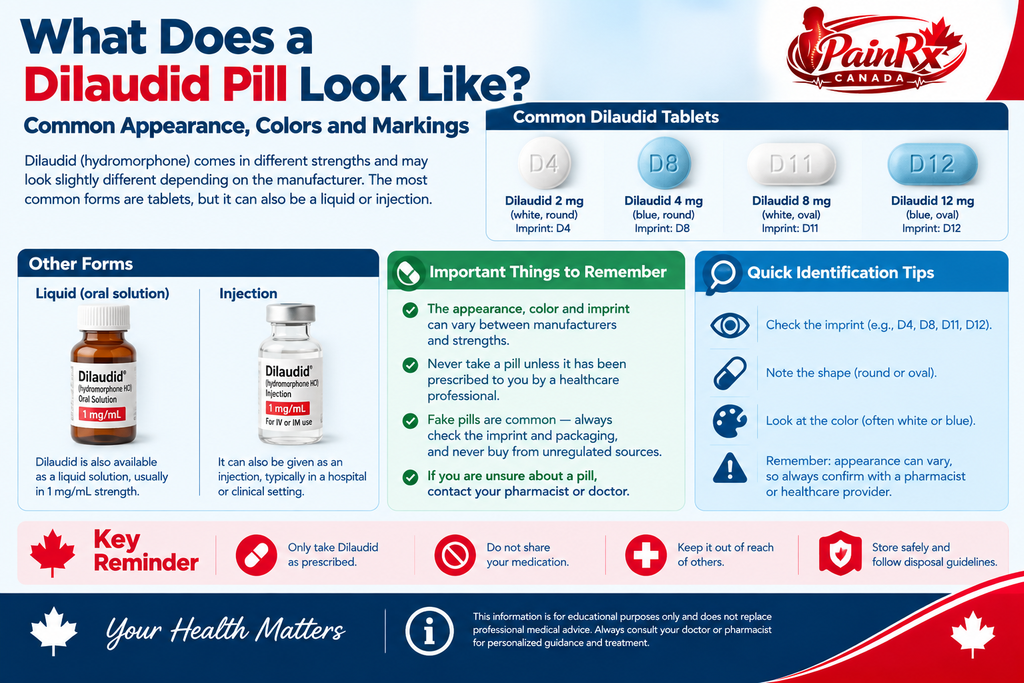
A patient picks up a refill and notices the tablet looks slightly different than last time. A parent finds an unlabeled pill and wonders if it belongs to a family member. A caregiver wants to double-check that the pharmacy filled the right medication. Each of these situations raises the same question: what does Dilaudid actually look like, and how much can appearance alone tell you?
This guide covers what Canadian patients can generally expect Dilaudid tablets to look like. It also explains why appearance alone can’t confirm a pill’s identity, and it flags a serious counterfeit pill risk every Canadian should know about.
The General Forms Dilaudid Comes In
Dilaudid (hydromorphone) comes in several forms in Canada, and each one looks different.
Immediate-release tablets are small and typically round, and they come in multiple strengths. Colour and markings vary by manufacturer, since both the brand-name product and several generic versions exist on the Canadian market.
Oral liquid is a coloured solution, often with a distinct flavour. Doctors prescribe it for patients who need an easier-to-swallow form or more flexible dosing.
Injectable solution is a clear liquid. Hospital and clinic staff administer this form directly.
Extended-release tablets look different from immediate-release ones. Manufacturers design them so patients can’t cut, crush, or chew them, since damaging the tablet can release the full dose all at once.
Why Exact Colour and Imprint Descriptions Get Complicated
Every legitimate prescription tablet sold in Canada carries a Drug Identification Number (DIN). Health Canada’s Drug Product Database lists the approved appearance, strength, and manufacturer for each authorized product tied to that number.
Colour and imprint details vary between the brand-name product and its generic equivalents. Generic manufacturers also change fairly often, and pharmacies sometimes switch suppliers for the same strength and active ingredient. A tablet’s exact colour, shape, and imprint code can shift because of this, even when the medication itself hasn’t changed. For this reason, this guide intentionally avoids listing specific imprint codes as if they apply universally. To confirm a specific tablet’s identity, check it against Health Canada’s Drug Product Database using its DIN, or ask a pharmacist directly.
Why Appearance Alone Isn’t Enough
Colour, shape, and general size offer only a rough first impression. They were never designed to serve as a complete identification method on their own. Many medications share similar round shapes and common tablet colours like white, yellow, or orange, so two entirely different drugs can look almost identical at a glance.
The imprint code pressed into a tablet works as a more reliable identifying feature. Health Canada requires this imprint on approved prescription products specifically to support accurate identification. Even so, always confirm an imprint against an official source rather than relying on memory or a casual comparison photo.
A Serious Counterfeit Pill Risk in Canada
This question carries a safety dimension that goes beyond simple curiosity. Canadian police services have issued public warnings about counterfeit pills sold as Dilaudid that don’t actually contain hydromorphone. In one recent case, investigators found that a batch sold as Dilaudid in Newfoundland and Labrador contained a synthetic opioid roughly 20 times more potent than fentanyl. Authorities linked that batch to a spate of youth overdose deaths.
Manufacturers of counterfeit pills design them specifically to resemble legitimate prescription tablets, so visual similarity offers no real safety guarantee. A pill that looks convincingly like Dilaudid, whether it comes from a pharmacy-adjacent source or anywhere outside a licensed pharmacy, could contain an entirely different and far more dangerous substance.
How to Verify a Pill Is What It’s Supposed to Be
A few practical steps can help confirm a tablet’s legitimacy, especially if its appearance seems different than expected.
Compare the tablet to the description on the pharmacy label or original packaging, since a licensed pharmacy dispenses a specific, verifiable product. Contact the dispensing pharmacist directly if a refill looks different from a previous fill; manufacturer changes happen, but a pharmacist can always explain them. Never take a pill obtained outside a licensed pharmacy, no matter how convincing its appearance seems, since this is exactly where counterfeit substitution happens.
Only purchase medication from a licensed Canadian pharmacy. Treat any pill acquired outside that channel as unverified and potentially dangerous, even if it looks identical to a real prescription.
What to Do If You’re Unsure About a Pill
If a patient, caregiver, or parent finds a pill and isn’t sure what it is, a few safe options exist. A pharmacist can typically identify a pill quickly and reliably, often without an appointment. Health Canada’s Drug Product Database lets you search by DIN if that number appears on any accompanying packaging. Poison control centres in every Canadian province can also help identify a substance and advise on next steps, particularly if a child may have swallowed something accidentally.
Don’t guess based on appearance alone, and never assume a pill is safe just because it resembles a known medication.
Frequently Asked Questions
Do all Dilaudid tablets look the same regardless of manufacturer? No. Brand-name and generic versions can differ in colour, shape, and imprint, since different manufacturers produce approved versions of the same medication. This reflects a normal part of how generic prescribing works in Canada.
Is it safe to identify a pill just by comparing it to a photo online? Not reliably. Photos found online may not reflect the exact product available in Canada, may show an outdated version, or may miss manufacturer differences entirely. Confirming through a pharmacist or Health Canada’s official database works far better.
Why did my Dilaudid prescription look different this time? Pharmacies sometimes switch suppliers for a generic medication, which can change a tablet’s appearance even though the active ingredient and dose stay the same. Contact the pharmacist to confirm if this happens.
How can I tell if a Dilaudid pill I didn’t get from a pharmacy is real? You can’t reliably confirm this through appearance alone. Treat any pill obtained outside a licensed pharmacy as unverified, given documented cases of counterfeit pills sold as Dilaudid that contained entirely different and highly dangerous substances.
What should I do if I think I’ve taken a counterfeit pill? Watch closely for signs of an opioid overdose, including extreme drowsiness that’s hard to rouse from, slow or shallow breathing, blue-tinged lips or fingertips, and unresponsiveness. Call 911 immediately if any of these appear, and use naloxone if you have it, since counterfeit pills can contain substances far more potent than expected.
The Bottom Line
Dilaudid comes in tablet, liquid, and injectable forms, and tablet appearance varies by strength and manufacturer. Colour and general shape offer only a rough first impression. Imprint codes, verified against Health Canada’s official Drug Product Database or confirmed by a pharmacist, give you a far more reliable way to identify a specific tablet.
The more important safety point extends beyond simple identification. Confirmed counterfeit pills sold as Dilaudid have circulated in Canada, and some have contained opioids many times more potent than fentanyl. Treat any pill not obtained directly from a licensed pharmacy as unverified and potentially dangerous, regardless of how closely it resembles a real prescription.
This article is for general informational purposes only and is not a substitute for professional medical advice. Dilaudid and hydromorphone are prescription-only controlled substances in Canada. Always consult a doctor or pharmacist with questions about your specific medication, dosing, or symptoms, and seek emergency medical help immediately for any signs of an opioid overdose.