

Is Dilaudid the Same as Hydromorphone?

Is Dilaudid the Same as Hydromorphone? A Canadian Guide
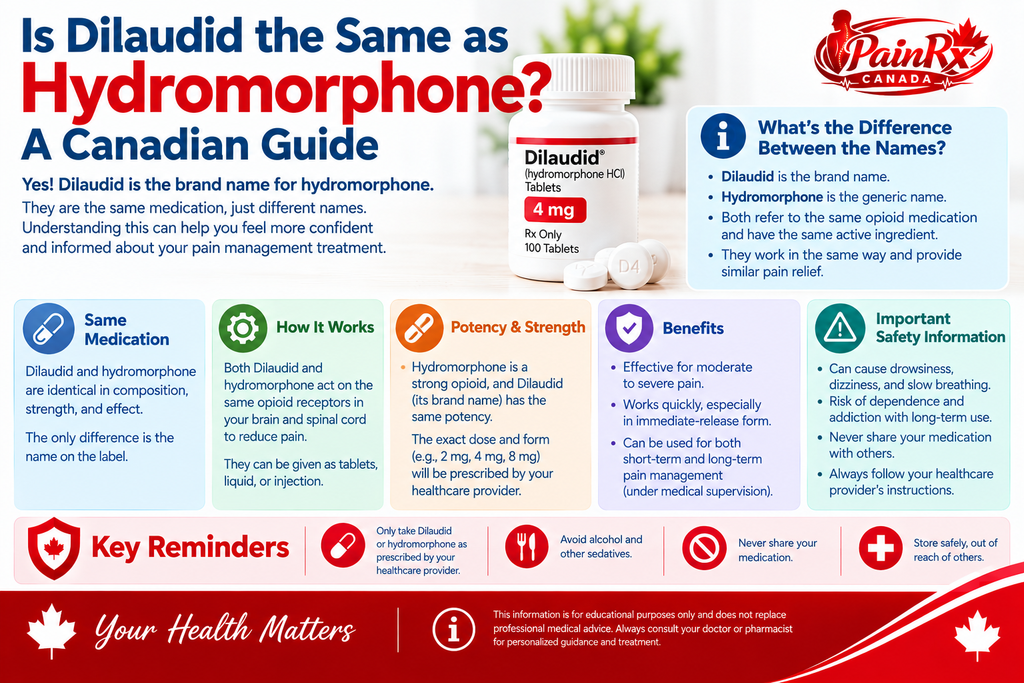
A prescription label reads “hydromorphone.” A pharmacy bottle at home says “Dilaudid.” A patient looks at both bottles and wonders if something has changed. Maybe a mistake happened somewhere along the way. This mix-up happens all the time across Canadian pharmacies. The confusion clears up fast once you understand how the two names relate to each other. This guide explains exactly how Dilaudid and hydromorphone connect, why both names exist at all, and what Canadian patients should know when they see either one on a label.
The Quick Answer
Yes, Dilaudid and hydromorphone are the same medication. Hydromorphone is the generic, scientific name for the active drug. Dilaudid is simply a brand name that a pharmaceutical company uses to market that same drug. Every Dilaudid tablet, liquid, or injection contains hydromorphone as its active ingredient. Every generic hydromorphone product contains that identical active ingredient too. The difference between them comes down to manufacturer, packaging, and sometimes price. It has nothing to do with the medication’s actual effect on the body.
Understanding Brand Names vs. Generic Names
Nearly every prescription drug carries two names. Understanding this two-name system clears up a lot of confusion at the pharmacy counter. The generic name refers to the drug’s active chemical compound. It stays consistent no matter who manufactures the product. The brand name works differently. A company chooses it for marketing purposes once it develops and patents a drug. Brand names can vary between countries. They can even vary between different formulations of the same underlying drug.
Hydromorphone is the generic name here. Dilaudid is the original, best-known brand name. A German pharmaceutical company first introduced it in the 1920s. It later spread across North America through wide clinical marketing. Once a drug’s patent protection expires, other manufacturers step in. They can produce and sell their own versions under the generic name. Sometimes they release the drug under a separate brand name entirely. This explains why a Canadian pharmacy might dispense a product simply labelled “hydromorphone” instead of “Dilaudid.” The original prescription might reference either name, and both point to the same medication.
Comparing Dilaudid and Generic Hydromorphone
| Feature | Dilaudid (Brand) | Generic Hydromorphone |
|---|---|---|
| Active ingredient | Hydromorphone hydrochloride | Hydromorphone hydrochloride |
| Effectiveness | Identical | Identical |
| Manufacturer | Specific brand-name company | Multiple approved manufacturers |
| Appearance | Consistent, brand-specific | May vary by manufacturer |
| Cost | Generally higher | Generally lower |
| Available forms | Tablet, liquid, injectable | Tablet, liquid, injectable |
| Regulatory approval in Canada | Health Canada approved | Health Canada approved |
| Controlled substance status | Schedule I (CDSA) | Schedule I (CDSA) |
Health Canada requires every generic medication to demonstrate bioequivalence before granting approval. A generic hydromorphone product must deliver the same amount of active drug into the bloodstream. It must do so at essentially the same rate as Dilaudid does. Patients can therefore expect the same pain relief from either version. They can also expect the same side-effect profile, provided the dose stays identical.
Why Might the Name on My Prescription Change?
Several everyday situations explain the switch between Dilaudid and hydromorphone. In most cases, nothing changes about the actual treatment.
Pharmacies frequently substitute a generic version for a brand-name prescription. Most Canadian provinces allow, or even require, this kind of substitution unless a doctor specifically blocks it on the prescription. Pharmacists rely on this system to lower costs for patients and for the healthcare system as a whole. A hospital pharmacy works a little differently. It often stocks whichever formulation happens to be available at the time. Hospitals typically buy in bulk from whichever approved manufacturer currently offers the best pricing or supply reliability.
Doctors and pharmacists also use the two names interchangeably out of habit. Dilaudid remains a widely recognized name, even decades after generic versions became standard. If a patient notices a name change between refills, asking the pharmacist to confirm the active ingredient is always reasonable. A quick question at the counter can settle any doubt for good.
Are There Any Real Differences Between Them?
The core medication stays identical across every version. A few minor practical differences can still exist between specific products. Inactive ingredients, often called fillers or excipients, vary slightly between manufacturers. These fillers typically don’t affect how the drug works in the body. In rare cases, a patient with a sensitivity to one specific inactive ingredient might notice something different. Tablet size, shape, and colour can also differ between the brand-name and generic versions. This occasionally causes confusion for patients who manage several medications at once.
Price usually stands out as the most noticeable difference for patients. Brand-name Dilaudid typically costs more than generic hydromorphone. Most Canadian provincial drug plans and private insurers default to covering the generic version. A doctor needs to justify the brand-name request specifically for insurance to cover it instead. Patients paying out of pocket often save a meaningful amount. Requesting the generic version, when it’s clinically appropriate, tends to make the biggest financial difference.
Both Are Equally Regulated and Equally Serious
Hydromorphone serves as the active ingredient in both products. Because of this, Health Canada regulates Dilaudid and generic hydromorphone under the same level of oversight. Both fall under the Controlled Drugs and Substances Act. Both require a prescription. Both come with strict pharmacy tracking and dispensing rules. Both carry the same risks of dependence, misuse, and overdose that apply to any hydromorphone product. Patients should never assume a generic version runs weaker or safer than the brand name. The active drug, and its effects on the body, stay the same either way.
What This Means for Everyday Use
For most patients, the gap between Dilaudid and hydromorphone comes down to naming alone. It isn’t a difference in the medication itself. Your prescribed dose stays the same. The timing between doses stays the same. Precautions around alcohol and other sedating medications stay the same too, regardless of which name appears on the label. Warning signs of overdose, dependence, or an allergic reaction apply equally to either version. The same emergency response applies as well. That means calling 911 and using naloxone if needed, no matter which name sits on the bottle.
Patients switching between the brand name and the generic, or even between different generic manufacturers, generally don’t need a dose adjustment. Health Canada’s bioequivalence standards exist specifically to prevent that kind of disruption. If a patient notices any change in how they feel after a product switch, reporting it to a pharmacist or doctor is a reasonable precaution. Individual sensitivity to inactive ingredients happens occasionally, even though it remains uncommon overall.
Tips for Canadian Patients
A few simple habits can prevent most of the confusion that comes with brand-name and generic switching.
- Check the active ingredient. Always look at what’s listed on your prescription label. This confirms what you’re actually taking, regardless of which name sits above it.
- Ask your pharmacist directly. A quick question resolves most naming confusion immediately, especially if a refill looks different from your last one.
- Ask about cost-saving options. If cost is a concern, ask whether a generic hydromorphone product fits your situation. This can lower your out-of-pocket expense without changing your treatment at all.
- Keep a personal medication list. Include both the generic and brand names for everything you take. This habit helps avoid confusion during hospital visits, specialist appointments, or trips to an unfamiliar pharmacy.
A Brief History of the Dilaudid Name
Knowing where the Dilaudid name came from helps explain why it still shows up so often today. A German pharmaceutical company developed hydromorphone in the 1920s. Researchers built it as a modification of the morphine molecule, aiming for a faster-acting option for severe pain. The company marketed the drug under the name Dilaudid. The name blends roots meant to evoke both its relationship to morphine-like compounds and its refined chemical structure.
The brand became deeply established in hospitals and clinical practice across North America. Many healthcare providers kept using the name Dilaudid long after generic hydromorphone entered the market. Familiarity and habit kept the name alive. This pattern shows up across plenty of older medications. The original brand name often becomes part of everyday clinical language. It sticks around even after patent protection ends and multiple generic manufacturers start producing the same drug.
How Health Canada Approves Generic Versions
Patients sometimes wonder how a generic manufacturer can simply start producing a version of a well-known drug like Dilaudid. The approval process runs more rigorously than many people realize. Before Health Canada approves any generic hydromorphone product, the manufacturer submits detailed data. This data must demonstrate that the generic version delivers the same amount of active drug into the bloodstream. It also has to move at essentially the same speed as the original brand-name product.
This standard is called bioequivalence. It protects patients by ensuring that a switch from Dilaudid to a generic version doesn’t meaningfully change how the medication performs in the body. The same protection applies when switching between different generic manufacturers. Health Canada doesn’t stop monitoring once a product reaches the market, either. The agency continues tracking manufacturing quality and reported side effects for generic products in the same way it tracks brand-name drugs. This ongoing oversight explains why Canadian patients and healthcare providers can trust generic hydromorphone as a reliable, equally effective alternative to the brand name.
Cost and Insurance Considerations Across Canada
Drug coverage varies by province, and this affects how patients experience the Dilaudid-versus-hydromorphone question in real life. Most provincial formularies list generic hydromorphone as the default covered option. A doctor typically needs to document a specific medical reason before a plan covers the brand-name Dilaudid instead. Private insurers generally follow a similar approach, favouring the lower-cost generic unless a special circumstance applies.
For patients without full insurance coverage, this pricing gap matters quite a bit. Generic hydromorphone often costs a fraction of what brand-name Dilaudid costs at the pharmacy counter. Asking a pharmacist about the price difference before filling a prescription can prevent an unwelcome surprise. Pharmacists in Canada are generally happy to walk through these cost differences, since generic substitution exists specifically to make treatment more affordable without changing its effectiveness.
Talking to Your Doctor or Pharmacist About the Switch
Some patients feel more comfortable sticking with one consistent product, even when the active ingredient never changes. This preference is completely valid, especially for anyone managing a long-term condition or a complex medication schedule. A doctor can note “no substitution” on a prescription if there’s a specific clinical reason for staying on brand-name Dilaudid. Insurance coverage for that request still depends on the individual plan, so it helps to confirm coverage details before assuming the brand name will be affordable.
Pharmacists play a central role in this conversation too. They can explain exactly why a particular product was dispensed on a given visit, and they can flag any known differences in inactive ingredients ahead of time. Many pharmacies also keep dispensing records on file, so a pharmacist can quickly confirm whether a patient has been receiving the same manufacturer’s product across refills. Bringing a specific question to that conversation, such as asking whether a formulation change occurred since the last fill, tends to get a faster and more useful answer than a general question about the medication overall.
Patients managing pain from a serious illness, recovering from major surgery, or receiving palliative care sometimes interact with hydromorphone across several different care settings within a short period. A hospital stay might involve one manufacturer’s version, while a community pharmacy fills a follow-up prescription with another. Because Health Canada’s bioequivalence rules apply across every approved version, this kind of transition rarely causes a clinical problem. Still, keeping an updated medication list on hand, and sharing it with every provider involved in care, remains one of the simplest ways to avoid confusion during a transition between care settings.
How Hydromorphone Compares to Other Common Opioids
Understanding where hydromorphone sits among other prescription opioids can add useful context for patients encountering it for the first time. Hydromorphone belongs to the same general drug class as morphine, oxycodone, and fentanyl, since all of these medications work on the body’s opioid receptors to reduce the perception of pain. Hydromorphone is generally considered more potent than morphine on a milligram-for-milligram basis, which is one reason prescribers calculate dosing carefully when switching a patient from one opioid to another.
This class-wide relationship doesn’t mean the drugs are interchangeable at the same dose, and it doesn’t mean Dilaudid and hydromorphone differ from each other within that broader family. The point worth remembering is narrower: Dilaudid and hydromorphone describe the exact same compound, while morphine, oxycodone, and fentanyl are chemically distinct medications that happen to belong to the same therapeutic category. A pharmacist or physician remains the best resource for any question about comparing potency or converting between different opioid medications, since these calculations depend heavily on individual patient factors.
Frequently Asked Questions
Is Dilaudid stronger than hydromorphone? No, they’re the same medication at the same strength. Dilaudid is simply the brand name for hydromorphone, and both contain the identical active ingredient at whatever dose gets prescribed.
Why does my pharmacy sometimes give me hydromorphone instead of Dilaudid? Pharmacies commonly substitute an approved generic version for a brand-name prescription to reduce cost. Health Canada requires generics to be bioequivalent to the original brand, so the effect on your body stays the same.
Is generic hydromorphone as safe as Dilaudid? Yes. Health Canada holds generic hydromorphone to the same safety and effectiveness standards as brand-name Dilaudid. Both fall under equal regulation as controlled substances.
Will switching from Dilaudid to generic hydromorphone change how my pain medication works? Generally, no. Bioequivalence testing ensures the generic version delivers the same amount of active drug at essentially the same rate. Most patients notice no difference at all.
Is Dilaudid more expensive than hydromorphone? Typically, yes. The brand-name version usually costs more than the generic. Most Canadian insurance plans default to covering the generic unless a doctor specifies a medical reason for the brand name.
Can I ask my pharmacist for the brand name Dilaudid instead of the generic? You can ask, but coverage and availability depend on your specific insurance plan and your doctor’s prescription. Some plans require documentation of a medical reason before they’ll cover the brand name over the generic.
Are the side effects different between Dilaudid and hydromorphone? No. Since the active ingredient is identical, the side-effect profile stays the same for both. Minor differences in inactive ingredients rarely cause a noticeable difference for most patients.
The Bottom Line
Dilaudid and hydromorphone are the same medication. Hydromorphone serves as the generic, scientific name, and Dilaudid stands as the original brand name. Health Canada regulates both equally. Both carry the same risks and benefits. Both require the same careful, prescription-guided use. Patients can feel confident that a switch between the two names doesn’t represent any change in their actual treatment, whether it happens at the pharmacy counter or in a hospital setting. When in doubt, checking with a pharmacist remains the simplest way to confirm exactly what’s in any prescription.
This article is for general informational purposes only and is not a substitute for professional medical advice. Dilaudid and hydromorphone are prescription-only controlled substances in Canada. Always consult a doctor or pharmacist with questions about your specific medication.