
Is Dilaudid Stronger Than Percocet?

Is Dilaudid Stronger Than Percocet? A Canadian Patient Guide
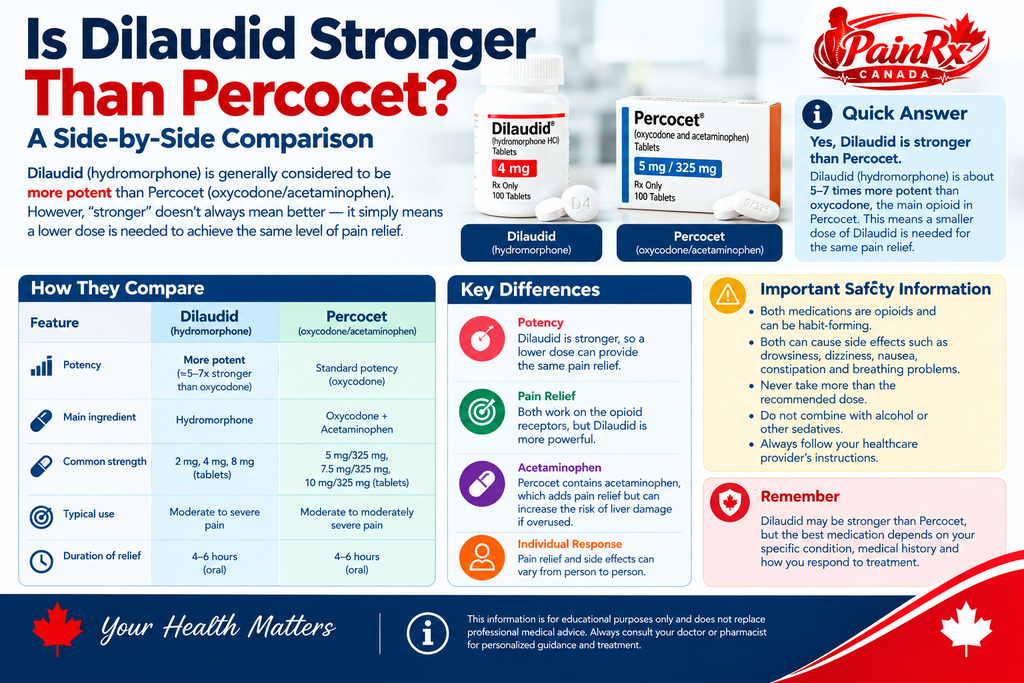
A patient switching between pain medications, or comparing notes with someone else’s prescription, often lands on the same question: is Dilaudid actually stronger than Percocet? The short answer is yes, milligram for milligram, but that answer alone doesn’t capture the full picture.
This guide breaks down what each medication actually contains, how their strength compares, and why “stronger” doesn’t automatically mean “better” for a given patient.
What Each Medication Actually Contains
Dilaudid and Percocet aren’t directly comparable in a simple way, because they’re built differently.
Dilaudid contains a single active ingredient: hydromorphone, a potent opioid. Percocet is a combination medication that contains oxycodone, a different opioid, plus acetaminophen, a non-opioid pain reliever also known as Tylenol.
This structural difference matters. Comparing the two means comparing hydromorphone’s opioid strength against oxycodone’s opioid strength, while also accounting for the acetaminophen that Percocet adds on top.
Comparing Opioid Potency
Clinical literature consistently places hydromorphone as more potent than oxycodone on a milligram-for-milligram basis. Equianalgesic dosing tables, which doctors use to compare how much of one opioid produces the same pain relief as another, generally show that a smaller dose of hydromorphone matches the effect of a larger dose of oxycodone.
This doesn’t translate into a simple “Dilaudid is twice as strong” statement that applies to every patient. The exact ratio varies across clinical studies, and individual response depends on factors like tolerance, metabolism, and the specific pain condition being treated. Doctors and pharmacists use precise conversion calculations rather than general rules of thumb when switching a patient from one opioid to another.
Why Percocet’s Acetaminophen Component Matters
Percocet’s acetaminophen component changes the safety conversation in a way that pure hydromorphone doesn’t share.
Acetaminophen carries its own maximum daily limit, currently 4,000 mg per day for adults in Canada, because exceeding it raises the risk of serious liver damage. This limit effectively caps how much Percocet a patient can safely take in a day, regardless of how much additional oxycodone might otherwise be tolerated.
Dilaudid doesn’t carry this same built-in ceiling, since it contains no acetaminophen. This is part of why doctors sometimes switch a patient to Dilaudid when Percocet’s acetaminophen limit becomes a practical obstacle to adequate pain control.
When a Doctor Chooses Dilaudid Over Percocet
Several situations commonly lead a doctor toward Dilaudid instead of Percocet.
Higher pain severity. Percocet typically manages moderate pain. Dilaudid is generally reserved for pain severe enough that a stronger, single-ingredient opioid better suits the situation.
Acetaminophen limits. A patient who already takes acetaminophen for another reason, or who has liver concerns, may need to avoid Percocet’s acetaminophen load entirely.
Hospital or acute settings. Dilaudid’s injectable forms make it useful for rapid pain control in a hospital, a role Percocet, an oral-only medication, doesn’t fill.
Route flexibility. Dilaudid comes in oral, injectable, and extended-release forms. Percocet is only available orally, which limits its use to situations where oral dosing is practical.
When Percocet Remains the Better Choice
Greater potency doesn’t make Dilaudid the automatic choice for every patient.
Percocet often provides adequate relief for moderate post-surgical or injury-related pain without the higher overdose risk that comes with a more potent single-ingredient opioid. Its wide familiarity among prescribers and pharmacists also supports more predictable dosing for common situations. A doctor weighs the actual pain level against the medication’s strength, since prescribing a stronger opioid than a situation requires increases risk without a corresponding benefit.
Safety Considerations for Both Medications
Both medications carry standard opioid risks, and Percocet adds acetaminophen-specific risks on top.
Respiratory depression, the most serious opioid risk, applies to both Dilaudid and the oxycodone component of Percocet. Combining either medication with alcohol or other central nervous system depressants raises this risk significantly. Patients and caregivers should know the signs of an opioid emergency: extreme drowsiness that’s hard to rouse from, slow or shallow breathing, blue-tinged lips or fingertips, and unresponsiveness. Call 911 immediately if these appear, and use naloxone if it’s available.
For Percocet specifically, patients need to track total daily acetaminophen intake from every source, including over-the-counter cold and pain products, to avoid accidentally exceeding the safe daily limit.
Frequently Asked Questions
Can I switch from Percocet to Dilaudid on my own if Percocet isn’t working? No. Switching between opioids requires a doctor’s calculation of an appropriate equivalent dose. Taking Dilaudid without this guidance significantly raises the risk of overdose, since the two medications aren’t interchangeable at a 1:1 dose.
Why would my doctor prescribe Dilaudid instead of just increasing my Percocet dose? Increasing a Percocet dose also increases acetaminophen intake, which has its own safety ceiling. A doctor may switch to Dilaudid specifically to increase opioid pain control without exceeding that acetaminophen limit.
Is Dilaudid more addictive than Percocet? Both carry a real risk of dependence and addiction as opioids. Some research suggests more potent opioids carry a somewhat higher misuse risk for certain individuals, but risk depends heavily on dose, duration of use, and individual factors, not on the medication alone.
Does Dilaudid work faster than Percocet? Onset depends more on the form used than on the medication itself. An oral Dilaudid tablet and an oral Percocet tablet have broadly similar onset windows, while Dilaudid’s injectable forms act considerably faster than any oral option.
Is it dangerous to take Dilaudid and Percocet together? Taking two opioids together without explicit medical direction significantly raises the risk of dangerous respiratory depression. This should never happen outside a doctor’s specific instructions.
The Bottom Line
Dilaudid is stronger than Percocet on a milligram-for-milligram opioid basis, but that comparison only tells part of the story. Percocet’s acetaminophen component adds its own safety limit and often provides sufficient relief for moderate pain, while Dilaudid’s greater potency and flexible forms suit more severe pain or situations where acetaminophen isn’t appropriate.
Neither medication is simply “better.” The right choice depends on pain severity, other medications a patient takes, and a doctor’s assessment of the safest path to adequate relief.
This article is for general informational purposes only and is not a substitute for professional medical advice. Dilaudid and Percocet are prescription-only controlled substances in Canada. Always consult a doctor or pharmacist with questions about your specific medication, dosing, or symptoms, and seek emergency medical help immediately for any signs of an opioid overdose.