

Is Dilaudid Stronger Than Oxycodone?

Is Dilaudid Stronger Than Oxycodone? A Canadian Patient Guide
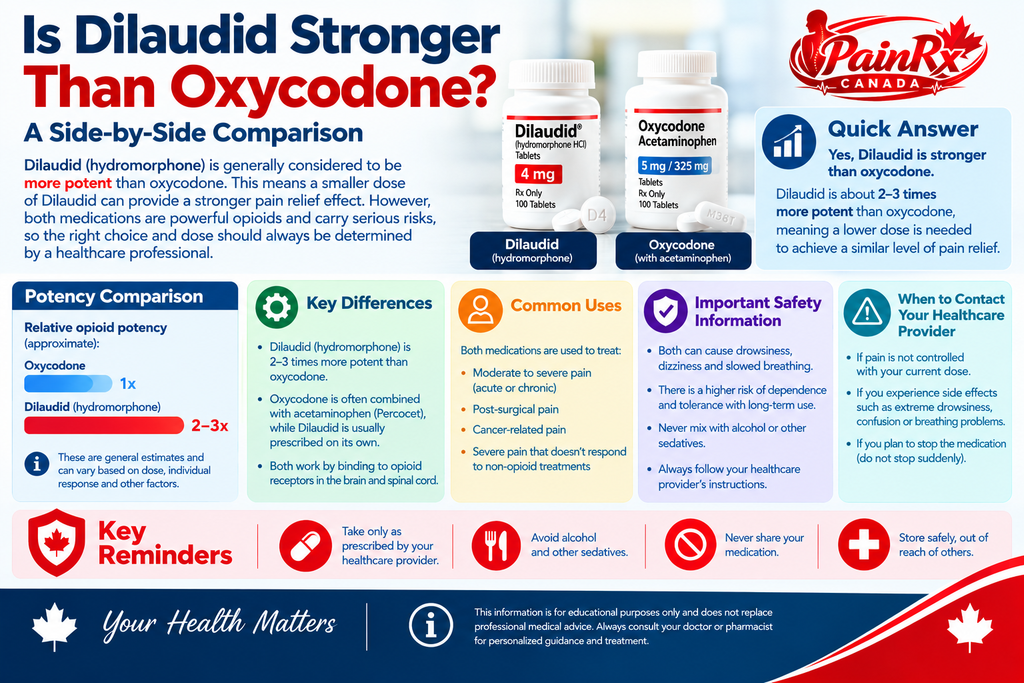
Dilaudid and oxycodone both show up frequently in Canadian pain management, and patients switching between them, or comparing a hospital prescription to a take-home one, often want a straight answer: which one is actually stronger? The short answer is Dilaudid, milligram for milligram, but the full comparison involves more than raw potency.
This guide compares hydromorphone (Dilaudid) and oxycodone directly, without the acetaminophen combination found in products like Percocet, and looks at how each medication is metabolized, used, and prescribed.
Comparing Pure Opioid Potency
Both Dilaudid and oxycodone are opioids on their own, unlike combination products that pair an opioid with acetaminophen. This makes a direct potency comparison more straightforward.
Standard clinical equianalgesic dosing tables consistently rank hydromorphone as more potent than oxycodone by weight. A smaller milligram amount of hydromorphone typically produces pain relief comparable to a larger milligram amount of oxycodone. The exact ratio varies across studies and patients, which is why doctors and pharmacists calculate specific conversions rather than relying on a single fixed number.
How Their Metabolism Differs
One of the more meaningful differences between these two opioids involves how the body processes them, not just their raw strength.
Hydromorphone undergoes a relatively simple metabolic pathway called glucuronidation, which doesn’t rely heavily on the liver’s cytochrome P450 enzyme system. This gives it fewer opportunities for interactions with other medications that affect those enzymes.
Oxycodone’s metabolism is more complex and partly involves the cytochrome P450 system. Some research has explored whether genetic differences in these enzymes affect how strongly a patient responds to oxycodone, though current evidence on this remains mixed and inconclusive. In practice, this means oxycodone’s effectiveness can be somewhat more sensitive to other medications a patient takes, though this varies by individual.
Kidney Function and Opioid Choice
Both medications rely partly on the kidneys to clear their breakdown products, but doctors weigh this differently depending on the patient.
Patients with reduced kidney function can accumulate opioid metabolites more than patients with normal kidney function, which can intensify side effects. Doctors evaluate each patient’s kidney function individually when choosing between hydromorphone and oxycodone, and this decision depends on the specific case rather than a blanket rule favoring one opioid over the other.
Available Forms for Each Medication
Both Dilaudid and oxycodone come in multiple forms, which affects how doctors use them in different settings.
| Medication | Available Forms | Common Setting |
|---|---|---|
| Dilaudid (hydromorphone) | Oral tablet, oral liquid, injection, extended-release tablet | Hospital and home use |
| Oxycodone | Oral tablet, oral liquid, extended-release tablet | Primarily home and outpatient use |
Dilaudid’s injectable forms give it an advantage in hospital and emergency settings where rapid pain control matters most. Oxycodone is generally used orally across both acute and chronic pain settings.
When Doctors Choose Dilaudid Over Oxycodone
Several situations commonly lead a doctor toward hydromorphone instead of oxycodone.
Severe or rapidly escalating pain. Dilaudid’s higher potency and injectable options suit pain that needs fast, strong control, such as in a hospital setting.
Prior inadequate response to oxycodone. A patient who hasn’t found sufficient relief from oxycodone, or who experienced problematic side effects, may respond better to hydromorphone.
Need to minimize drug interactions. Hydromorphone’s simpler metabolic pathway can make it a preferable option for patients taking multiple medications that interact with liver enzymes.
When Oxycodone Remains the Better Choice
Greater potency doesn’t automatically make Dilaudid the right choice for every patient.
Oxycodone often provides adequate relief for moderate to moderately severe pain without the higher risk profile that comes with a more potent opioid. Its widespread use across Canadian prescribing also means more established dosing familiarity for common outpatient situations, particularly for chronic non-cancer pain managed at home. A doctor generally starts with the option that matches the pain severity most closely, since prescribing more potency than a situation requires adds risk without added benefit.
Safety Considerations for Both Medications
Both Dilaudid and oxycodone carry the same core opioid risks, though hydromorphone’s greater potency means errors carry a somewhat higher margin of danger at equivalent doses.
Respiratory depression, breathing that becomes dangerously slow or shallow, represents the most serious risk with either medication. This risk increases when a dose exceeds what’s prescribed, when doses come too close together, or when either opioid combines with alcohol, benzodiazepines, or other central nervous system depressants.
Patients and caregivers should learn the signs of an opioid emergency: extreme drowsiness that’s hard to rouse from, slow or shallow breathing, blue-tinged lips or fingertips, and unresponsiveness. Call 911 immediately if these appear, and use naloxone if it’s available.
Frequently Asked Questions
Can I take Dilaudid and oxycodone at the same time? Combining two opioids without explicit medical direction significantly raises the risk of dangerous respiratory depression. This should never happen outside a doctor’s specific instructions.
Why would my doctor switch me from oxycodone to Dilaudid? Common reasons include inadequate pain control on oxycodone, side effects that don’t resolve, a need for an injectable option, or a desire to reduce potential drug interactions in a patient taking multiple medications.
Is Dilaudid more addictive than oxycodone? Both carry a genuine risk of dependence and addiction. Some evidence suggests more potent opioids may carry a somewhat higher misuse risk for certain individuals, but risk depends heavily on dose, duration, and individual factors rather than the medication alone.
Does a lower milligram number mean Dilaudid is a smaller, safer dose than oxycodone? Not necessarily. Because hydromorphone is more potent by weight, a smaller number of milligrams doesn’t automatically mean a proportionally smaller effect. Doses aren’t directly comparable across different opioids without a proper clinical conversion.
Which one works faster, Dilaudid or oxycodone? Onset depends more on the form than the specific opioid. Oral tablets of both medications have broadly similar onset windows, while Dilaudid’s injectable forms act considerably faster than any oral option from either medication.
The Bottom Line
Dilaudid is stronger than oxycodone on a milligram-for-milligram basis, supported by standard clinical potency comparisons. That difference in potency comes with a difference in how carefully each needs to be dosed, along with some meaningful distinctions in metabolism and available forms.
Neither medication is universally “better.” The right choice depends on pain severity, kidney function, other medications a patient takes, and how a patient has responded to opioids in the past, all of which a doctor evaluates individually.
This article is for general informational purposes only and is not a substitute for professional medical advice. Dilaudid and oxycodone are prescription-only controlled substances in Canada. Always consult a doctor or pharmacist with questions about your specific medication, dosing, or symptoms, and seek emergency medical help immediately for any signs of an opioid overdose.