

Is Dilaudid Stronger Than Morphine?

Is Dilaudid Stronger Than Morphine? A Canadian Guide to Opioid Potency
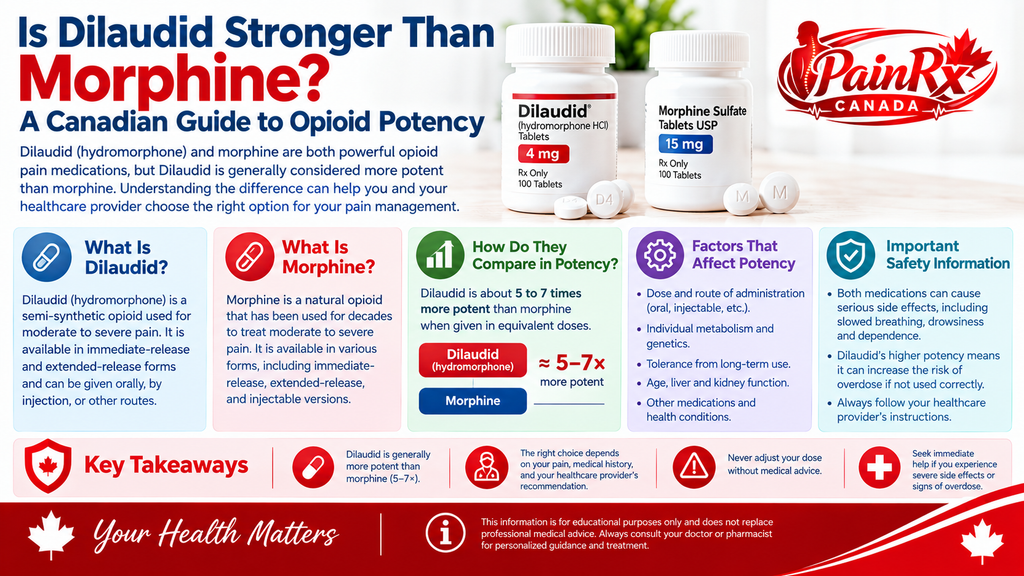
A doctor switches your prescription from morphine to Dilaudid, and a natural question follows right away. Is Dilaudid actually stronger? This question matters for patients managing severe pain after surgery, cancer treatment, or a serious injury. It also matters for families supporting a loved one through end-of-life care. This guide explains how Dilaudid and morphine compare, why potency differs between them, and what Canadian patients should know before either medication is used.
The Quick Answer
Yes, Dilaudid is stronger than morphine on a milligram-for-milligram basis. Dilaudid is the brand name for hydromorphone, a semi-synthetic opioid derived from morphine itself. Because of how the body absorbs and processes it, hydromorphone produces a stronger effect per milligram than morphine does. That does not mean Dilaudid is automatically the “better” or safer choice, though. Both drugs carry serious risks, and a doctor selects between them based on a patient’s specific condition, tolerance, and medical history, not on strength alone.
What Is Dilaudid?
Dilaudid is the brand name most commonly associated with hydromorphone hydrochloride. Pharmaceutical companies first developed it in the 1920s by modifying the morphine molecule. Since then, it has become a standard option in Canadian hospitals for managing severe, acute pain. Doctors prescribe it after major surgery, for cancer-related pain, and for other conditions where weaker opioids fail to provide relief. Hydromorphone comes in tablets, oral liquid, and injectable forms, and Health Canada classifies it as a controlled substance under the Controlled Drugs and Substances Act.
What Is Morphine?
Morphine is one of the oldest and most well-studied opioids in medicine. Chemists first isolated it from the opium poppy in the early 1800s, and it remains a benchmark for measuring other opioids. Canadian doctors prescribe morphine for many of the same reasons as Dilaudid: severe post-surgical pain, cancer pain, and palliative care. It’s available in immediate-release and extended-release tablets, oral liquid, and injectable forms. Like hydromorphone, morphine is a controlled substance in Canada, and it requires a prescription.
Why Is Dilaudid Stronger Than Morphine?
Several factors combine to make hydromorphone more potent than morphine by weight. First, hydromorphone binds more effectively to the body’s opioid receptors, which produces a stronger pain-relieving effect at a lower dose. Second, hydromorphone is more lipophilic than morphine, meaning it crosses into fatty tissue, including the brain, more readily. This allows it to act faster and more intensely once it reaches the bloodstream. Because of these properties, healthcare providers generally consider hydromorphone several times more potent than morphine on a milligram-for-milligram basis, which is why hospital protocols never treat the two as interchangeable at equal doses.
This difference in potency is exactly why dose conversions between opioids are never something patients should calculate on their own. A pharmacist or physician always performs this calculation, since it depends on the specific formulation, the patient’s tolerance, kidney and liver function, and other medications currently in use. Getting an opioid conversion wrong can lead to dangerous under-treatment of pain or, more seriously, a life-threatening overdose.
Comparing Dilaudid and Morphine
| Feature | Dilaudid (Hydromorphone) | Morphine |
|---|---|---|
| Drug class | Semi-synthetic opioid | Natural opioid (opiate) |
| Relative potency | Generally more potent by weight | Baseline reference opioid |
| Onset of action (oral) | Faster, roughly 15–30 minutes | Slower, roughly 30–60 minutes |
| Duration of action | Shorter, generally 4–6 hours | Longer, generally 4–6 hours for immediate release |
| Common forms | Tablet, liquid, injectable | Tablet, extended-release tablet, liquid, injectable |
| Typical uses | Severe acute pain, cancer pain, post-surgical pain | Severe acute pain, cancer pain, palliative care |
| Controlled substance status in Canada | Schedule I (CDSA) | Schedule I (CDSA) |
| Common side effects | Drowsiness, nausea, constipation, itching | Drowsiness, nausea, constipation, itching |
Both drugs share a similar side-effect profile, since they act on the same opioid receptors in the body. The differences that matter most for patients come down to potency, onset speed, and how each drug fits an individual’s medical situation, rather than one drug being universally “better” than the other.
Does Stronger Mean More Dangerous?
Not necessarily, and this distinction is genuinely important to understand. A stronger opioid simply requires a smaller dose to achieve the same pain relief. When a doctor prescribes Dilaudid, the dose is calculated specifically to match that increased potency, so the intended effect stays proportional and controlled. Danger arises not from potency itself, but from dosing errors, combining opioids with other central nervous system depressants like alcohol or benzodiazepines, or using an opioid without medical supervision.
That said, some Canadian addiction medicine specialists note that hydromorphone’s faster onset and shorter duration can make it more reinforcing for some patients, which may carry a somewhat higher risk of misuse for certain individuals. This is one of several factors a doctor weighs before choosing between the two medications, alongside a patient’s personal and family history, current health status, and the type of pain being treated.
Side Effects of Both Medications
Dilaudid and morphine cause largely overlapping side effects, since both belong to the same drug class. Common effects include drowsiness, dizziness, nausea, vomiting, constipation, and itching. Some patients also experience confusion, particularly older adults or those with reduced kidney function. Both drugs can cause respiratory depression, which is slowed or shallow breathing, and this risk increases significantly at higher doses or when combined with other sedating substances.
Long-term use of either medication can lead to physical dependence, tolerance, and, in some patients, addiction. This is true regardless of which opioid is used, and it’s a key reason Canadian prescribing guidelines encourage the lowest effective dose for the shortest necessary duration whenever possible.
Who Should Avoid These Medications, or Use Extra Caution
Certain patients face a higher risk profile with either Dilaudid or morphine, and a doctor should always be consulted before starting either one.
- People with respiratory conditions: Asthma, COPD, and sleep apnea all raise the risk of dangerous breathing complications with opioid use.
- People with liver or kidney disease: Both organs help clear these drugs from the body, so impaired function can cause the medication to build up to unsafe levels.
- Older adults: Slower metabolism and increased sensitivity to sedation make careful, lower dosing especially important in this group.
- Pregnant individuals: Opioid use during pregnancy requires close medical supervision, since it can affect the newborn.
- People with a history of substance use disorder: A doctor may recommend alternative pain management strategies or additional monitoring for this group.
- Anyone taking benzodiazepines, sleep medications, or alcohol: Combining these substances with opioids significantly raises the risk of fatal respiratory depression.
Recognizing an Opioid Overdose
Because both Dilaudid and morphine are potent opioids, recognizing the signs of an overdose can save a life. Watch for extremely slow or stopped breathing, blue or grey lips and fingertips, unresponsiveness, pinpoint pupils, and limp muscles or a gurgling sound while breathing.
If you suspect an opioid overdose, call 911 immediately. Naloxone, sold under the brand name Narcan in Canada, can temporarily reverse an opioid overdose and is available free of charge at most Canadian pharmacies without a prescription. Many provinces also distribute take-home naloxone kits and offer training on how to use them. Administering naloxone and calling emergency services right away gives the best chance of a safe outcome while help arrives.
Practical Guidance for Canadian Patients
Never adjust your own dose or switch between Dilaudid and morphine without your prescriber’s direction, since the two are not interchangeable at equal amounts. Store both medications securely, away from children and anyone who might misuse them, since Health Canada classifies both as controlled substances precisely because of their potential for harm and diversion. Always disclose every medication and supplement you’re taking to your doctor and pharmacist, including over-the-counter products, since interactions with sedatives or certain antidepressants can be serious. If you experience unusual drowsiness, confusion, or breathing difficulty on either medication, contact your healthcare provider or seek emergency care right away.
Frequently Asked Questions
Is Dilaudid stronger than morphine? Yes, hydromorphone is generally considered more potent than morphine on a milligram-for-milligram basis, due to differences in how the body absorbs and processes each drug.
Why do doctors sometimes switch patients from morphine to Dilaudid? Doctors may switch medications when a patient’s pain isn’t well controlled, when side effects become difficult to manage, or when a faster-acting option better suits the clinical situation. The specific dose is always recalculated by a medical professional during any switch.
Is Dilaudid more addictive than morphine? Both drugs carry a real risk of dependence and addiction. Some evidence suggests hydromorphone’s faster onset may be somewhat more reinforcing for certain individuals, but addiction risk depends heavily on individual factors, not the drug alone.
Can I take Dilaudid and morphine together? No, these medications should never be combined without explicit direction from a prescriber, since doing so significantly raises the risk of dangerous respiratory depression and overdose.
Is Dilaudid safer than morphine for older adults? Neither drug is inherently safer for older patients. Dosing and monitoring matter more than the choice of drug, and a geriatric specialist or pharmacist can help determine the most appropriate option.
How is Dilaudid different from morphine in how fast it works? Oral hydromorphone generally takes effect somewhat faster than oral morphine, though the exact timing depends on the formulation and the individual patient.
What should I do if I think someone has taken too much Dilaudid or morphine? Call 911 immediately and administer naloxone if it’s available. Stay with the person, and if possible, place them in the recovery position while waiting for emergency responders.
Dilaudid and Morphine in Palliative and Cancer Care
Both medications play a major role in Canadian palliative care programs, where the goal is comfort and quality of life rather than cure. Morphine has a long track record in this setting, and many palliative care teams default to it first because of decades of clinical experience and its predictable, longer-lasting effect. Dilaudid often becomes the preferred option when a patient develops side effects on morphine, when kidney function declines, or when a faster-acting medication better matches breakthrough pain episodes. Neither drug is considered universally superior in palliative settings. The choice comes down to the individual patient’s response, organ function, and comfort goals, all of which a palliative care physician monitors closely and adjusts over time.
Cancer pain specialists sometimes rotate patients between different opioids, a practice called opioid rotation, when tolerance builds or side effects become difficult to manage. Switching from morphine to Dilaudid, or the reverse, is a standard part of this strategy, and it always involves a careful recalculation of dose by the care team rather than a simple substitution.
Cost and Availability in Canada
Both Dilaudid and generic hydromorphone are covered under most provincial drug plans and private insurance formularies when prescribed for an approved medical indication, though coverage details vary by province and by specific plan. Morphine is generally the less expensive of the two, since it has been available in generic form for longer and is manufactured more widely. Pharmacists across Canada stock both medications, though the injectable forms are typically reserved for hospital or clinical settings rather than take-home prescriptions. Patients without insurance coverage should ask their pharmacist about the exact cost difference for their specific dose and formulation, since prices vary between provinces and pharmacy chains.
The Bottom Line
Dilaudid is stronger than morphine by weight, thanks to how effectively hydromorphone binds to opioid receptors and crosses into the brain. Still, “stronger” doesn’t mean “more dangerous” or “better,” since doctors adjust the dose of each medication to match its potency and a patient’s specific needs. Both drugs are serious, tightly controlled medications in Canada, and both carry real risks of dependence, misuse, and overdose. Always follow your prescriber’s exact instructions, never adjust your dose independently, and reach out to your healthcare provider or pharmacist with any questions about either medication.
This article is for general informational purposes only and is not a substitute for professional medical advice. Dilaudid and morphine are prescription-only controlled substances in Canada. Always consult a doctor or pharmacist before starting, stopping, or changing any opioid medication.