

How Strong Is Dilaudid?

How Strong Is Dilaudid? A Canadian Patient Guide
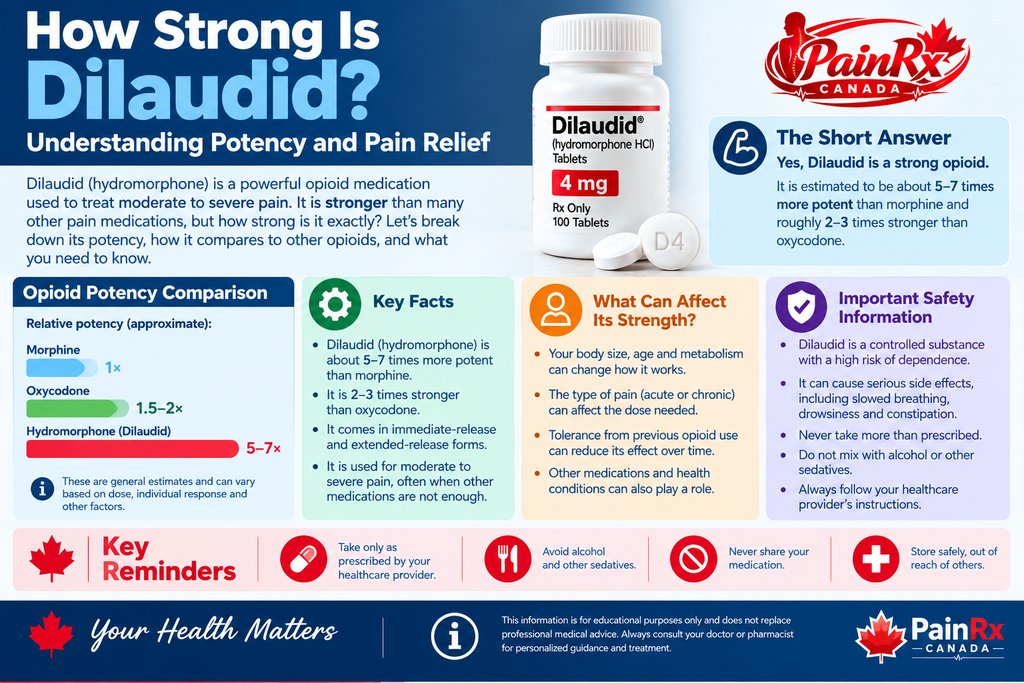
“Strong” means different things depending on what a patient is actually asking. Some want to know how Dilaudid compares to other opioids. Others want to understand why their specific dose feels the way it does. This guide covers both angles: where hydromorphone sits on the opioid potency scale, and what actually determines how strong a given dose feels for a given patient.
Where Hydromorphone Sits on the Opioid Scale
Hydromorphone, sold under the brand name Dilaudid, ranks among the more potent opioids used in general clinical practice. Clinical equianalgesic dosing tables, which compare how much of one opioid produces the same pain relief as another, consistently place hydromorphone above morphine and oxycodone in potency per milligram.
This doesn’t mean Dilaudid sits at the absolute top of the opioid scale. Fentanyl and a handful of other synthetic opioids used mainly in hospital and specialized settings are considerably more potent than hydromorphone. Dilaudid occupies a strong-but-not-strongest position, reserved for pain that milder opioids can’t adequately control.
How Dilaudid Compares to Familiar Opioids
Versus morphine. Hydromorphone is generally considered several times more potent than morphine by weight, which is why hydromorphone doses look smaller in milligrams for a similar level of pain relief.
Versus oxycodone. Hydromorphone is also more potent than oxycodone on a milligram-for-milligram basis, according to standard clinical references, though the exact ratio varies across studies and patients.
Versus codeine. Codeine sits at the weaker end of the opioid spectrum and requires conversion in the liver to become fully active. Dilaudid works directly and far more potently, which is why doctors reserve it for pain codeine can’t manage.
Versus fentanyl. Fentanyl is dramatically more potent than hydromorphone, sometimes by a factor of dozens. Doctors typically reserve fentanyl for situations requiring extremely fast, powerful pain control under close supervision.
None of these comparisons translate into a simple conversion a patient should calculate independently. Doctors and pharmacists use precise, individualized formulas when switching a patient between opioids, accounting for tolerance, the specific formulations involved, and the route of administration.
Why “Strength” Isn’t Just About the Molecule
A medication’s inherent potency is only one part of how strong it feels in practice. Several other factors shape the real-world experience of a Dilaudid dose.
Dose size. Dilaudid comes in a range of strengths, and a doctor selects the specific dose based on pain severity, body size, and prior opioid exposure. A low dose of a potent opioid can feel milder than a high dose of a less potent one.
Route of administration. An IV dose reaches full strength almost immediately, while an oral dose builds more gradually after passing through digestion. The same milligram amount can feel different depending on how it enters the body.
Individual tolerance. A patient who regularly takes opioids typically needs a larger dose to achieve the same effect a first-time patient would feel from a much smaller amount. Tolerance changes perceived strength without changing the medication itself.
Formulation. Immediate-release Dilaudid delivers its effect relatively quickly and directly. Extended-release versions spread a similar total dose across many hours, producing a steadier but less intense moment-to-moment sensation.
What Makes Dilaudid Feel Strong to a New Patient
Patients taking an opioid for the first time often describe Dilaudid’s effects as noticeably more intense than what they expected from previous pain medication experiences.
Beyond pain relief, this can include drowsiness, a sense of calm or mild euphoria, and slower reaction times. These accompanying effects are part of why doctors caution against driving or operating machinery until a patient knows how a specific dose affects them. They also explain why Dilaudid carries a meaningfully higher misuse and dependence risk than non-opioid pain medications.
Why Potency Also Means Higher Risk
A more potent opioid isn’t simply “more effective” without a trade-off. Potency and risk generally move together, which is central to how doctors approach hydromorphone prescribing.
Respiratory depression, or breathing that becomes dangerously slow or shallow, represents the most serious risk associated with any strong opioid. This risk grows when a dose exceeds what’s prescribed, when doses come too close together, or when hydromorphone combines with alcohol, benzodiazepines, or other sedating medications.
Patients and caregivers should learn the signs of an opioid emergency: extreme drowsiness that’s hard to rouse from, slow or shallow breathing, blue-tinged lips or fingertips, and unresponsiveness. Call 911 immediately if these appear, and use naloxone if it’s on hand.
Why Doctors Don’t Simply Prescribe the Strongest Available Option
Given hydromorphone’s potency, patients sometimes wonder why a doctor wouldn’t default to it for any significant pain. In practice, doctors match medication strength to pain severity as closely as possible, since prescribing a stronger-than-necessary opioid increases risk without adding meaningful benefit.
This is part of the broader principle behind opioid prescribing in Canada: start with the lowest effective dose and the least potent option that adequately controls pain, then adjust based on the patient’s actual response.
Frequently Asked Questions
Is Dilaudid the strongest pain medication available? No. Fentanyl and certain other synthetic opioids used mainly in hospital settings are considerably more potent. Dilaudid is a strong opioid, but not the strongest one used in medical practice.
Why does my Dilaudid dose feel different than a friend’s, even though we take the same milligram amount? Individual factors like body weight, metabolism, opioid tolerance, and the route of administration all affect how strong a given dose feels, even at an identical milligram amount.
Does a higher milligram number always mean a stronger effect? Not directly, since strength also depends on the specific opioid, the formulation, and the route. Comparing milligrams across different opioids or forms without a proper conversion can be misleading and isn’t a reliable way to judge relative strength.
Can I become tolerant to Dilaudid, making it feel weaker over time? Yes. Regular use commonly leads to tolerance, meaning a previously effective dose may feel less potent over time. This should be addressed with a doctor rather than through independent dose increases.
Is it safe to compare my Dilaudid dose to someone else’s opioid prescription? No. Doses are individualized based on a specific patient’s pain, health history, and tolerance. Comparing doses between patients doesn’t provide a meaningful or safe reference point.
The Bottom Line
Dilaudid ranks among the more potent opioids in common clinical use, stronger than morphine, oxycodone, and codeine, though less potent than fentanyl. Its real-world strength for any individual patient depends on far more than the molecule itself, including dose, route, formulation, and personal tolerance.
That potency is exactly why hydromorphone requires careful, doctor-directed use. Any question about dose strength, comparisons to another medication, or how a specific prescription should feel belongs in a conversation with a doctor or pharmacist.
This article is for general informational purposes only and is not a substitute for professional medical advice. Dilaudid and hydromorphone are prescription-only controlled substances in Canada. Always consult a doctor or pharmacist with questions about your specific medication, dosing, or symptoms, and seek emergency medical help immediately for any signs of an opioid overdose.