

How Long Does Dilaudid Take to Kick In?

How Long Does Dilaudid Take to Kick In? A Canadian Patient Guide
A patient leaves the hospital pharmacy with a small bottle of Dilaudid. Before the car even leaves the parking lot, the question comes up: how long until this actually starts working?
Pharmacists and nurses hear this question constantly, and for good reason. Pain doesn’t wait politely. Knowing what to expect helps patients plan their day, judge whether a dose is working, and recognize when something feels off.
This guide covers the general timelines for Dilaudid (hydromorphone), the factors that speed things up or slow things down, and the safety points every Canadian patient should keep in mind.
The Short Answer
Onset depends heavily on how the medication enters the body. Clinical references describe a general pattern.
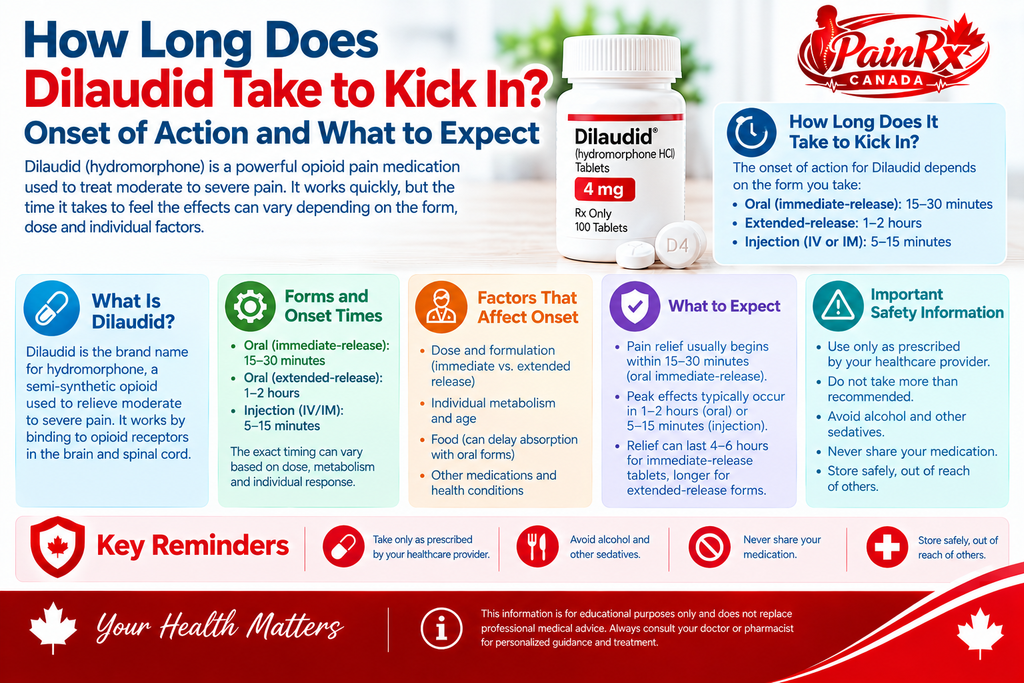
An intravenous (IV) dose tends to produce a noticeable effect within about five minutes. An intramuscular (IM) or subcutaneous injection typically takes about fifteen minutes. An oral tablet or liquid usually takes fifteen to thirty minutes before pain relief becomes noticeable. Peak effect usually follows some time after that initial onset. A single dose commonly provides a few hours of relief, though this varies from person to person.
These numbers are general reference points, not guarantees. Every patient’s body processes medication differently. A doctor or pharmacist who knows a patient’s specific prescription and health history remains the best source for what to expect in that individual case.
Why Route of Administration Matters So Much
The way a medication enters the body directly affects how quickly it can act. This concept explains why the same drug can feel dramatically different depending on the form it takes.
When hydromorphone enters a vein directly, it bypasses the digestive system entirely and reaches the bloodstream immediately. This is why IV administration, typically reserved for hospital settings, tends to produce the fastest onset.
An intramuscular or subcutaneous injection also avoids the digestive tract. But the medication must first absorb from the muscle or fatty tissue into the bloodstream, which adds a bit of time compared to a direct IV line.
Why Oral Doses Take Longer
Oral tablets and liquids travel the longest path. After a patient swallows the dose, it passes through the stomach, absorbs through the lining of the small intestine, and then travels through the liver before reaching general circulation.
Pharmacists often call this liver step “first-pass metabolism.” It explains why oral opioids generally act more slowly. It’s also why doctors often calculate oral doses differently than injectable ones for the same level of pain relief.
A Comparison of Onset by Route
| Route of Administration | Typical Onset | Common Setting |
|---|---|---|
| Intravenous (IV) | Around 5 minutes | Hospital, under medical supervision |
| Intramuscular / Subcutaneous injection | Around 15 minutes | Hospital or clinical setting |
| Oral tablet or liquid | Roughly 15–30 minutes | Home use, outpatient care |
| Extended-release oral tablet | Slower, gradual onset | Home use for chronic pain management |
Extended-release formulations work differently than immediate-release ones. Rather than producing a quick peak, they release the medication gradually over many hours. Doctors generally prescribe them to manage persistent pain around the clock rather than to relieve a sudden pain spike.
Factors That Can Influence How Quickly It Works
No two patients experience a medication identically. Several individual factors can shift how fast Dilaudid seems to take effect.
An empty or full stomach. Food can delay how quickly the stomach empties its contents into the small intestine. Taking an oral dose with food can slow absorption somewhat compared to taking it on an empty stomach.
Body composition and metabolism. Differences in body weight, muscle mass, and metabolic rate can all affect how quickly a patient absorbs and processes a dose. This is part of why doctors individualize dosing rather than relying on one standard amount for everyone.
Liver and kidney function. The liver metabolizes hydromorphone, and the kidneys help clear its byproducts. Patients with liver or kidney conditions may process the medication differently than patients with typical organ function. Doctors often adjust doses or monitoring for these patients as a result.
Tolerance from previous opioid use. Patients who take opioids regularly, whether for chronic pain or other medical reasons, often develop a tolerance. This tolerance can change how quickly and how strongly they notice a dose’s effects compared with someone taking an opioid for the first time.
Age. Older adults often process medications more slowly than younger adults. Doctors frequently start older patients on more conservative doses and adjust gradually based on response.
Other medications in the system. Certain drugs, including some sedatives and other central nervous system depressants, can interact with hydromorphone and change how a patient experiences it. This is exactly why keeping an updated medication list and disclosing all current medications to a doctor or pharmacist matters.
What “Kicking In” Actually Feels Like
For most patients using Dilaudid as prescribed for pain, the pain gradually eases rather than shifting instantly. Some patients also notice mild drowsiness, a sense of calm, or slight lightheadedness alongside the pain relief. Opioid medications commonly produce these accompanying effects. This is part of why doctors advise patients not to drive or operate machinery until they know how a particular dose affects them.
A dose can still be working even without a strong, immediately noticeable sensation. Pain relief can build gradually and subtly, especially with oral formulations. Patients should generally wait through the full expected onset window before assuming a dose failed to work.
When Relief Seems Slower Than Expected
If pain relief seems to take noticeably longer than the general timeframes above, a patient can take a few reasonable, safe steps.
First, wait through the full recommended window before considering an additional dose. Taking more of an opioid before the first dose has had time to act raises the risk of overdose. Second, check that the dose matched the prescription, including the right formulation and timing relative to food. This step can help identify a simple explanation.
Talk to a Provider, Not a Guess
If pain relief consistently feels inadequate or repeatedly slower than expected, patients should raise this with a prescribing doctor or pharmacist rather than adjusting the dosing schedule on their own. A slower-than-expected response can sometimes signal that a dose needs reassessment, that a different formulation might suit the patient better, or that another issue affects how the pain is managed.
Patients should never take an extra dose or combine Dilaudid with other medications to try to speed up or intensify its effect without first talking to a healthcare provider.
Why Patients Should Never Adjust Timing or Dosing on Their Own
A doctor calculates the interval between doses and the prescribed amount carefully, based on each patient’s specific medical situation, because hydromorphone is a potent opioid. Taking a dose earlier than prescribed, taking an extra dose to compensate for a slow-feeling onset, or combining it with alcohol or other sedating medications all raise the risk of serious harm, including slowed or stopped breathing.
Respiratory depression, or breathing that becomes dangerously slow or shallow, ranks as the most serious risk tied to opioid medications like Dilaudid. This risk climbs substantially when doses come too close together, when the medication combines with other central nervous system depressants such as alcohol, benzodiazepines, or certain sleep medications, or when a dose exceeds what a doctor prescribed.
Patients and caregivers should learn the signs of an opioid emergency: extreme drowsiness that’s hard to rouse from, slow or shallow breathing, blue-tinged lips or fingertips, and unresponsiveness. If any of these signs appear, call 911 immediately. Naloxone, if available, can help reverse the effects while emergency help arrives.
Onset Versus Duration: Two Different Things
It’s easy to confuse how quickly a medication starts working with how long its effects last. These represent two separate properties of any drug. Dilaudid’s relatively fast onset, particularly by injection, doesn’t mean its effects wear off just as fast.
Depending on the formulation and the patient, a single immediate-release dose commonly provides several hours of pain relief. Extended-release versions, by contrast, maintain a steadier level of relief over a much longer stretch of time.
This distinction matters because it directly shapes how doctors time prescriptions. A doctor’s instructions about how many hours to wait between doses account for both how long the medication takes to act and how long its effects last, along with safety margins based on how the body clears the drug. Patients should follow the prescribed schedule rather than estimate timing based on how they currently feel.
A Note on Injectable Use Outside a Medical Setting
Doctors intend Dilaudid’s IV and IM forms for use within a supervised medical setting, such as a hospital or clinic, where trained staff can monitor a patient’s response and manage complications immediately. Injectable opioids carry meaningfully higher risks outside that kind of supervised environment, including a much narrower margin between a therapeutic dose and a dangerous one.
Any Canadian patient prescribed an injectable form of hydromorphone should use it only as their healthcare team directs and only in the setting that team specifies.
Frequently Asked Questions
How long does it take for oral Dilaudid to start working? Most patients notice pain relief beginning somewhere between fifteen and thirty minutes after taking an oral dose. Individual response can vary based on factors like an empty stomach or each patient’s own metabolism.
Does Dilaudid work faster than other opioid pain medications? Relative speed depends heavily on the specific medication and route being compared. Experts generally consider hydromorphone a relatively fast-acting opioid, especially in its injectable forms. A doctor or pharmacist offers the best comparison for a specific medication a patient may be considering.
Why does my IV dose in the hospital work faster than my tablets at home? An IV dose enters the bloodstream directly and skips the digestive process entirely. An oral tablet, by contrast, must pass through the digestive system and the liver before reaching general circulation, which naturally takes more time.
Can I take another dose if I don’t feel relief within the expected time? This decision should always involve a doctor or pharmacist rather than a patient’s own judgment. Taking an additional dose too soon significantly raises the risk of overdose, particularly with an opioid medication like Dilaudid.
Does food affect how fast Dilaudid works? Food can slow absorption of an oral dose somewhat compared to taking it on an empty stomach. Still, a doctor’s specific instructions about food and timing should always take priority over general expectations.
Is a slower onset a sign that something is wrong? Not necessarily. Individual factors like metabolism, organ function, and opioid tolerance can all affect how quickly a dose seems to work. A patient should discuss a pattern of consistently slow or inadequate relief with a healthcare provider, though a single instance isn’t automatically a cause for concern.
How long does a single dose of Dilaudid last once it kicks in? Duration varies by formulation and by patient. A single immediate-release dose commonly provides several hours of relief, while extended-release versions maintain effects over a longer period.
Practical Tips for Canadian Patients
A simple log of when a patient takes each dose and notices relief can genuinely help. It supports personal awareness and gives a doctor accurate information at follow-up appointments. Following the exact timing instructions on a prescription label, rather than adjusting based on how a particular day feels, remains the safest way to use any opioid medication.
Store Dilaudid securely, away from children, pets, and anyone without a prescription for it. Even a single dose can harm someone without an opioid tolerance. Dispose of unused medication properly, typically by returning it to a pharmacy rather than keeping it at home indefinitely, to reduce the risk of accidental exposure or misuse by others. Finally, keep naloxone on hand and learn how to use it. This offers a reasonable precaution for many patients and households with opioid medications present, and pharmacists across Canada can often provide it along with brief training on its use.
The Bottom Line
Dilaudid’s onset time depends primarily on how a patient takes it: IV doses act fastest, injections follow close behind, and oral forms generally take a bit longer because of digestion and liver processing. Individual factors like metabolism, organ function, food intake, and opioid tolerance can all shift these general timeframes in either direction.
Hydromorphone is a potent, tightly regulated controlled substance. Any questions about whether a dose is working, or any temptation to adjust timing or amount independently, should always go through a doctor or pharmacist rather than a patient’s own guess. Used exactly as prescribed and monitored appropriately, Dilaudid can provide effective, predictable pain relief. Understanding its general timing helps patients use it safely and with realistic expectations.
This article is for general informational purposes only and is not a substitute for professional medical advice. Dilaudid and hydromorphone are prescription-only controlled substances in Canada. Always consult a doctor or pharmacist with questions about your specific medication, dosing, or symptoms, and seek emergency medical help immediately for any signs of an opioid overdose.