

How Long Does It Take for Dilaudid to Work?

How Long Does It Take for Dilaudid to Work? A Canadian Patient Guide
A patient takes a prescribed dose of Dilaudid and then watches the clock. Minutes pass, and the obvious question follows: is this actually working?
This question differs slightly from asking when a dose “kicks in.” Kicking in refers to the first noticeable sign of relief. Working refers to the medication doing its full job: easing pain to a manageable level and keeping it there. This guide walks through what “working” really means for Dilaudid (hydromorphone), how to judge it, and what to do if it doesn’t seem to be happening.
The General Timeline
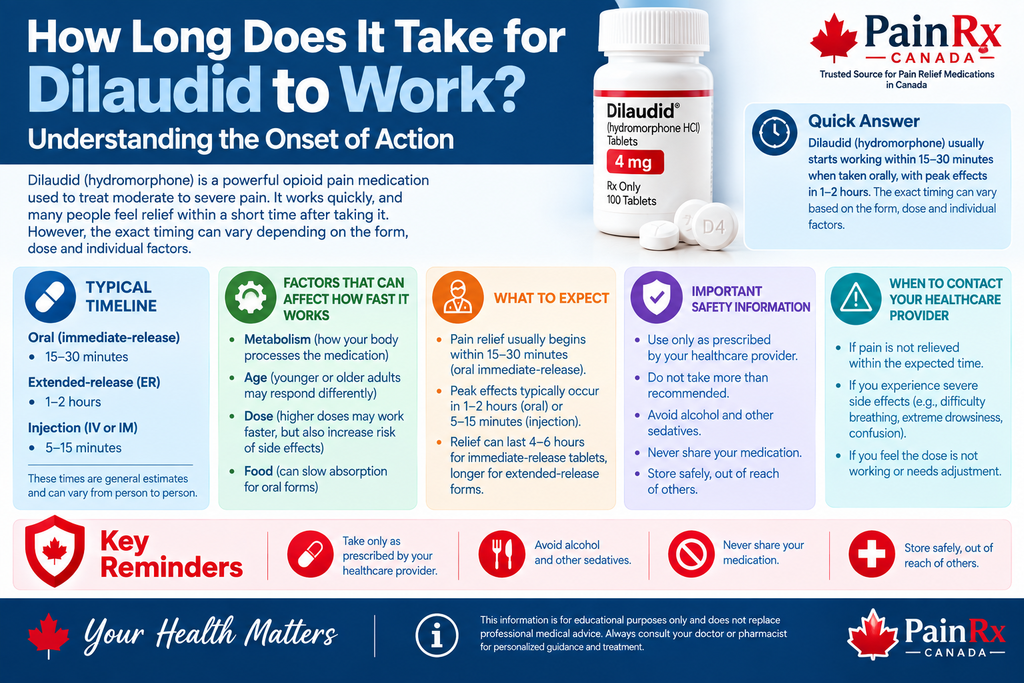
Hydromorphone starts acting at different speeds depending on how a patient takes it.
An IV dose typically produces an effect within about five minutes. An intramuscular or subcutaneous injection usually takes about fifteen minutes. An oral tablet or liquid generally takes fifteen to thirty minutes to show noticeable relief. Full effect, or peak effect, usually arrives some time after that first sign of relief.
These figures come from general clinical references. They don’t guarantee a specific experience for every patient. A doctor or pharmacist can give more precise expectations based on a patient’s exact prescription and health history.
What “Working” Actually Looks Like
Pain relief from Dilaudid rarely arrives as a single dramatic moment. Instead, most patients notice pain easing gradually over several minutes.
A few signs suggest the medication is doing its job:
- Pain intensity drops from its starting level, even if it doesn’t disappear completely
- Movement or breathing that previously triggered sharp pain becomes more tolerable
- A sense of calm or mild drowsiness sets in alongside the pain relief
- Sleep becomes easier, especially if pain had been keeping the patient awake
None of these signs need to happen all at once. Pain relief can also plateau at a partial level rather than eliminating pain entirely, which is often the realistic goal for chronic or severe pain management.
Why “Working” Can Mean Different Things for Different Patients
Two patients can take the same dose and describe very different experiences. Several factors explain this.
Pain severity and cause. Severe or complex pain sometimes responds more slowly or only partially, even when the medication reaches full effect in the bloodstream. A dose can be pharmacologically active without erasing pain completely.
Opioid tolerance. Patients who take opioids regularly often need a higher dose to notice the same effect a new patient would feel from a smaller amount. This doesn’t mean the medication has stopped working. It reflects how the body adapts over time.
Individual metabolism. Body weight, liver and kidney function, and genetic differences in drug metabolism all shape how quickly and strongly a patient feels a dose.
Expectations going in. A patient expecting total pain elimination may perceive partial relief as the medication “not working,” when it’s actually functioning as intended for that pain level.
How to Tell the Difference Between Slow Onset and No Effect
Waiting through the medication’s full expected onset window matters before drawing any conclusions. Fifteen to thirty minutes for an oral dose isn’t unusual, and some patients need the longer end of that range.
If the full window passes with genuinely no change in pain, a few possibilities exist. The dose might not suit that particular pain level. An interaction with food or another medication might be slowing absorption. Or a different formulation might work better for that patient’s situation.
None of these possibilities call for self-adjustment. They call for a conversation with the prescribing doctor or pharmacist.
What Not to Do If Dilaudid Doesn’t Seem to Be Working
Patients sometimes feel tempted to take an extra dose, take it sooner than prescribed, or combine it with alcohol or another sedating medication to intensify the effect. Every one of these choices raises the risk of a dangerous overdose.
Opioid overdose risk climbs sharply when a second dose stacks on top of a first dose that hasn’t fully cleared or taken effect yet. It also climbs when hydromorphone combines with other central nervous system depressants, including alcohol, benzodiazepines, or sleep aids.
Respiratory depression, meaning breathing that becomes dangerously slow or shallow, represents the most serious opioid risk. Warning signs include extreme drowsiness that’s hard to wake someone from, slow or shallow breathing, blue-tinged lips or fingertips, and unresponsiveness. Call 911 immediately if any of these appear. Naloxone can reverse the effects while help arrives, if it’s on hand.
When to Contact a Doctor or Pharmacist
A single dose that seems slow or only partially effective isn’t automatically a red flag. A pattern, however, is worth raising with a healthcare provider.
Contact a doctor or pharmacist if:
- Pain relief consistently falls short across multiple doses, not just one
- The medication seems to stop working sooner than expected before the next scheduled dose
- New or worsening side effects accompany the pain relief
- Any uncertainty exists about whether the current dose or schedule still fits the pain level
A doctor may adjust the dose, change the formulation, or investigate whether something else affects how the pain responds to treatment. This decision should never happen through self-adjustment at home.
Onset, Duration, and “Working” Are Related but Different
Three separate ideas often get bundled together: how fast a dose kicks in, how long it lasts, and how well it works. A fast-acting IV dose and a slower oral tablet can both work equally well once they reach full effect. They simply take different amounts of time to get there.
Duration matters just as much as onset. An immediate-release dose commonly provides a few hours of relief before wearing off, while extended-release formulations spread a steadier effect across a much longer stretch of time. A dose that works well but wears off faster than expected is a different issue than a dose that never worked in the first place, and the two call for different conversations with a provider.
Frequently Asked Questions
How do I know if Dilaudid is actually working or if I just feel sleepy? Drowsiness alone doesn’t confirm pain relief. Look for an actual drop in pain intensity or improved ability to move, breathe, or rest comfortably. If drowsiness appears without any change in pain, mention this to a doctor or pharmacist.
Is it normal for Dilaudid to only partially reduce my pain? Yes, partial relief is a common and often expected outcome, especially for severe or chronic pain. Complete pain elimination isn’t always the realistic goal of opioid therapy.
How long should I wait before deciding a dose isn’t working? Wait through the full expected onset window for the specific route: about five minutes for IV, about fifteen minutes for an injection, and fifteen to thirty minutes for an oral dose. A pattern of consistently inadequate relief across multiple doses is what warrants a call to a provider, not a single instance.
Can building tolerance make it seem like Dilaudid stopped working? Yes. Regular opioid use can lead to tolerance, which means a previously effective dose may feel weaker over time. A doctor needs to manage this change; patients shouldn’t increase their own dose to compensate.
Should I take an extra dose if the first one doesn’t seem to be working? No. Taking an additional dose before the prescribed interval significantly raises the risk of overdose. Always contact a doctor or pharmacist instead of adjusting the dose independently.
The Bottom Line
Dilaudid working as intended usually means a gradual, sometimes partial, easing of pain rather than a sudden, complete resolution. Onset speed depends on the route of administration, while how well the dose actually manages pain depends on individual factors like tolerance, pain severity, and metabolism.
Hydromorphone is a potent, tightly controlled medication. Any concern about whether it’s working correctly belongs in a conversation with a doctor or pharmacist, never in a decision to adjust the dose or timing alone. Used exactly as prescribed, Dilaudid can provide effective and predictable pain relief.
This article is for general informational purposes only and is not a substitute for professional medical advice. Dilaudid and hydromorphone are prescription-only controlled substances in Canada. Always consult a doctor or pharmacist with questions about your specific medication, dosing, or symptoms, and seek emergency medical help immediately for any signs of an opioid overdose.