

How Long Does Dilaudid Stay in Your Urine?

How Long Does Dilaudid Stay in Your Urine? A Canadian Patient Guide
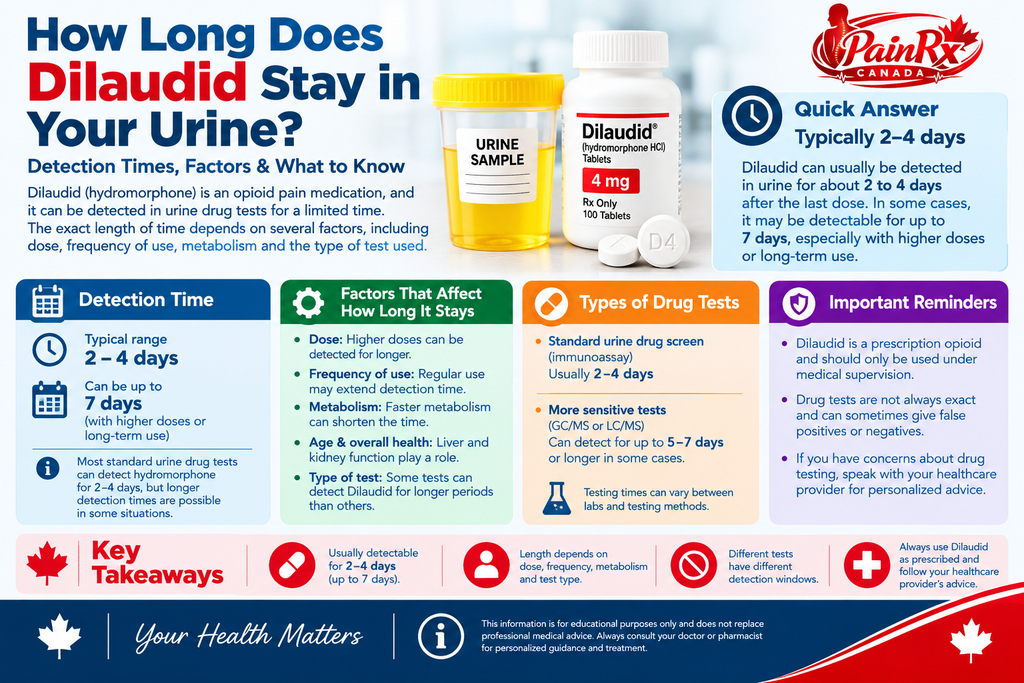
A patient in a pain management program, a post-surgical monitoring plan, or a workplace testing situation often wants a clear answer: how long will Dilaudid actually show up in a urine test? The honest answer involves more nuance than a single number, including a testing detail that surprises many patients.
This guide covers hydromorphone’s general urine detection window, the factors that shift it, and an important limitation of standard drug tests that patients should understand.
The General Detection Window
Most clinical references place hydromorphone’s urine detection window at roughly two to four days after the last dose. This window reflects how long detectable metabolite levels typically remain in urine, not how long a patient feels the medication’s effects.
This detection window is considerably longer than hydromorphone’s pain-relieving effects, which typically last only a few hours per dose. A patient can feel completely back to their baseline while still testing positive for the medication.
Why Detection Outlasts the Pain Relief
Hydromorphone has a relatively short elimination half-life, generally around two to three hours for immediate-release formulations. Half-life refers to the time it takes for half of the drug to clear from the bloodstream.
After roughly five half-lives, most of a dose has cleared from the blood, which for immediate-release Dilaudid happens within about 15 hours. Urine testing, however, detects metabolites like hydromorphone-3-glucuronide, which the kidneys continue filtering out over a longer stretch of time than the parent drug remains active in the bloodstream. This gap between feeling effects and testing positive applies to most opioids, not just Dilaudid specifically.
An Important Testing Limitation Patients Should Know
Here’s a detail many patients don’t expect: standard urine opiate immunoassay tests, the quick screening tests commonly used in clinics and workplaces, are built primarily to detect morphine and codeine. Their sensitivity to hydromorphone specifically is often much weaker.
Published toxicology research on pain management patients has found that a substantial share of urine samples from patients actually taking hydromorphone screened negative on standard immunoassay tests, even though more sensitive laboratory methods confirmed the drug’s presence. This happens because of how the screening antibody reacts, or fails to react, with hydromorphone’s specific molecular structure.
This matters most for patients being monitored for compliance in a pain management program. A negative standard opiate screen doesn’t necessarily mean hydromorphone is absent. Confirmatory testing methods, such as gas chromatography-mass spectrometry or liquid chromatography-tandem mass spectrometry, detect hydromorphone far more reliably and are used to verify results when accuracy matters.
Factors That Can Shift the Detection Window
Individual detection times vary based on several factors, in either direction from the general two-to-four-day estimate.
Formulation. Extended-release Dilaudid releases more slowly and can remain detectable somewhat longer than an immediate-release dose of the same size.
Dose and frequency. Higher doses, or regular repeated dosing, can extend detection beyond the typical window because more of the drug and its metabolites accumulate in the body.
Kidney function. Since the kidneys clear hydromorphone’s metabolites, reduced kidney function can slow this process and extend how long metabolites remain detectable.
Individual metabolism. Age, body composition, liver function, and genetic variation in the enzymes that process hydromorphone all affect clearance speed from person to person.
Testing method and cutoff level. Different labs use different sensitivity thresholds, so the same urine sample could test positive at one facility and negative at another, depending on the assay’s cutoff.
Detection Windows for Other Test Types
Urine testing is the most common method, but other test types have different windows.
| Test Type | Typical Detection Window |
|---|---|
| Urine | Roughly 2 to 4 days |
| Blood | Several hours to about 2 days |
| Saliva | Roughly a few hours to 4 days |
| Hair | Up to about 90 days |
Blood testing is less common in routine monitoring because of its shorter window and more invasive collection. Hair testing offers the longest window but is used less frequently, mainly for detecting patterns of longer-term use rather than a single recent dose.
Why This Information Matters in Legitimate Medical Contexts
Understanding detection windows serves genuine, practical purposes rather than helping anyone evade a test. Patients in structured pain management programs are often tested specifically to confirm they’re taking their prescribed medication as directed, not using non-prescribed substances instead. Understanding how testing works helps patients recognize why a doctor might request a repeat or confirmatory test, and it helps explain why a negative screen isn’t automatically treated as evidence of non-adherence.
Patients with questions about an unexpected test result should raise them directly with the ordering doctor or clinic rather than guessing at the cause.
Frequently Asked Questions
Why did I test negative for opioids on a standard drug screen even though I’m taking Dilaudid as prescribed? Standard opiate immunoassays have limited sensitivity to hydromorphone specifically, and a real dose can sometimes produce a negative screening result. A confirmatory lab test using a more sensitive method can verify hydromorphone’s presence more reliably.
Does taking Dilaudid for just one day mean it clears my system faster than regular use? Generally, yes. A single dose typically clears faster than doses taken repeatedly over days or weeks, since regular use can lead to some accumulation of the drug and its metabolites.
Can other medications cause a false positive for opioids on a urine test? Certain medications, including some antibiotics like quinolones, have been associated with false-positive opiate screening results in some cases, though this is relatively uncommon. Any unexpected result should go through confirmatory testing rather than assumption.
Does extended-release Dilaudid stay detectable longer than immediate-release Dilaudid? Generally yes, since extended-release formulations release the drug more slowly and remain active in the body longer, which can extend the detection window somewhat compared to immediate-release doses of similar size.
Is a urine test the most accurate way to detect Dilaudid use? Urine testing is common and practical, but standard immunoassay screens have real limitations for hydromorphone specifically. Confirmatory laboratory testing provides a more accurate and reliable result when precision matters.
The Bottom Line
Dilaudid generally remains detectable in urine for roughly two to four days after the last dose, well beyond the few hours its pain-relieving effects last. Individual factors like formulation, dose, kidney function, and metabolism can shift this window in either direction.
One detail deserves particular attention: standard opiate immunoassay screens don’t always detect hydromorphone reliably, even in patients taking it exactly as prescribed. Anyone with questions about a specific test result, a monitoring program, or how Dilaudid interacts with a testing requirement should talk to the prescribing doctor or the clinic conducting the test.
This article is for general informational purposes only and is not a substitute for professional medical advice. Dilaudid and hydromorphone are prescription-only controlled substances in Canada. Always consult a doctor or pharmacist with questions about your specific medication, dosing, or symptoms, and seek emergency medical help immediately for any signs of an opioid overdose.