

How Long Does Dilaudid Last?

How Long Does Dilaudid Last? Duration, Onset, and Safety Guide
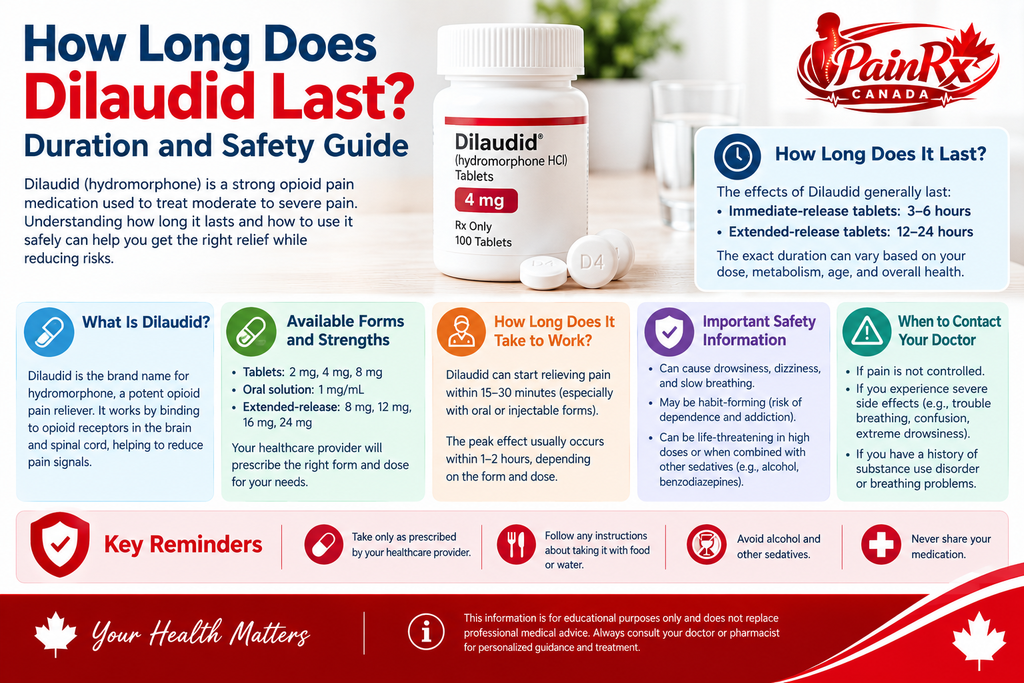
Dilaudid is a powerful prescription opioid, and questions about how long it lasts come up often among patients, caregivers, and anyone managing severe pain under medical supervision. This guide explains the onset, duration, and half-life of Dilaudid across its different forms. It also covers the safety information that matters most for anyone using this medication.
This article provides general information only. It isn’t medical advice, and it doesn’t replace the official prescribing information or guidance from your doctor or pharmacist. Dilaudid is a Schedule II controlled substance with serious risks, including addiction, misuse, and fatal overdose. Only take it exactly as your doctor prescribes it.
What Dilaudid Is
Dilaudid is the brand name for hydromorphone, a strong opioid pain medication. Doctors prescribe it for moderate to severe pain, often when other pain relief options haven’t provided adequate relief. Hydromorphone belongs to the same broad drug class as morphine and oxycodone, though it’s generally considered more potent than morphine on a milligram-for-milligram basis.
Doctors use Dilaudid across several clinical settings. Hospitals commonly administer it for acute, severe pain, including post-surgical recovery. Cancer care teams also prescribe it for cancer-related pain. Some patients receive it for severe chronic pain when other treatments haven’t worked, always under close medical supervision.
How Long Dilaudid Takes to Start Working
Onset time depends heavily on the form of Dilaudid and how a doctor administers it. Immediate-release oral tablets typically begin relieving pain within fifteen to thirty minutes. Injectable forms, given intravenously in a hospital setting, work considerably faster, often within five minutes.
This rapid onset explains why hospitals rely on injectable hydromorphone for acute, severe pain requiring fast relief, such as immediately after surgery. Oral forms suit situations where pain is significant but doesn’t require this same speed of relief.
How Long the Effects of Dilaudid Last
The duration of pain relief varies by formulation, and understanding this matters for anyone using this medication under medical guidance.
| Formulation | Typical Onset | Duration of Pain Relief | Common Use |
|---|---|---|---|
| Immediate-release oral tablet | 15–30 minutes | 4–5 hours | Moderate to severe pain, dosed regularly |
| Oral liquid solution | 15–30 minutes | 4–5 hours | Patients who have difficulty swallowing tablets |
| Extended-release tablet | 6 hours (gradual) | Up to 24 hours | Continuous, around-the-clock chronic pain |
| Intravenous (IV) injection | Within 5 minutes | 4–5 hours | Hospital settings, acute severe pain |
| Subcutaneous injection | 15–30 minutes | 4–5 hours | Palliative and hospice care |
These figures represent general ranges. Your prescriber determines your specific dosing schedule based on your pain severity, other health conditions, and how your body responds to the medication.
Understanding the Half-Life
It has a relatively short elimination half-life, generally between two and three hours in most adults. The half-life refers to how long it takes the body to clear half of the drug from the bloodstream. This shorter half-life partly explains why immediate-release forms need dosing every four to six hours, unlike some longer-acting opioids.
Several factors can extend this half-life, meaning the drug stays in your system longer than average. Reduced liver or kidney function significantly slows how quickly your body processes and eliminates the medication, since these organs handle its metabolism and excretion. Age also plays a role, since older adults often clear medications more slowly than younger adults. This is one reason doctors often start older patients on lower doses.
Factors That Affect How Long Dilaudid Lasts for You
Individual variation in how long Dilaudid lasts can be significant, even between people taking the same dose. Metabolism varies naturally between individuals, affecting how quickly the liver processes the medication.
Body weight and composition can influence how the drug distributes and clears from your system. Liver and kidney health matter considerably, since impairment in either organ can cause the medication to build up or last longer than expected, increasing the risk of side effects. Other medications you’re taking can also speed up or slow down how your body processes hydromorphone, which is why disclosing your full medication list to your doctor and pharmacist matters significantly.
Tolerance developed through regular opioid use can also change how long you perceive the pain-relieving effects lasting, even though the drug’s actual presence in your bloodstream follows a similar pattern regardless of tolerance.
Why Timing and Dosing Intervals Matter
Sticking closely to your prescribed dosing schedule matters for both safety and effective pain control. Taking doses too close together increases the risk of dangerous side effects, including life-threatening respiratory depression, since the medication can accumulate in your system faster than your body clears it.
On the other hand, waiting significantly longer than prescribed between doses isn’t inherently dangerous, but it can allow pain to become poorly controlled, which is sometimes harder to manage than staying ahead of pain with consistent dosing. If your prescribed schedule isn’t managing your pain adequately, or if effects seem to wear off well before your next scheduled dose, contact your prescriber rather than adjusting the dose or timing yourself.
Serious Risks to Understand
Dilaudid carries a Boxed Warning, the strongest warning regulatory agencies require, reflecting the serious risks associated with this medication.
Addiction, abuse, and misuse represent genuine risks, even for patients taking the medication exactly as prescribed. Opioids carry real potential for developing dependence over time.
Life-threatening respiratory depression ranks among the most serious risks, particularly when combined with other substances that slow breathing, or when taken in higher doses than prescribed.
Interactions with alcohol, benzodiazepines, and other central nervous system depressants significantly increase the risk of fatal respiratory depression. This combination causes a substantial share of opioid-related deaths.
Accidental exposure poses a severe risk to children and anyone who isn’t the intended patient. Even a small amount can be fatal to a child, making secure storage essential.
Recognizing an Overdose
Understanding overdose signs can genuinely save a life. Watch for slow, shallow, or stopped breathing, along with extreme drowsiness or an inability to wake up. Pinpoint pupils and bluish or grayish skin, lips, or fingertips also signal a possible overdose.
Call 911 immediately if you suspect an overdose. Naloxone can temporarily reverse an opioid overdose, and many pharmacies sell it without a prescription. Keeping naloxone accessible if you or someone in your household uses this medication represents a genuinely life-saving precaution. Administer it if available while waiting for emergency responders, and stay with the person until help arrives.
Safe Storage and Disposal
Store Dilaudid securely, ideally in a locked location out of reach of children, guests, and anyone else in your household. Given the serious risk of accidental exposure, secure storage isn’t optional.
Never keep unused Dilaudid “just in case” once your treatment ends. Don’t dispose of it in household trash or flush it unless specifically instructed. Many pharmacies offer drug take-back programs designed specifically for safely disposing of controlled substances like this one.
Frequently Asked Questions
Does Dilaudid last longer than morphine?
Immediate-release Dilaudid and immediate-release morphine have broadly similar durations of action, generally in the four-to-five-hour range. However, Dilaudid is considerably more potent milligram for milligram, meaning a much smaller dose produces comparable pain relief.
Why does Dilaudid seem to wear off faster than expected?
Individual metabolism, tolerance, liver and kidney function, and pain severity can all affect how long relief feels like it lasts. If effects consistently wear off earlier than your prescribed schedule anticipates, discuss this with your prescriber rather than taking an extra dose on your own.
Can I take Dilaudid with other pain medications?
Combining Dilaudid with other medications, including other opioids, should only happen under direct medical guidance. Some combinations carry serious risks, particularly with other central nervous system depressants.
Is extended-release Dilaudid the same medication as immediate-release?
Both contain hydromorphone, but they behave very differently in the body. Extended-release formulations release the medication gradually over about twenty-four hours, while immediate-release forms release it quickly and require more frequent dosing.
How long does Dilaudid stay in your system for drug testing purposes?
Standard urine drug tests can generally detect hydromorphone for roughly two to four days after the last dose, though this varies based on individual metabolism, dose, and frequency of use. Blood tests typically detect it for a shorter window, while hair testing can detect use for a considerably longer period.
What should I do if I miss a dose?
Follow the specific guidance your prescriber gave you for missed doses, since this can vary depending on your formulation and treatment plan. Never double up on a dose to make up for a missed one without direct instruction from your doctor.
Talking to Your Doctor
If you have questions about how Dilaudid is working for your specific pain situation, whether effects seem too short, too strong, or inconsistent, bring this directly to your prescriber rather than adjusting your use independently. Pain management often requires fine-tuning over time, and your doctor can adjust your formulation, dose, or schedule based on how your body responds.
Final Thoughts
Dilaudid’s duration of action depends heavily on its formulation, ranging from four to five hours for immediate-release forms to roughly twenty-four hours for extended-release tablets. Understanding onset, duration, and the factors that influence how your body processes this medication can help you use it more safely under your doctor’s guidance. Given its serious risks, including the potential for dependence and life-threatening respiratory depression, Dilaudid requires careful medical supervision throughout treatment, along with secure storage and proper disposal once treatment ends.