

Tylenol 500mg: How Many Can I Take?

Tylenol 500mg: How Many Can I Take? A Canadian Dosage Guide
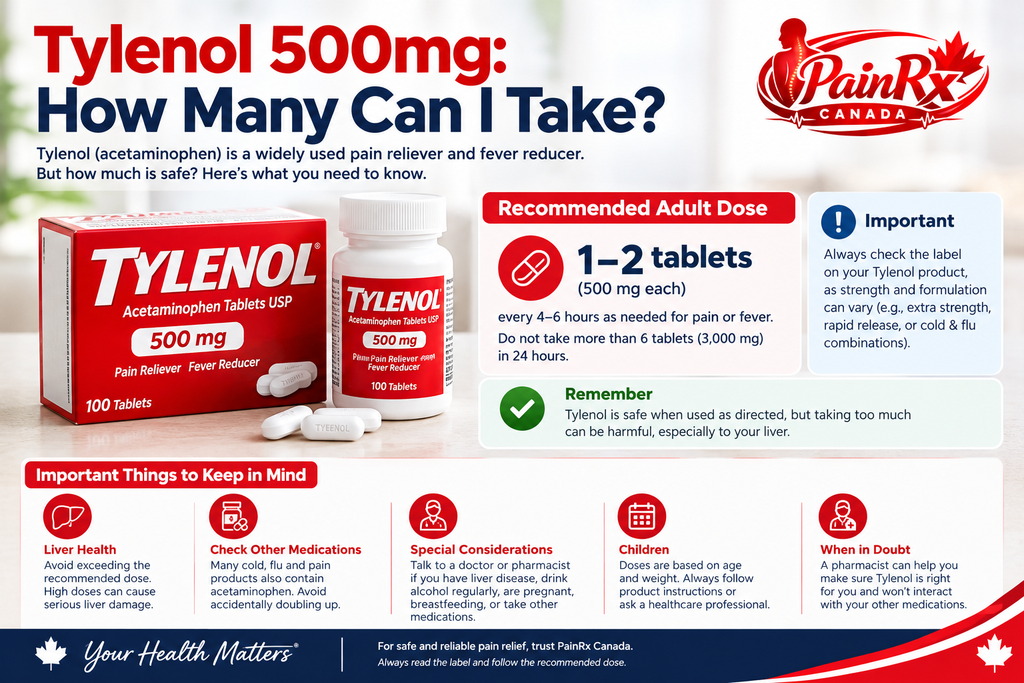
You reach for a Tylenol Extra Strength caplet. It says 500mg on the label. Then the question hits: how many can you actually take? This question matters more than most people realize. Acetaminophen overdose sends over 4,000 Canadians to the hospital every year. This guide breaks down exactly how many 500mg Tylenol tablets are safe, how often to take them, and when to stop and call a doctor.
The Quick Answer
Healthy adults can take one or two Tylenol 500mg tablets every four to six hours. Never exceed eight tablets in 24 hours. That works out to a hard ceiling of 4,000mg per day. Health Canada set this limit after a 2009 label review, and it still applies today. Children, seniors, and anyone with liver concerns need a lower dose. The full breakdown is below.
Tylenol 500mg: The Official Dosing Rules
Tylenol Extra Strength contains 500mg of acetaminophen per caplet. The Canadian label is specific about how to use it. Adults and children 12 and older take one tablet every four to six hours. If one tablet doesn’t relieve the pain or fever, the label allows two tablets at the next dose. Even then, the daily total cannot exceed eight tablets, or 4,000mg.
| Detail | Guideline |
|---|---|
| Strength per tablet | 500 mg acetaminophen |
| Standard adult dose | 1–2 tablets |
| Time between doses | Every 4–6 hours |
| Maximum tablets per day | 8 tablets |
| Maximum daily acetaminophen | 4,000 mg |
| Minimum age for this dose | 12 years and older |
This limit exists for a real reason. Your liver processes acetaminophen. Push past 4,000mg in a day, and you raise your risk of serious, sometimes fatal, liver damage. Health Canada reviewed this exact threshold in 2009 and chose to keep it at 4,000mg, unlike the United States, where Tylenol lowered its own recommended maximum to 3,000mg. Canadian labels still list 4,000mg as the ceiling, so always check your specific product’s packaging first.
How Many Tablets Is That, Really?
Let’s put the math in plain terms. Eight tablets at 500mg each equals exactly 4,000mg. That’s your absolute daily maximum, and it assumes you take no other acetaminophen-containing product that day. Many people don’t realize how many products contain acetaminophen. Cold and flu remedies often include it. So do some sleep aids and prescription painkillers like Tylenol #3 or Percocet. Combining products without checking labels is one of the most common ways Canadians accidentally exceed the safe limit.
| Product Type | Strength | Max Tablets/Day |
|---|---|---|
| Regular Strength Tylenol | 325 mg | 12 tablets |
| Extra Strength Tylenol | 500 mg | 8 tablets |
| Arthritis / Extended Release | 650 mg | 6 tablets |
Before combining anything, read the “medicinal ingredients” section on every box in your medicine cabinet. If acetaminophen appears twice, your daily total climbs faster than you think.
A Sample Safe Dosing Schedule
Spacing your doses correctly matters just as much as the total count. Here’s what a full day of safe, spaced-out dosing might look like for a healthy adult using the maximum allowed amount.
| Time | Dose | Running Total |
|---|---|---|
| 8:00 a.m. | 2 tablets (1,000 mg) | 1,000 mg |
| 2:00 p.m. | 2 tablets (1,000 mg) | 2,000 mg |
| 8:00 p.m. | 2 tablets (1,000 mg) | 3,000 mg |
| 2:00 a.m. (if needed) | 2 tablets (1,000 mg) | 4,000 mg |
This is a general example only. Most people don’t need the full maximum every day. Always use the smallest dose that controls your symptoms, and stop once your pain or fever resolves.
Who Should Take Less Than the Standard Dose
The 4,000mg ceiling assumes a healthy adult with no complicating conditions. Several groups need a lower dose, and some should avoid acetaminophen altogether without medical guidance.
- People with liver disease: The liver breaks down acetaminophen. Existing liver damage lowers your safe threshold significantly, so a doctor should set your personal limit.
- Regular or heavy alcohol users: Alcohol strains the liver in the same way acetaminophen does. Combining the two raises your toxicity risk even at doses that are normally considered safe.
- Older adults: Metabolism slows with age. Seniors often need a reduced dose to stay within a safe margin.
- People under 12: Children require weight-based dosing with a children’s formula, not the adult 500mg tablet. Check the pediatric dosing chart or ask a pharmacist.
- Anyone taking prescription medication: Some prescriptions already contain acetaminophen. Ask your pharmacist before adding Tylenol on top of them.
- People who are malnourished or fasting: Low food intake can reduce the liver’s ability to process acetaminophen safely, so a lower dose is wise.
Warning Signs of Taking Too Much
Acetaminophen overdose doesn’t always cause immediate, obvious symptoms. That delay is exactly what makes it dangerous. Early signs can look mild. Nausea, vomiting, loss of appetite, and sweating can all appear within hours. Without treatment, liver damage can develop over the following one to three days, sometimes without severe symptoms until it’s advanced.
Call a Poison Control Centre or go to an emergency department immediately if you suspect you’ve taken too much. Do this even if you feel fine. This applies whether the overdose was accidental or you simply lost track of your daily total. Every Canadian province has a Poison Control number, and staff can advise you within minutes.
Practical Tips to Stay Within the Safe Range
Keep a simple log of the time and amount for every dose you take in a day. It’s easy to forget an earlier dose once a few hours pass. Set a phone reminder before your next dose is due, rather than relying on memory. Check every medicine label in your house for the word “acetaminophen,” including cold remedies and prescription painkillers. Choose Regular Strength Tylenol over Extra Strength when your pain is mild, since it gives you more flexibility within the daily limit. And always ask a pharmacist if you’re unsure. Canadian pharmacists offer this advice for free, and it takes just a minute at the counter.
Frequently Asked Questions
How many Tylenol 500mg can I take at once? Adults can take one or two tablets at a time, spaced four to six hours apart. Two tablets equal 1,000mg, which is a single standard dose for pain or fever that doesn’t respond to one tablet.
How many Tylenol 500mg can I take in a day? Eight tablets is the absolute maximum, totaling 4,000mg. Most people need far less than this to control their symptoms.
Is 3000mg of Tylenol a day safe? Yes, 3,000mg sits comfortably under the Canadian 4,000mg daily maximum, and many health providers now recommend staying closer to this lower number as a safety margin, especially for regular or prolonged use.
Can I take Tylenol 500mg every 4 hours? The label allows dosing every four to six hours. Taking it every four hours is fine, as long as your total for the day doesn’t exceed eight tablets.
What happens if I accidentally take too much Tylenol? Contact a Poison Control Centre or go to an emergency room right away, even without symptoms. Early treatment dramatically improves the outcome for acetaminophen overdose.
Can I take Tylenol 500mg with Advil? Yes, healthy adults can generally combine acetaminophen and ibuprofen, since they work through different pathways. Each drug’s individual daily maximum still applies.
Is it safe to take Tylenol 500mg every day for a week? Short-term daily use is generally considered low-risk for healthy adults, but a doctor should be consulted if you need Tylenol daily for more than five days for pain, or three days for fever.
The Bottom Line
For most healthy Canadian adults, one to two Tylenol 500mg tablets every four to six hours works well, capped at eight tablets, or 4,000mg, in 24 hours. Track your doses carefully, check every other product for hidden acetaminophen, and use the lowest amount that controls your symptoms. Anyone with liver concerns, a drinking habit, or another medical condition should confirm their personal limit with a doctor or pharmacist before relying on the standard maximum.
This article is for general informational purposes only and is not a substitute for professional medical advice. Always read product labels and consult a doctor or pharmacist regarding your specific health situation before taking any medication.