

Tonmya for Fibromyalgia: Is It Available in Canada Yet?

Tonmya for Fibromyalgia: What Canadians Need to Know
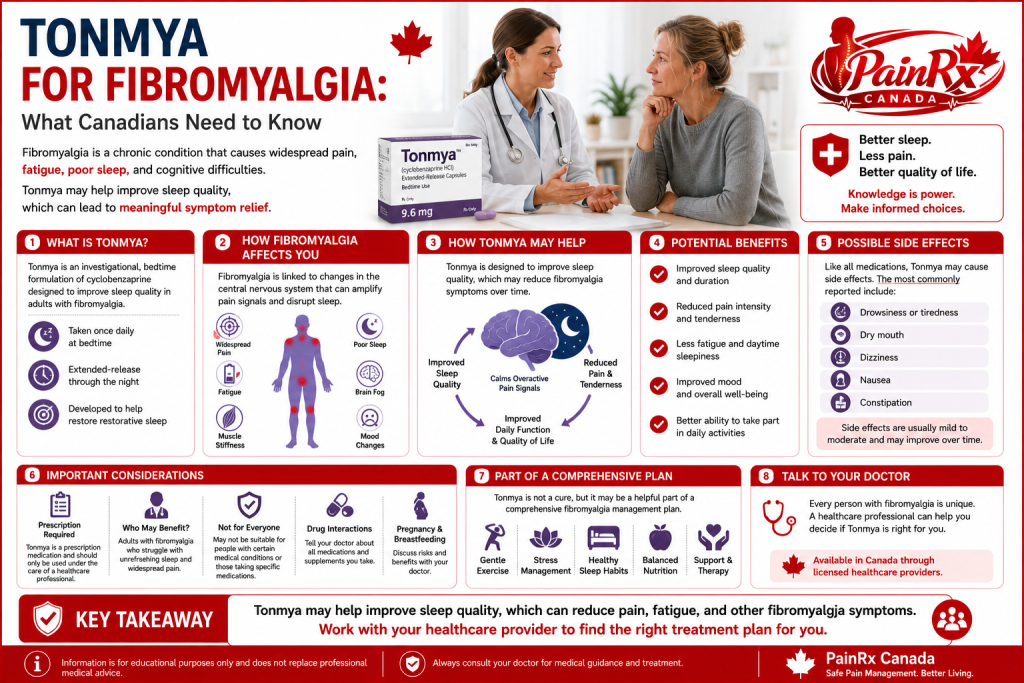
Fibromyalgia patients have waited a long time for new treatment options. In August 2025, that wait produced real news south of the border. The US Food and Drug Administration approved Tonmya, the first new FDA-approved therapy for fibromyalgia in over 15 years. Naturally, many Canadians living with fibromyalgia want to know: is Tonmya available here, and if not, when might it be? This guide covers what Tonmya is, how it works, and where things currently stand for Canadian patients.
This article provides general information only. It isn’t medical advice. Speak with your doctor or a Canadian pharmacist about treatment options suited to your specific situation.
What Is Tonmya?
Tonmya is the brand name for a sublingual formulation of cyclobenzaprine hydrochloride, designed to provide rapid transmucosal absorption. Rather than swallowing a tablet, patients dissolve it under the tongue. This route allows the medication to enter the bloodstream quickly while bypassing some of the liver processing that occurs with standard oral tablets.
Cyclobenzaprine itself isn’t new. Doctors have used it for decades as a muscle relaxant. What makes Tonmya different is its status as the only brand of cyclobenzaprine approved specifically for fibromyalgia, rather than for short-term muscle spasm treatment. Other cyclobenzaprine products, including generic versions, don’t carry this specific approval.
How Tonmya Works
Researchers don’t fully understand the exact mechanism behind Tonmya’s effect on fibromyalgia symptoms. However, pharmacology studies show cyclobenzaprine acts on several receptor systems, including serotonin, adrenergic, histamine, and acetylcholine receptors. These pathways all play roles in how the nervous system processes pain and regulates sleep.
This connection to sleep matters significantly for fibromyalgia treatment. The medication’s developers specifically designed Tonmya as <cite index=”7-1″>a once-daily, non-opioid bedtime treatment</cite>, based on research linking poor sleep quality to worsened fibromyalgia symptoms. Patients take the tablet at night, and <cite index=”2-1″>the sublingual tablet should be administered at bedtime, after brushing teeth and finishing other oral care, with eating or drinking avoided for at least fifteen minutes after the tablet dissolves</cite>.
What the Clinical Trials Showed
Tonmya’s approval rested on substantial clinical evidence. <cite index=”2-1″>Three double-blind, placebo-controlled trials involving 1,474 patients supported the approval, with participants diagnosed using the 2016 American College of Rheumatology criteria for fibromyalgia</cite>. Across these trials, researchers measured whether the medication meaningfully reduced daily pain compared to placebo.
The results were promising. <cite index=”6-1″>Tonmya showed improvement in fibromyalgia pain as early as the first week of treatment, with continued improvement in pain relief, sleep quality, and fatigue over time</cite>. For a condition where treatment options have remained limited for over a decade, this represented a meaningful development for the fibromyalgia community.
Is Tonmya Available in Canada?
This is the question most Canadian fibromyalgia patients want answered directly: not yet. As of mid-2026, Tonmya remains unapproved outside the United States. Tonix Pharmaceuticals, the company behind Tonmya, has indicated interest in expanding beyond the US market. Shortly after the FDA approval was announced, the company’s CEO confirmed that Tonix was considering next steps for Canada, Europe, and Asia.
However, considering a market and receiving regulatory approval are two very different stages. Health Canada requires its own review and approval process before any medication becomes available for prescription in Canada, regardless of FDA approval status in the US. This process typically involves submitting a New Drug Submission, which Health Canada then reviews independently.
Why Health Canada Approval Takes Time
Canadians sometimes wonder why a medication approved by the FDA doesn’t automatically become available in Canada. Health Canada operates as a fully independent regulatory body. It doesn’t simply defer to FDA decisions, even though the two agencies often review similar data and sometimes reach similar conclusions.
Pharmaceutical companies typically need to file a separate submission specifically for the Canadian market, which involves its own timeline, requirements, and review process. Companies often prioritise their largest markets first, meaning a smaller market may wait longer for a formal submission, let alone approval. Given the company’s own stated timeline for exploring Canadian entry, Canadian availability likely remains at least months, and quite possibly longer, away from formal approval.
What Canadians Can Do in the Meantime
While waiting for a potential Canadian approval, Canadian fibromyalgia patients still have several established treatment options available through their existing healthcare system.
Existing approved fibromyalgia medications remain available in Canada, including pregabalin, duloxetine, and other options commonly used to manage fibromyalgia symptoms. These medications have well-established safety and effectiveness records for many patients.
Generic cyclobenzaprine is already available in Canada, though not specifically approved for fibromyalgia. Some doctors may consider off-label use based on individual clinical judgment, though this differs meaningfully from Tonmya’s specific sublingual formulation and its fibromyalgia-focused clinical trial data.
Non-medication approaches continue to play a central role in Canadian fibromyalgia management, including graded exercise, sleep improvement strategies, cognitive behavioural therapy, and multidisciplinary pain clinic support.
Staying informed through your doctor remains the best way to track this medication’s status. As Health Canada submissions and reviews progress, your GP or rheumatologist will generally be aware of new treatment options entering the Canadian market well before public announcements circulate widely.
Should You Try to Access Tonmya From the US?
Some Canadians consider trying to access medications approved elsewhere but not yet available domestically. This carries genuine risks and complications worth understanding clearly. Bringing prescription medication across the border, or ordering it through international pharmacies, involves legal, safety, and practical complexities that vary depending on individual circumstances.
Beyond the legal considerations, there’s also the matter of ongoing medical supervision. A medication like Tonmya requires proper diagnosis, dosing guidance, and monitoring from a prescriber familiar with the product and your health history. Without this oversight, self-directed access to any medication carries meaningful risk. Speaking with your Canadian doctor about your options, including realistic timelines for Canadian approval, remains the safest and most appropriate path forward.
What This Means for the Broader Fibromyalgia Community
Tonmya’s approval matters beyond the specific medication itself. It signals renewed pharmaceutical interest in fibromyalgia treatment after a long period without new options. This approval brought the total number of FDA-approved fibromyalgia medications to four, alongside pregabalin, duloxetine, and milnacipran. For Canadian patients, this broader trend offers reason for cautious optimism, even while the specific medication remains unavailable locally for now.
Final Thoughts
Tonmya represents a genuine advancement in fibromyalgia treatment, backed by substantial clinical trial data and a novel approach targeting sleep and pain together. For Canadian patients, though, it remains an American product for the time being, with no confirmed timeline for Health Canada approval. In the meantime, Canadians living with fibromyalgia have established treatment options worth discussing with their healthcare provider, while keeping an eye on future developments as Tonix Pharmaceuticals potentially pursues expansion into the Canadian market.