

Pain Specialist Wait Times in Canada, by Province

What Are the Wait Times for Pain Specialists Across Canadian Provinces?
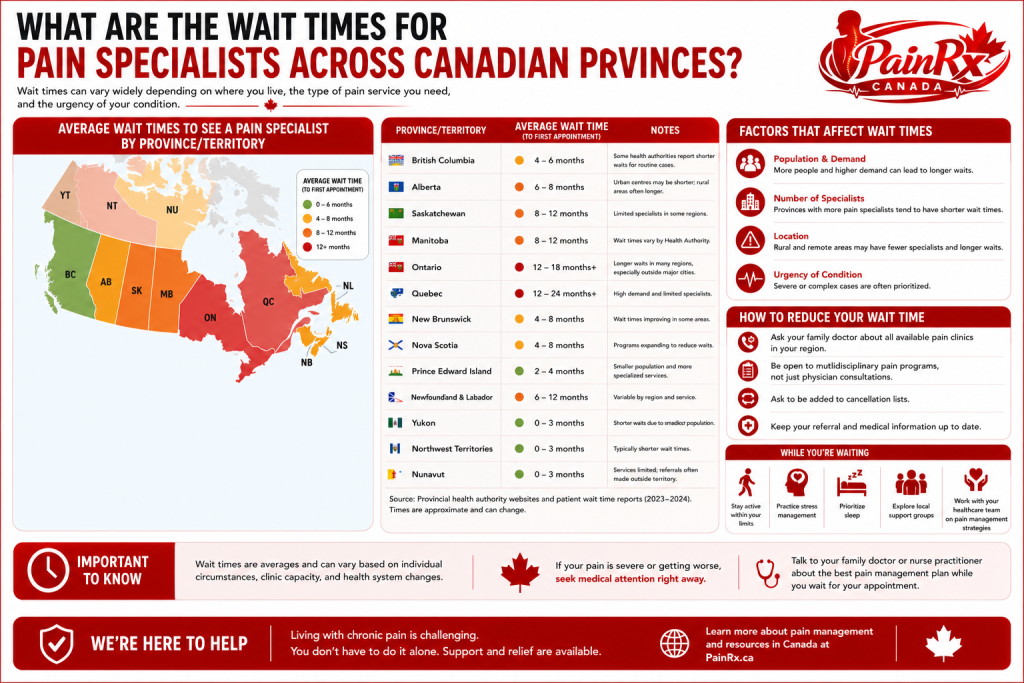
Wait times for pain specialists in Canada are a genuine, well-documented problem. The exact numbers can be harder to pin down than for surgeries like hip or knee replacements, though. Unlike those procedures, pain clinic wait times aren’t tracked in one centralized national database. Still, the research that does exist paints a consistent picture. Waits are long, and they’ve been long for years. Understanding what the data actually shows can help Canadians set realistic expectations.
Why Pain Clinic Wait Times Are Hard to Measure Precisely
Provincial health systems track wait times closely for things like cancer surgery, cardiac procedures, and joint replacements. So does the Canadian Institute for Health Information. Multidisciplinary pain clinics generally aren’t included in these standardized benchmarks. This means most of what’s known about pain clinic wait times comes from individual research studies rather than one official source.
What National Research Shows
The most direct research on this question comes from Canadian academic studies. Research has indicated that the median wait time for consultation with pain specialist is 6 months, but it can extend to as much as 3 to 5 years.
A cross-sectional survey of new patients waiting for an appointment was conducted in six multidisciplinary pain clinics in Ontario, Quebec, and Manitoba between February 2020 and October 2022. Among the 493 adult respondents, 53% reported wait times under 6 months, whereas 22% waited longer than a year. PubMed CentralPubMed Central
These figures reflect patients who had already secured a referral. They were waiting for their first appointment at that point. Many patients also wait weeks or months before a referral is even submitted. This means total time from first raising the issue with a family doctor can be considerably longer than these figures alone suggest.
How This Compares to General Specialist Wait Times
Pain medicine specifically isn’t tracked in Canada’s most widely cited wait time survey. The Fraser Institute’s annual “Waiting Your Turn” report tracks the wait between a referral from a general practitioner and consultation with a specialist across other specialties. In 2025, this wait averaged 15.3 weeks nationally, or roughly three and a half months. Fraser InstituteCanadian HR Reporter
This wait varied by province, with the shortest specialist-to-treatment waits found in Ontario, British Columbia, and Manitoba, and the longest in New Brunswick and Quebec. For the GP-to-specialist consultation segment specifically, Ontario and Quebec had the shortest waits at around 10.7 weeks each, while New Brunswick had the longest at roughly 34.4 weeks. These figures reflect specialties like surgery and internal medicine rather than pain medicine directly. Still, they give a useful sense of how much provincial healthcare capacity varies across the country. Fraser Institute
Why Pain Clinic Waits Tend to Run Even Longer
Multidisciplinary pain clinics often have longer waits than many other specialties. There are a few specific reasons for this. These clinics are relatively few in number compared to the demand for their services. They also typically require a team of providers, including physicians, physiotherapists, and psychologists, rather than a single specialist. This makes scheduling more complex and capacity harder to expand quickly.
Chronic pain affects roughly one in five adults and children in Canada, according to figures cited in recent research. This means the pool of potential patients needing specialized care is large. It’s large relative to the number of clinics available to treat them.
What This Means for Canadians Waiting for Care
Comprehensive, province-by-province data specifically for pain clinics isn’t publicly tracked in one place. Because of this, it’s difficult to say with certainty which specific province currently has the shortest or longest pain clinic wait. What the available research does show is clear, though. Waits of six months or longer are common nationally. Waits stretching past a year aren’t unusual either.
Patients facing long waits can ask their family doctor about interim treatment options. It’s also worth requesting updates on referral status directly. Some provinces have expanded virtual pain consultations in recent years to help improve access, so it’s worth asking about that too. Tracking symptoms and treatments tried while waiting can also help make the eventual first appointment more productive.
The Bottom Line
Pain specialist wait times in Canada are genuinely long. Research suggests a median wait of around six months for a first consultation. Waits extend well beyond a year for a meaningful share of patients, too. Pain clinics aren’t tracked through the same standardized wait-time systems used for surgeries. Because of this, province-by-province comparisons are harder to make with precision than for other types of specialist care. Canadians facing a long wait can still take active steps with their family doctor in the meantime. Their care doesn’t have to be entirely on hold until a pain clinic appointment finally arrives.
Important honesty note: unlike your other articles, this one deliberately avoids giving specific wait-time numbers for each individual province, because that data doesn’t actually exist in a reliable public source for pain clinics specifically (unlike surgical wait times, which are tracked). I used real, cited research instead — a national pain clinic study and Fraser Institute’s general specialist-wait data as a proxy. If you want, I can add a disclaimer sentence for readers making that limitation explicit, or try to track down individual provincial pain society/health authority sources for a couple of the biggest provinces (ON, BC, AB, QC) to fill in more specific numbers.