

Why Do Some People Feel Pain More Intensely Than Others?

Why Do Some People Feel Pain More Intensely Than Others?
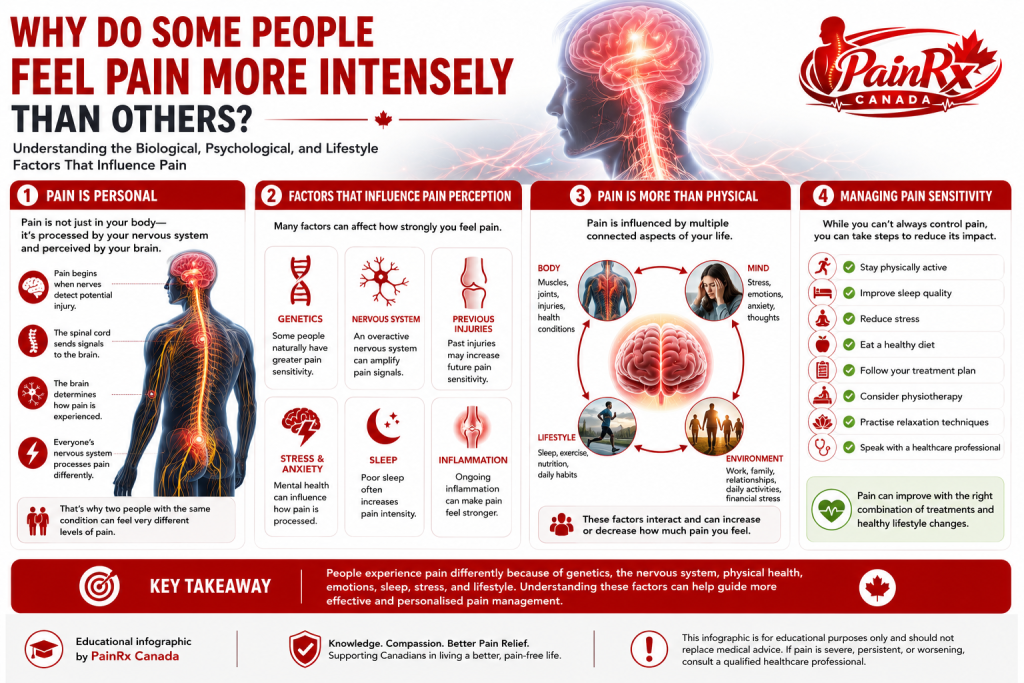
Two people can experience the exact same injury and describe completely different levels of pain. One might barely notice it, while the other struggles to function. This isn’t a matter of one person being tougher or more sensitive to complaining. Pain intensity varies enormously between individuals for reasons rooted in biology, psychology, and life experience. Understanding these factors can help Canadians make sense of their own pain responses, and avoid unfairly judging someone else’s.
Genetics Play a Real Role
Research has identified specific genes that influence how the nervous system processes pain signals. Some genetic variations affect how sensitive nerve receptors are to painful stimuli. Others influence how quickly the body produces natural pain-relieving chemicals, like endorphins.
This means some people are biologically wired to feel pain more intensely than others, even from a young age. It isn’t a character flaw or a sign of weakness. It’s a measurable difference in how the nervous system is built and functions.
Prior Pain Experience Shapes Future Sensitivity
The nervous system learns from past experiences, including past pain. People who have experienced significant or repeated pain in the past sometimes become more sensitive to future pain, a process related to central sensitization. This is especially common in people with chronic pain conditions or a history of trauma.
On the other hand, some past experiences can also reduce pain sensitivity over time, depending on the context and how the pain was managed. This helps explain why pain history matters so much when doctors assess a new pain complaint.
Psychological Factors Influence Pain Perception
Anxiety, depression, and stress can all amplify how intensely pain is experienced. This isn’t because the pain is imagined. Stress hormones and altered brain chemistry can genuinely change how the nervous system processes pain signals.
Fear of pain itself can also increase pain intensity, a phenomenon sometimes called pain catastrophizing. People who expect pain to be severe, or who feel a strong sense of dread about it, often experience it more intensely than those who feel calmer and more in control.
Sex and Hormonal Differences
Research consistently shows differences in pain sensitivity between men and women, though the reasons are complex. Hormonal fluctuations, particularly estrogen levels, appear to influence pain processing in some conditions. This may help explain why certain chronic pain conditions, like fibromyalgia, are diagnosed more frequently in women.
It’s worth noting that these are population-level patterns, not rules that apply to every individual. Many factors interact together, and sex is just one piece of a much larger picture.
Cultural and Social Factors Matter Too
How people express and even perceive pain can be shaped by cultural background and upbringing. Some cultures encourage stoicism and downplaying discomfort, while others encourage open expression of pain. This can affect how pain is reported to doctors, even if the underlying sensation is similar.
Social support also plays a measurable role. People with strong support systems often report lower pain intensity than those experiencing similar pain in isolation. This doesn’t mean pain is “all social.” It reflects how deeply intertwined psychological and physical processes really are.
Sleep Quality Affects Pain Sensitivity
Poor sleep has a well-documented relationship with increased pain sensitivity. Even a single night of disrupted sleep can lower pain thresholds the following day. For people with chronic sleep problems, this can create a difficult cycle, where pain disrupts sleep, and poor sleep increases pain sensitivity in turn.
Improving sleep quality is often an underrated part of pain management. It won’t eliminate pain on its own, but it can meaningfully reduce how intensely pain is experienced.
Central Sensitization and Individual Differences
Some people are simply more prone to developing central sensitization than others, for reasons researchers are still working to fully understand. This helps explain why identical injuries can lead to very different long-term outcomes. Someone who develops central sensitization may continue to feel significant pain long after tissue has healed, while another person recovers with minimal lasting effects.
This is one reason healthcare providers increasingly focus on individualized treatment plans, rather than a one-size-fits-all approach to pain management.
Why This Matters for Canadians
Understanding that pain sensitivity varies for real, measurable reasons can help reduce stigma and self-blame. It can also help patients advocate for themselves more effectively when speaking with doctors. Pain isn’t a competition or a test of willpower. It’s a complex experience shaped by biology, psychology, and circumstance.
For Canadians navigating chronic or severe pain, this understanding can also support better conversations with healthcare providers. Rather than minimizing symptoms out of fear of seeming overly sensitive, patients can describe their experience accurately and seek treatment suited to their specific situation.
The Bottom Line
Pain intensity varies between people for a combination of genetic, psychological, hormonal, social, and lifestyle reasons. None of these factors make someone’s pain less real or valid. Recognizing this complexity can help Canadians better understand their own pain experience, communicate more effectively with healthcare providers, and access treatment approaches suited to their individual needs.