

What Is the Penthrox Inhaler Used For?

What Is the Penthrox Inhaler Used For? A Canadian Guide to the Green Whistle
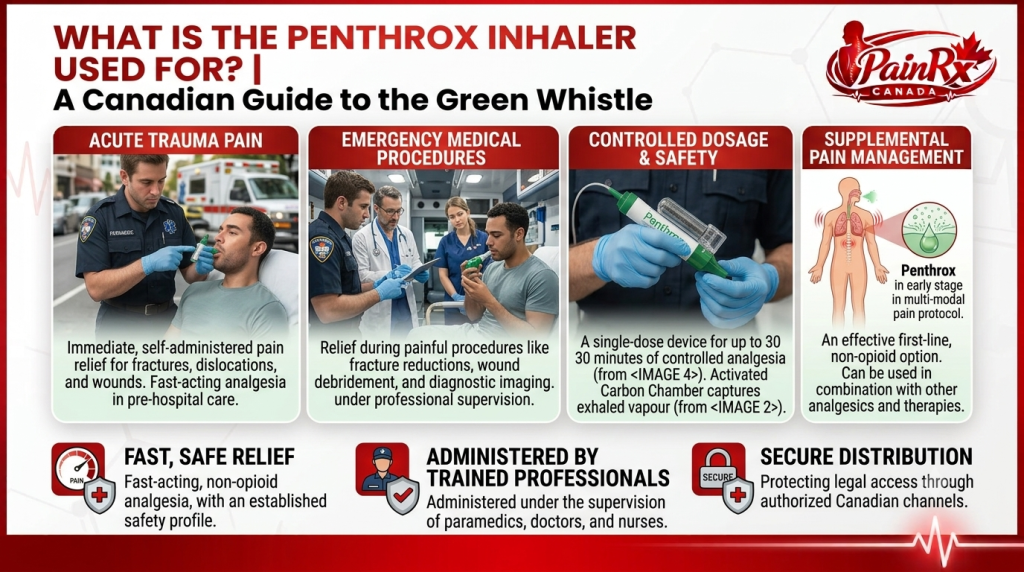
Imagine you are enjoying a family ski trip in British Columbia’s Whistler Blackcomb mountains. Suddenly, a family member takes a bad fall and suffers a suspected broken leg. The pain is severe, and help is on the way. When the paramedics arrive, they reach for a small, green plastic device and place it in your loved one’s mouth. Within minutes, the pain begins to subside. This device is the Penthrox inhaler, often called the “green whistle.”
Understanding what the Penthrox inhaler is used for can help Canadians feel more informed and less anxious about emergency medical care. Whether you are a patient, a caregiver, or a curious member of the public, knowing the applications of this innovative pain relief tool is valuable.
This comprehensive guide will explain the medical uses of the Penthrox inhaler, its benefits in various healthcare settings, and its specific role within the Canadian healthcare system. We will explore when healthcare professionals use it, why they choose it over other options, and what patients can expect during treatment.
Understanding the Penthrox Inhaler
Before we explore its specific uses, it is helpful to understand what the Penthrox inhaler actually is. As we have discussed in previous guides, the Penthrox inhaler is a small, portable, handheld device that delivers methoxyflurane, a potent inhalational analgesic. It is designed for the self-administration of pain relief in acute, emergency situations.
The device is lightweight, disposable, and does not require any external power source, oxygen supply, or bulky machinery. These features make it ideal for use in pre-hospital settings like ambulances, as well as in busy hospital emergency departments. Its distinctive green colour has earned it the nickname “the green whistle.”
What is Methoxyflurane?
Methoxyflurane is the active ingredient in the Penthrox inhaler. It is a halogenated hydrocarbon that acts as a central nervous system depressant. At the low doses used in the inhaler, it provides powerful analgesia (pain relief) without causing full unconsciousness or significant respiratory depression.
Importantly, methoxyflurane is a non-opioid painkiller. This means it does not carry the same risks of addiction, dependence, and respiratory depression associated with opioid medications like morphine or fentanyl. This makes it a safer alternative for many patients.
What Is the Penthrox Inhaler Used For?
The Penthrox inhaler is specifically indicated for the management of moderate to severe acute pain in patients who are conscious and able to self-administer the medication. Let us explore the specific medical applications in detail.
Acute Traumatic Pain
The primary use of the Penthrox inhaler is for the short-term relief of pain resulting from trauma. This includes injuries such as:
- Fractures (Broken Bones): Penthrox is highly effective for managing the intense pain associated with broken bones, whether it is a fractured arm, leg, or ribs.
- Dislocations: When a joint becomes dislocated, such as a shoulder or knee, the pain is often excruciating. Penthrox provides rapid relief while healthcare professionals prepare to reduce (relocate) the joint.
- Burns: Burns can cause severe pain, especially during the initial assessment and wound cleaning. Penthrox provides effective analgesia without the need for intravenous access.
- Soft Tissue Injuries: Severe lacerations, muscle tears, and other soft tissue injuries can also benefit from Penthrox’s rapid pain relief.
- Sprains and Strains: While less severe, some significant sprains and strains may require strong pain relief, and Penthrox can be a suitable option.
Pain Associated with Procedures
In addition to trauma, healthcare professionals use the Penthrox inhaler to manage pain during certain medical procedures. These include:
- Fracture Reduction: The process of setting a broken bone can be extremely painful. Penthrox provides effective analgesia during this procedure, allowing healthcare professionals to work more efficiently and with less patient distress.
- Dislocation Reduction: Similarly, relocating a dislocated joint requires significant pain relief. Penthrox allows patients to tolerate the procedure with minimal discomfort.
- Wound Debridement: Cleaning and removing dead tissue from a wound can be painful. Penthrox can provide effective pain relief during this process.
- Suturing (Stitching): For large or deep lacerations, Penthrox can provide pain relief while the healthcare professional stitches the wound.
- Abscess Drainage: Draining an infected abscess can be painful. Penthrox can help manage the pain during this procedure.
Use in Different Healthcare Settings
The Penthrox inhaler has a wide range of applications across various healthcare settings in Canada.
| Setting | Common Uses |
|---|---|
| Ambulances (Pre-Hospital) | Trauma from motor vehicle accidents, falls, sports injuries, burns, fractures, dislocations |
| Emergency Departments | Fracture reduction, dislocation reduction, burn care, wound debridement, suturing |
| Urgent Care Centres | Minor fractures, dislocations, wound management |
| Sports Medicine Clinics | Acute sports injuries, fracture reduction, dislocation reduction |
| Remote and Occupational Clinics | Injuries in remote locations, industrial accidents, workplace injuries |
Benefits of Using Penthrox
Healthcare professionals in Canada choose Penthrox for several important reasons:
- Rapid Onset of Action: Pain relief typically begins within 2 to 4 minutes of the first inhalation. This is significantly faster than oral medications and comparable to intravenous opioids.
- Non-Invasive Administration: No needles are required. This is particularly beneficial for patients who are needle-phobic or when gaining IV access is difficult.
- Patient-Controlled Dosing: The patient controls how much medication they receive, taking only as much as they need. This reduces the risk of overdose and allows for individualised pain management.
- Non-Opioid: Penthrox does not contain opioids. This eliminates the risks of addiction, dependence, and respiratory depression associated with opioid medications.
- Minimal Sedation: Patients often remain awake, alert, and communicative while using Penthrox. This is crucial for medical assessments and patient cooperation.
- Portability and Ease of Use: The device is small, lightweight, and does not require any external power or oxygen supply. This makes it ideal for use in ambulances and other pre-hospital settings.
How Penthrox Compares to Other Pain Relief Options
Understanding what Penthrox treats also involves comparing it to other common pain relief options used in Canadian emergency medicine.
Penthrox vs. Opioids (Morphine, Fentanyl)
The most significant difference is that Penthrox is a non-opioid. While opioids like morphine and fentanyl work by binding to opioid receptors in the brain, Penthrox works through a completely different mechanism.
| Feature | Penthrox | Opioids |
|---|---|---|
| Mechanism of Action | Central nervous system depressant | Binds to opioid receptors |
| Risk of Addiction | Very low | High |
| Risk of Respiratory Depression | Low | High |
| Sedation | Mild | Moderate to severe |
| Administration | Inhaled (self-administered) | Usually IV or oral |
| Needles Required | No | Often yes (for IV) |
Penthrox vs. Entonox (Nitrous Oxide)
Entonox is a mixture of nitrous oxide and oxygen, also used for pain relief in emergency settings. Both are inhaled gases, but key differences separate them.
| Feature | Penthrox | Entonox |
|---|---|---|
| Active Ingredient | Methoxyflurane | Nitrous Oxide + Oxygen |
| Delivery System | Small, portable, disposable device | Requires a large cylinder and delivery system |
| Portability | Excellent | Poor |
| Onset of Action | 2-4 minutes | 1-2 minutes |
| Duration of Action | 15-20 minutes (per breath) | 2-3 minutes (after stopping inhalation) |
Penthrox vs. Oral Pain Relievers
Oral pain relievers like ibuprofen, acetaminophen, or oral opioids are commonly used for pain management. However, they have several disadvantages compared to Penthrox.
| Feature | Penthrox | Oral Pain Relievers |
|---|---|---|
| Onset of Action | 2-4 minutes | 30-60 minutes |
| Route of Administration | Inhaled | Oral (by mouth) |
| Patient Control | Yes (self-administered) | No (fixed dose) |
| Suitability for Severe Pain | Yes | Limited |
What Patients Can Expect When Using Penthrox
If you or a loved one receives Penthrox in an emergency setting, understanding the process can help reduce anxiety and ensure effective pain relief.
Before Administration
A healthcare professional will assess you to determine if Penthrox is appropriate. This assessment includes:
- Medical History: The healthcare professional will ask about your medical history, including any kidney or liver problems, respiratory conditions, or allergies.
- Vital Signs: They will check your heart rate, blood pressure, and oxygen saturation.
- Pain Assessment: They will ask you to rate your pain on a scale of 0 to 10 to establish a baseline.
During Administration
The healthcare professional will prepare the device by snapping the glass ampoule to release the liquid methoxyflurane into the wick. They will then hand you the device and guide you on how to use it.
You should:
- Place the mouthpiece in your mouth and close your lips around it.
- Take a slow, deep breath, inhaling the vapours deeply into your lungs.
- Hold your breath for a few seconds.
- Exhale slowly.
- Continue to take breaths as needed for pain. You are in control of how much you take.
The healthcare professional will monitor your vital signs and pain levels throughout the process.
After Administration
After you stop using the device, the pain relief will gradually wear off. The healthcare professional will continue to monitor you and may offer alternative pain relief if needed. You should not drive or operate machinery for at least 24 hours after receiving Penthrox.
Frequently Asked Questions
To further assist Canadians, we have provided answers to the most frequently asked questions about what the Penthrox inhaler treats.
Can Penthrox Be Used for Chronic Pain?
No, Penthrox’s indication strictly limits it to the short-term management of moderate to severe acute pain, such as that caused by trauma or injury. It is not suitable for chronic pain conditions like arthritis, back pain, or neuropathy.
Is Penthrox Used for Dental Pain?
Clinicians do not typically use Penthrox in dental settings. Dentists usually use other forms of analgesia and anaesthesia for dental procedures. However, in emergency situations involving dental trauma, clinicians may use Penthrox in a hospital or ambulance setting.
Can Penthrox Be Used for Post-Surgical Pain?
In some cases, healthcare professionals may use Penthrox for post-surgical pain, particularly in the immediate recovery period. However, clinicians more commonly use it for pain resulting from trauma or during procedures.
Is Penthrox Used for Headaches?
No, clinicians do not use Penthrox for headaches or migraines. Clinicians only use it for acute, traumatic pain.. Headaches require different types of treatment.
Can Penthrox Be Used in Children?
In Canada, health authorities have approved Penthrox for use in adults and children over the age of 18. Health authorities have not approved it for use in children under 18 years of age.
Conclusion
The Penthrox inhaler is a versatile and valuable tool in Canadian emergency medicine. Healthcare professionals primarily use it to manage moderate to severe acute pain resulting from trauma, including fractures, dislocations, burns, and soft tissue injuries. Additionally, they use it to manage pain during medical procedures such as fracture reduction, wound debridement, and suturing.
Its rapid onset of action, non-invasive administration, patient-controlled dosing, and non-opioid nature make it a preferred choice for many healthcare professionals. Penthrox is available in ambulances, hospital emergency departments, urgent care centres, and occupational health settings across Canada.
Understanding what the Penthrox inhaler treats empowers Canadians to make informed decisions about their healthcare. It reassures Canadians that our healthcare system has access to innovative, effective, and safe pain relief options when they need them most.
FAQs
1. Can Penthrox be used for pain from a heart attack?
No, Penthrox is not indicated for cardiac pain (pain from a heart attack). Patients with chest pain require immediate medical assessment and specific treatments. Penthrox is used for traumatic pain, not for internal organ pain.
2. Can I request Penthrox if I am in an emergency department?
You can certainly discuss pain relief options with your healthcare provider. They will assess your condition and determine the most appropriate pain management strategy, which may include Penthrox if clinical indications support its use.
3. Is Penthrox used in Canadian military medicine?
Yes, the Canadian Armed Forces uses Penthrox in its medical units for field use. Its portability and ease of use make it ideal for military environments and remote locations.
4. Can Penthrox be used for pain during childbirth?
Clinicians do not typically use Penthrox for pain during labour and delivery. There are other, more established options for pain management in childbirth, such as epidurals and nitrous oxide.
5. How long does the pain relief from Penthrox last?
The pain relief from a single inhalation typically lasts for 15 to 20 minutes. Because manufacturers designed the device for intermittent use, patients can take additional breaths as the pain returns, up to a total treatment time of 60 minutes.