

What Medicine is in the Green Whistle?

What Medicine is in the Green Whistle? Understanding the Active Ingredient in Penthrox
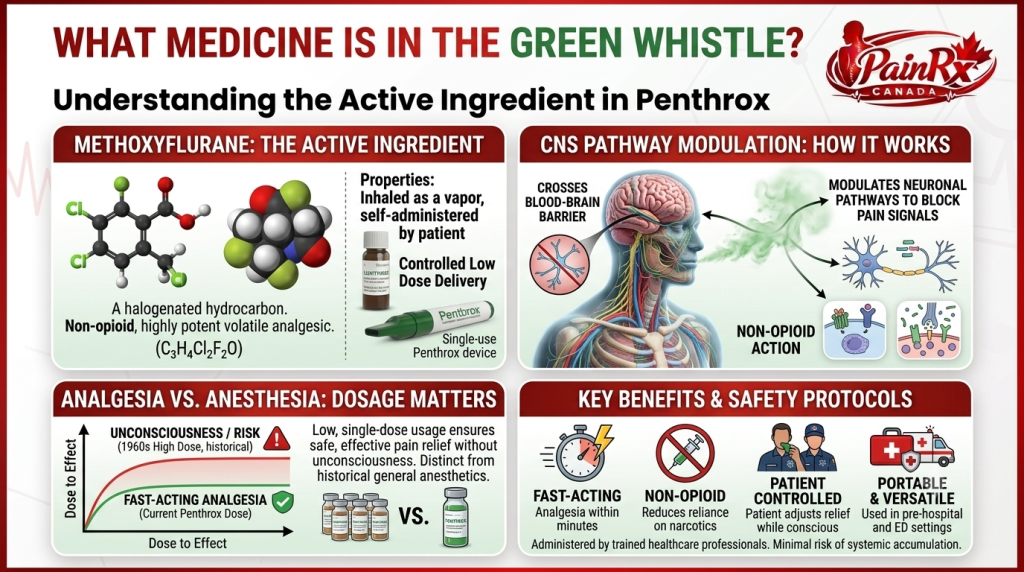
If you have ever seen a Canadian athlete, soldier, or trauma patient inhale from a small green device, you have probably wondered what is inside it. That distinctive device is called the “green whistle,” and the medicine it delivers is a powerful, fast-acting pain reliever. Here is a straightforward explanation of what it contains and how it works.
The Active Ingredient: Methoxyflurane
The green whistle contains methoxyflurane, a potent inhaled medication that provides rapid pain relief. Methoxyflurane is a type of anaesthetic medicine. The green whistle, however, delivers a significantly lower dose than surgeons use to put a patient to sleep for surgery. Instead, at this lower dose, it acts as a strong analgesic (painkiller), effectively reducing pain without causing unconsciousness.
The Brand Name: Penthrox
You will often hear the green whistle referred to by its brand name, Penthrox. The device delivers a 3 mL dose of liquid methoxyflurane, which is 99.9% pure. The medicine vaporises as you breathe through the inhaler, and your lungs then absorb the vapour into your bloodstream.
Key Characteristics of the Medicine
- Rapid Onset: Pain relief begins quickly, often within a few minutes.
- Self-Administered: You are in control; you hold the device and breathe in the vapour as needed.
- Short-Acting: The pain relief from each dose is relatively short, lasting about 15 to 20 minutes, but the device can be used intermittently for up to an hour.
- Non-Opioid: It works differently from narcotic painkillers and does not carry the same risk of addiction or respiratory depression.
Use in Canada
In Canada, Health Canada approved Penthrox for use in 2022. Paramedics and emergency physicians across the country now use it to manage moderate to severe acute pain from injuries like fractures, dislocations, and burns. Because it does not require needles or intravenous access, it is particularly valuable in pre-hospital settings.
How Methoxyflurane Works in the Body
When you inhale methoxyflurane vapour, the drug rapidly absorbs through the alveoli in your lungs into your bloodstream. It then travels to your brain, where it acts on the central nervous system. Scientists believe methoxyflurane works by:
- Interacting with Neurotransmitters: It may inhibit the release of certain excitatory neurotransmitters while enhancing the activity of inhibitory ones. This reduces the transmission of pain signals.
- Modulating Ion Channels: It affects ion channels in nerve cells, which are responsible for transmitting pain signals. By modulating these channels, methoxyflurane reduces pain signal transmission to the brain.
- Depressing the Central Nervous System: It acts as a mild central nervous system depressant, which reduces overall brain activity and, consequently, the perception of pain.
This combination of effects results in rapid and significant pain relief. Importantly, at the low doses used in the green whistle, the drug does not cause the significant respiratory depression or heavy sedation associated with opioids.
Common Questions About the Medicine
Is Methoxyflurane the Same as Nitrous Oxide?
No, methoxyflurane is different from nitrous oxide (“laughing gas”). While both are inhaled gases used for pain and anxiety, they have distinct differences. Nitrous oxide requires a regulated gas supply, often delivered with oxygen, and can cause more significant euphoria and sedation. Methoxyflurane, by contrast, is a vapour from a liquid, does not require oxygen delivery, and provides more pure analgesia with less sedation.
Is Methoxyflurane an Opioid?
No, methoxyflurane is not an opioid. It belongs to a completely different class of drugs called halogenated hydrocarbons. It provides pain relief without acting on opioid receptors in the brain. This is why it does not carry the same risks of addiction, dependence, or respiratory depression associated with opioids.
Is Methoxyflurane Safe for the Kidneys?
At the low doses used in the green whistle, clinicians consider the risk of kidney toxicity very low. However, the drug does process through the kidneys, so patients with pre-existing kidney conditions should not use it. Healthcare professionals screen patients for kidney problems before administering Penthrox.
How Is Methoxyflurane Cleared from the Body?
After the drug exerts its effects, the liver metabolises (breaks down) methoxyflurane. The breakdown products then leave the body through the kidneys in the urine. The majority of the drug clears from the body within 4 to 6 hours. This rapid clearance explains why the effects of Penthrox are short-lived and why manufacturers designed the device for intermittent use.
Why Is Methoxyflurane Called the “Green Whistle”?
The device is intentionally coloured green for practical reasons. Its bright green colour makes it easily identifiable to medical professionals, especially in emergencies. It helps prevent it from being mistaken for other medical equipment or devices. The “whistle” part of the nickname comes from the sound the device can make when the patient inhales.
The History of Methoxyflurane
Developers first created methoxyflurane in the 1940s, and surgeons initially used it as a general anaesthetic for surgery. However, at the high doses required for anaesthesia, clinicians observed significant side effects, particularly kidney toxicity. As safer anaesthetic agents emerged, they replaced methoxyflurane for surgical use.
In the 1970s, researchers discovered that at much lower doses, methoxyflurane provided excellent pain relief without the same level of toxicity. This led to the development of the Penthrox inhaler, which delivers a precise, low dose of the drug. The device first appeared in Australia and New Zealand and has since gained adoption in many countries, including Canada.
Conclusion
The green whistle, or Penthrox inhaler, contains methoxyflurane, a non-opioid analgesic that provides rapid, effective pain relief for acute injuries. Its unique mechanism of action, rapid onset, and patient-controlled dosing make it a valuable tool in Canadian emergency medicine. While you cannot buy it for home use, you can rest assured that if you or a loved one experiences a traumatic injury, Canadian paramedics and emergency physicians have access to this innovative pain relief solution.
FAQs
1. Is methoxyflurane addictive?
No, methoxyflurane is not considered addictive. It does not act on the opioid receptors in the brain, which are responsible for the addictive properties of opioids like morphine and fentanyl.
2. Can I buy methoxyflurane over the counter?
No, methoxyflurane is a prescription-only medication in Canada. It is classified as a Schedule F drug and is only available through healthcare professionals in emergency settings.
3. Does methoxyflurane have a smell?
Yes, many patients describe the smell of methoxyflurane as being pleasant or fruity, similar to a sweet solvent. The device is called the “green whistle” because of its colour, not its smell.
4. Is methoxyflurane used in veterinary medicine?
Yes, methoxyflurane has been used in veterinary medicine as an anaesthetic for animals. However, its use in human medicine is specifically for analgesia at low doses.
5. How is methoxyflurane different from general anaesthesia?
Methoxyflurane at the dose used in the green whistle provides analgesia (pain relief) without causing unconsciousness. General anaesthesia, by contrast, induces a state of controlled unconsciousness and loss of all sensation.