

Topical Pain Relief vs. Oral Medication: Which is better for knee pain?

Topical Pain Relief vs. Oral Medication: Which is better for knee pain?
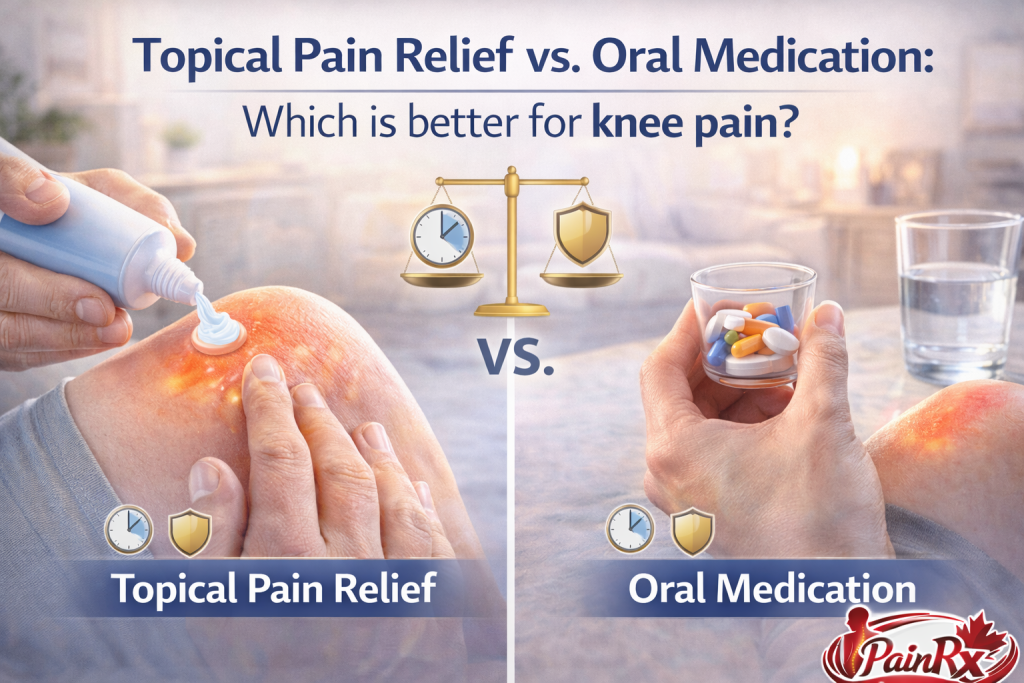
Your knee hurts. Maybe it is arthritis that flares with weather changes. Maybe you overdid it at the gym. Maybe it is the lingering result of an old injury. You stand in the pharmacy aisle or browse online, faced with a fundamental choice: do you reach for a tube of cream or a bottle of pills? The question of topical pain relief vs oral medication for knee pain is one of the most common dilemmas in pain management. Both options have passionate advocates. Both have scientific evidence behind them. The right choice depends on your specific situation.
Understanding the Basic Difference
The fundamental difference between topical and oral medications is how they reach your pain. Oral medications are swallowed. They enter your digestive system, are absorbed into your bloodstream, and travel throughout your entire body. This is called systemic delivery. The medication reaches your knee, but it also reaches your stomach, liver, kidneys, and brain.
Topical medications are applied directly to the skin over your painful knee. They are absorbed through the skin and penetrate into the underlying tissues: the muscles, tendons, and joints beneath. Very little enters your bloodstream. This is called localized delivery. The medication goes where it is needed most, with minimal effects elsewhere.
This basic difference drives everything else. When comparing topical pain relief vs oral medication for knee pain, you are really comparing targeted local action versus whole-body distribution.
Types of Topical Pain Relievers
Topical pain relievers come in many forms: gels, creams, ointments, patches, and sprays. They contain different active ingredients that work through various mechanisms.
NSAID gels are among the most common. These contain anti-inflammatory drugs like diclofenac (Voltaren), ibuprofen, or ketoprofen. They work by reducing inflammation in the tissues just beneath the skin. They are absorbed locally and reach the knee joint in therapeutic concentrations.
Counterirritants contain ingredients like menthol, camphor, or methyl salicylate. They create a cooling or warming sensation that distracts the brain from pain signals. They do not reduce inflammation but can provide rapid symptomatic relief.
Capsaicin comes from chili peppers. It depletes a chemical called substance P that transmits pain signals. It takes several days to work but can be effective for arthritis and nerve pain.
Lidocaine is a local anesthetic. It numbs the area by blocking nerve signals. It is available over the counter in patches or creams.
Each type has its place in the debate over topical pain relief vs oral medication for knee pain.
Types of Oral Pain Medications
Oral medications also come in several classes, each with different mechanisms and effects.
NSAIDs like ibuprofen (Advil), naproxen (Aleve), and prescription celecoxib reduce inflammation throughout the body. They are effective for arthritis and inflammatory pain but affect the stomach, kidneys, and cardiovascular system.
Acetaminophen (Tylenol) relieves pain but has little anti-inflammatory effect. It is processed by the liver and is gentler on the stomach than NSAIDs.
Opioids like codeine, tramadol, and morphine are potent pain relievers but carry risks of sedation, dependence, and addiction. They are typically reserved for severe pain not responding to other treatments.
Muscle relaxants may help if knee pain involves muscle spasm, but they cause significant drowsiness.
Understanding these options helps frame the comparison of topical pain relief vs oral medication for knee pain.
Speed of Relief: Which Works Faster?
When your knee hurts, you want relief now. How do the options compare?
Topical NSAIDs can work relatively quickly. The medication absorbs through the skin and reaches local tissues within 30 to 60 minutes. The cooling or warming effect of counterirritants is almost immediate, though this is sensory distraction rather than true pain relief.
Oral medications must be swallowed, digested, and absorbed into the bloodstream. They then must circulate to the knee. This process typically takes 30 minutes to two hours, depending on the drug and whether you have eaten.
For very rapid relief of acute knee pain, a topical counterirritant may provide the fastest subjective relief. For sustained anti-inflammatory effect, both routes take about an hour to become fully effective. In the race of topical pain relief vs oral medication for knee pain, the topical option often wins for immediate sensation, while both are similar for true pain relief.
Efficacy: Which Works Better?
The effectiveness question depends heavily on the type and depth of your knee pain.
For superficial knee pain involving skin, soft tissues, or mild arthritis, topical NSAIDs are surprisingly effective. High-quality studies show that topical diclofenac is as effective as oral NSAIDs for knee osteoarthritis. A landmark study found that both routes provided similar pain relief, but the topical route had far fewer side effects.
For deeper pain, such as from the hip joint or internal knee structures, oral medications may penetrate better. The bloodstream carries medication everywhere, including deep joints. Topical medications penetrate only about one to two centimeters. They reach the knee joint itself but may not reach deeper structures as effectively.
For inflammatory conditions like rheumatoid arthritis, oral NSAIDs may be more reliable because they achieve consistent blood levels throughout the body. However, topical NSAIDs still provide benefit.
The question of topical pain relief vs oral medication for knee pain often comes down to matching the treatment to the pain depth and type.
Safety Comparison: Side Effects Matter
This is where topical medications have a significant advantage. Because they act locally and enter the bloodstream minimally, they avoid most systemic side effects.
Oral NSAIDs carry well-documented risks. They can irritate the stomach lining, causing heartburn, ulcers, and bleeding. They can affect kidney function. They can increase blood pressure. They carry cardiovascular risks, especially with long-term use. For older adults or those with health conditions, these risks are significant.
Topical NSAIDs avoid most of these problems. Studies show that topical diclofenac has minimal effects on the stomach or kidneys. Blood levels are only about five percent of those achieved with oral doses. The main side effects are skin reactions: redness, itching, or rash at the application site.
Oral opioids carry risks of sedation, constipation, dependence, addiction, and respiratory depression. Topical options have none of these risks.
Acetaminophen is generally safe but can cause liver damage with high doses or with alcohol use. Topical alternatives avoid this entirely.
For safety-conscious patients, the comparison of topical pain relief vs oral medication for knee pain often favors topicals.
Convenience and Practicality
Oral medications are simple: swallow a pill with water. They require no mess, no staining of clothes, and no planning. You can take them anywhere.
Topical medications require application to the skin. You need clean hands. You need to wait for the product to absorb before dressing. Some products have strong odors. Some can stain clothing. You cannot easily apply them in public.
However, topicals offer flexibility. You can apply them exactly where it hurts. You can reapply as needed, within dosing limits. You can combine them with other treatments.
Oral medications require remembering to take them on schedule. Missing a dose means losing coverage. With topicals, you can respond to pain as it arises.
In the practical comparison of topical pain relief vs oral medication for knee pain, oral wins for sheer convenience, but topicals win for targeted, on-demand use.
Cost Considerations
Cost matters, especially for chronic conditions requiring long-term treatment.
Many topical NSAIDs are available over the counter. Voltaren (diclofenac) gel is widely available without prescription. Prices vary but are generally reasonable. However, topical products are used up faster than pills. A tube may last weeks, not months.
Oral NSAIDs are inexpensive, especially generic ibuprofen or naproxen. A bottle of hundreds of pills costs relatively little. However, the hidden costs of side effects must be considered. Stomach medications, doctor visits, and treatments for complications add up.
Prescription topicals and oral medications have similar costs under insurance. Without insurance, topicals may be more expensive.
When weighing topical pain relief vs oral medication for knee pain, consider both immediate out-of-pocket costs and potential long-term healthcare costs from side effects.
Knee Osteoarthritis: The Evidence
Knee osteoarthritis is one of the most common reasons for this comparison. The evidence strongly supports both options, with important nuances.
Clinical practice guidelines from major rheumatology organizations recommend topical NSAIDs as first-line treatment for knee osteoarthritis, especially in patients over 75 or those at high risk for oral NSAID side effects. This is a strong endorsement.
For patients with mild to moderate knee OA, topical diclofenac provides pain relief comparable to oral NSAIDs. For patients with severe OA, oral medications may be needed, but topicals can still provide additional benefit as part of a combination approach.
The choice of topical pain relief vs oral medication for knee pain in osteoarthritis should start with topicals, especially for older patients.
Acute Knee Injuries
For sudden injuries like sprains, strains, or sports injuries, both options have roles.
In the first 24 to 48 hours, ice and rest are primary. Topical NSAIDs can provide localized anti-inflammatory effects without systemic side effects. They are particularly useful when you want to avoid the stomach upset that oral NSAIDs can cause with high-dose acute use.
Oral NSAIDs may be preferred for more severe injuries with significant swelling and pain throughout the knee. They provide broader anti-inflammatory coverage.
The acute injury setting highlights the flexibility in topical pain relief vs oral medication for knee pain. You can start with topical and escalate to oral if needed, or even use both.
Combining Topical and Oral Medications
Many people assume they must choose one or the other. In reality, topical and oral medications can complement each other.
You might use an oral NSAID for baseline, round-the-clock coverage of chronic knee pain. Then you might add a topical NSAID or counterirritant for breakthrough pain or before activities that aggravate your knee.
You might use a topical lidocaine patch for localized pain and oral acetaminophen for general discomfort.
The key is ensuring total doses remain safe. Topical NSAIDs contribute minimally to systemic levels, so combining with oral NSAIDs is generally safe, but check with your pharmacist. The question of topical pain relief vs oral medication for knee pain does not have to be either/or. It can be both.
Special Populations
Certain groups have stronger reasons to choose one route over another.
Older adults are at higher risk for oral NSAID side effects. Topicals are strongly preferred as first-line treatment.
People with kidney disease should avoid oral NSAIDs. Topicals are much safer.
People with stomach ulcers or GERD should avoid oral NSAIDs. Topicals are excellent alternatives.
People taking blood thinners face increased bleeding risk with oral NSAIDs. Topicals are safer.
People with liver disease should be cautious with acetaminophen. Topicals avoid this concern.
Pregnant or breastfeeding women have limited options. Topicals with minimal absorption may be safer than oral medications, but always consult a doctor.
For these groups, the comparison of topical pain relief vs oral medication for knee pain strongly favors topicals.
When Oral Medications Are Necessary
Despite the advantages of topicals, oral medications remain essential in certain situations.
If your knee pain is severe and widespread, oral medications provide more comprehensive coverage. If you have multiple painful joints, treating each with topical would be impractical. If you have failed topical treatment after a fair trial, oral medications are the next step. If you have central sensitization where pain is amplified by the nervous system, oral medications that act on the brain may be more effective.
The choice is not about which is “better” in absolute terms. It is about matching the treatment to the patient and the condition.
Psychological Factors
How you feel about your treatment matters. Some people dislike swallowing pills. They worry about “medicating their whole body” for a local problem. For these people, topicals feel more natural and acceptable.
Others find applying creams messy or inconvenient. They prefer the simplicity of a pill. They may forget to apply topical medication regularly but remember a daily pill.
Patient preference is a valid factor in choosing topical pain relief vs oral medication for knee pain. The treatment that works is the one you will actually use consistently.
Practical Tips for Using Topicals
If you choose topicals, use them correctly for best results.
Apply to clean, dry skin. Rub in gently but thoroughly until the product disappears. Wash your hands after application unless your hands are the treatment site. Do not cover the area with tight bandages or heating pads unless directed. Wait before showering or bathing to allow full absorption. Do not apply to broken or irritated skin. Follow the dosing instructions on the package. More is not better.
For knee pain, apply a ribbon of gel about the length of your knee cap and spread evenly around the entire knee area, not just the painful spot.
Practical Tips for Using Oral Medications
If you choose oral medications, use them safely.
Take with food if the medication can irritate your stomach. Follow the dosing schedule exactly. Do not exceed the maximum daily dose. Keep a log if taking multiple medications. Stay hydrated. Avoid alcohol, especially with acetaminophen or opioids. Know the signs of side effects. Call your pharmacist with questions.
PainRx Canada: Your Guide to the Choice
At PainRx Canada, we help patients navigate choices like this every day. We do not believe in one-size-fits-all answers. We believe in matching treatments to individuals.
If you are struggling with knee pain, talk to us. We can review your medical history, your other medications, and your pain patterns. We can explain the evidence for each option. We can help you try topicals first if appropriate, or support your need for oral medications if necessary. We can also help you combine approaches safely.
The question of topical pain relief vs oral medication for knee pain is personal. Let us help you find your answer.
Conclusion: Match the Treatment to the Pain
So which is better? The answer depends on your knee, your health, and your preferences. For many people with mild to moderate knee pain, especially from osteoarthritis, topical NSAIDs are an excellent first choice. They work locally, avoid systemic side effects, and are supported by strong evidence. For deeper pain, more severe conditions, or when topicals fail, oral medications have an important role.
The best approach may even combine both, using oral medications for baseline coverage and topicals for breakthrough pain. The key is making an informed choice with professional guidance.
Now you understand the options. The next time your knee hurts, you will know how to choose.
Frequently Asked Questions
1. Can I use Voltaren gel and take oral ibuprofen together?
In most cases, yes, but with caution. Voltaren (diclofenac) and oral ibuprofen are both NSAIDs. Combining them increases the risk of side effects slightly, though topical contributes minimally to systemic levels. Always ask your pharmacist before combining.
2. How long does it take for topical pain relievers to work?
Counterirritants like menthol work immediately by distracting from pain. Topical NSAIDs typically take 30 to 60 minutes to reach full effect. Consistent use over several days provides maximum benefit for chronic conditions.
3. Are topical pain relievers safe for long-term daily use?
Topical NSAIDs are much safer for long-term use than oral NSAIDs. They avoid stomach, kidney, and cardiovascular risks. Skin reactions are the main concern. If you develop rash or irritation, stop use and consult a pharmacist.
4. Can I use a topical pain reliever if I have a knee replacement?
Generally yes, but check with your surgeon or doctor first. Topical medications are unlikely to harm a replacement joint. However, you should ensure your pain is not a sign of complications with the replacement itself.
5. Which is more cost-effective for chronic knee pain?
For short-term use, oral medications are often cheaper. For long-term use, topicals may be more cost-effective when you factor in the avoided costs of managing side effects from oral NSAIDs. Your pharmacist can help you compare options based on your specific situation.