

Stretching vs Strengthening For Chronic Pain

Stretching vs. Strengthening: What should you do for chronic pain?
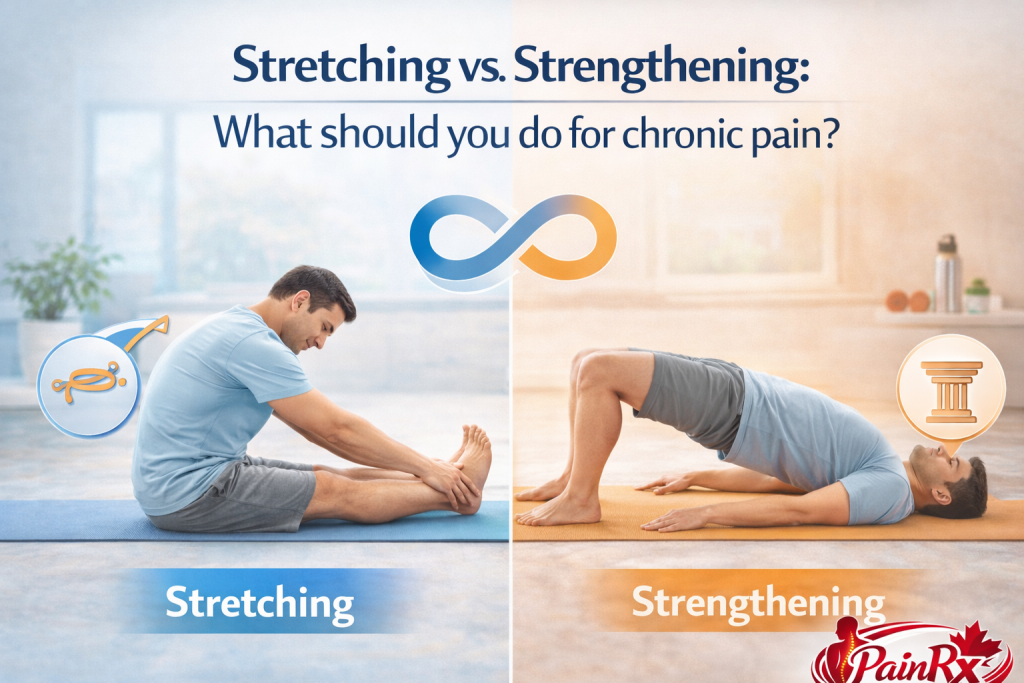
When chronic pain becomes your daily companion, you search for answers. You try heat. You try cold and you try medications. Eventually, someone mentions exercise. But what kind? Walk into any gym, and you will hear competing advice. Some say you must stretch those tight, aching muscles. Others insist you must strengthen your weak, unsupported frame. The confusion is real and frustrating. Understanding stretching vs strengthening for chronic pain is not about picking a winner. It is about knowing which tool to use and when. Your body needs different things at different times.
The Fundamental Difference
Let us start with basic definitions. Stretching is about lengthening muscles and soft tissues. It improves flexibility and range of motion. It feels good when muscles are tight. Strengthening is about building muscle power and endurance. It supports joints and improves stability. It feels necessary when things feel loose or weak.
These two approaches target completely different problems. Stretching addresses tightness. Strengthening addresses weakness. Chronic pain often involves both issues simultaneously. Your tight hamstrings might pull on your pelvis. Your weak core might fail to support your spine. This is why the debate confuses so many people. Both sides are right, but only for half the problem.
When Stretching Helps Chronic Pain
Stretching shines when muscles are in a constant state of tension. Chronic pain often causes muscles to guard. They tighten up to protect an area they perceive as injured. This guarding reflex creates stiffness and restricts movement.
If you feel like your muscles are constantly tight, stretching can help. Gentle, sustained stretches signal the nervous system to release tension. They increase blood flow to tight areas. They improve your range of motion. For conditions like chronic low back pain with tight hamstrings, stretching provides noticeable relief. For neck pain from hours at a computer, upper trap stretches work wonders.
However, stretching has limits. Overstretching already unstable joints can make things worse. If your pain comes from hypermobility or joint looseness, too much stretching is harmful. You must match the intervention to the problem.
When Strengthening Helps Chronic Pain
Strengthening becomes essential when weakness is the root cause. Muscles act as natural braces for your joints. When they are weak, joints take more force. They become unstable. They hurt.
Consider your lower back. Your core muscles, including your abdominals and back extensors, form a natural corset around your spine. When these muscles are weak, your vertebrae take more load. They compress more. They hurt more. Strengthening these muscles creates a supportive foundation. It takes pressure off painful structures.
For chronic knee pain, strengthening the quadriceps and glutes stabilizes the joint. For shoulder pain, strengthening the rotator cuff muscles protects against impingement. If your pain feels deep, achy, and related to poor posture or repeated strain, strengthening is likely your answer.
The Problem with Picking Just One
Here is where most people go wrong. They pick one approach and stick with it religiously. The stretcher stretches every day. They become more flexible, but their pain persists. Why? Because they are flexible but weak. Their joints are like overstretched rubber bands with no support.
The lifter strengthens relentlessly. They build impressive muscle, but their pain persists. Why? Because they are strong but tight. Their muscles are like steel cables that cannot lengthen properly. They pull joints out of alignment.
Chronic pain rarely respects simple categories. It usually involves both tightness and weakness. Tight muscles pull on weak attachments. Weak muscles allow joints to shift, causing other muscles to tighten in compensation. This is why asking stretching vs strengthening for chronic pain is often the wrong question. The real question is: how do I combine them effectively?
The Tensegrity Model: Understanding Your Body
There is a concept in biology called tensegrity. It combines tension and integrity. Your body operates on this principle. Bones provide compression resistance. Muscles, tendons, and ligaments provide tension. They pull against each other to create stability.
In this model, both tension (stretching) and compression (strengthening) are necessary. Too much tension without support, and structures collapse. Too much compression without flexibility, and structures crack. Your body needs a balance. It needs muscles that are long enough to allow full movement. It also needs muscles strong enough to control that movement.
When you understand this model, the debate dissolves. You stop asking which one is better. You start asking what your body needs right now.
Listening to Your Body: The Pain Signal
Your pain is information. Different pain qualities suggest different interventions. Learning to interpret these signals helps you choose wisely.
If your pain feels like stiffness, tightness, or pulling, stretching may help. These sensations suggest muscles are shortened and restricted. Gentle lengthening can relieve them.
If your pain feels deep, achy, or like your joints are grinding, strengthening may help. These sensations suggest instability and lack of support. Building muscle can stabilize the area.
If your pain is sharp and specific during certain movements, you may need both. The sharpness suggests a structure is being pinched or stressed. Lengthening tight neighbors and strengthening weak supports often resolves this.
Pay attention to how your body feels after each activity. Does stretching make you feel looser and better? Does strengthening make you feel more stable and supported? Your body gives feedback. Learn to hear it.
The Order of Operations: What Comes First?
For most chronic pain conditions, there is a logical order. Stretching often comes before strengthening. Here is why.
Tight muscles inhibit their opposites. Tight hip flexors, for example, inhibit your glutes. Your glutes cannot fire properly if they are constantly pulled out of position. If you try to strengthen without stretching first, you reinforce faulty patterns. You build strength on top of dysfunction.
Start with gentle stretching. Release the tightest areas. Restore some range of motion. Then, when your joints are in better alignment, begin strengthening. This approach builds strength on a foundation of flexibility. It creates muscles that are both long and strong.
Of course, there are exceptions. Some conditions require strengthening first to stabilize an area before it can safely stretch. A physical therapist can guide you through this process. For general guidance, however, stretch first, then strengthen.
Common Chronic Pain Conditions and What They Need
Different conditions respond to different emphases. Here is a general guide.
Chronic Low Back Pain: Often needs both. Tight hamstrings and hip flexors pull on the pelvis. Stretching these helps. Weak core and glutes fail to support the spine. Strengthening these is essential. Start with gentle cat-cow stretches and progress to bird dogs and bridges.
Chronic Neck Pain: Usually from prolonged posture. Tight upper traps and chest muscles pull the head forward. Stretching these is crucial. Weak deep neck flexors and upper back muscles fail to hold good posture. Strengthening these is the long-term solution.
Chronic Knee Pain: Often from muscle imbalances. Tight quads or IT bands pull on the kneecap. Stretching these helps. Weak glutes and hamstrings fail to stabilize the joint. Strengthening these is non-negotiable.
Chronic Shoulder Pain: Frequently involves both. Tight pectorals and lats restrict movement. Stretching these opens the joint. Weak rotator cuff and scapular muscles fail to control movement. Strengthening these protects the shoulder.
The Right Way to Stretch for Chronic Pain
Not all stretching is created equal. For chronic pain, certain approaches work better than others.
Avoid ballistic stretching. This involves bouncing movements. It triggers the stretch reflex and can irritate tissues. Instead, use static stretching. Hold a gentle stretch for 30 to 60 seconds. Breathe deeply. Allow the muscle to slowly release.
Better yet, try gentle dynamic stretching. This involves moving slowly through a range of motion. Leg swings, arm circles, and cat-cow stretches warm up tissues without forcing them. For chronic pain, gentle and slow always wins.
Never stretch into sharp pain. A gentle pulling sensation is okay. Sharp, stabbing, or pinching pain is not. Back off if you feel these sensations. You are not releasing anything. You are aggravating something.
The Right Way to Strengthen for Chronic Pain
Strengthening for chronic pain looks different from bodybuilding. You are not trying to max out. You are trying to build endurance and stability.
Start with low resistance. Bodyweight exercises are perfect. Focus on form above all else. Move slowly and deliberately. Feel the target muscles working. If you cannot feel the right muscles, reduce the load or range.
Hold positions rather than moving quickly. Planks, wall sits, and static holds build endurance without irritating joints. Progress gradually. Add one more repetition each week. Increase resistance only when current levels feel easy.
Listen to pain during strengthening. Muscle fatigue is normal. Joint pain is not. If an exercise hurts your joints, stop. Find a different exercise that targets the same muscles without the pain.
The Role of Medication in Your Exercise Journey
Exercise is powerful, but it takes time. You will not fix years of dysfunction in a week. While you build strength and flexibility, medication can help manage symptoms.
Pain medication can reduce discomfort enough to allow movement. It can calm the nervous system so you can stretch effectively. It can take the edge off so you can build strength without fear. This is not weakness. It is smart management.
At PainRx Canada, we support your exercise journey. We provide medications that make movement possible. We also educate you on how to use them wisely. The goal is always to reduce medication dependence over time as your body gets stronger. But there is no shame in needing help along the way.
When to Seek Professional Help
Self-guided exercise works for many people. However, some situations call for professional guidance.
If your pain is severe and unrelenting, see a doctor first. If you have numbness, tingling, or weakness, see a doctor immediately. You have tried exercise for several weeks with no improvement, consider physical therapy. A physical therapist assesses your specific imbalances. They design a program just for you. They watch your form and correct mistakes. This guidance is invaluable for complex chronic pain.
Many people waste months doing the wrong exercises. A few sessions with a professional can save you time and frustration. It is an investment in your recovery.
Building Your Routine: A Sample Week
Here is a sample routine combining both approaches for general chronic pain.
Monday: Gentle full-body stretching. Hold each stretch for 30 seconds. Focus on tight areas like hamstrings, hips, and chest.
Tuesday: Strengthening. Core work like planks and bird dogs. Glute work like bridges and clamshells. Upper back work like rows.
Wednesday: Rest or very gentle walking.
Thursday: Dynamic stretching. Cat-cow, leg swings, arm circles. Prepare your body for movement.
Friday: Strengthening. Same as Tuesday, perhaps adding one more repetition.
Saturday: Full-body stretching again. Hold longer stretches, 60 seconds each.
Sunday: Complete rest.
This balance gives your body both flexibility and stability. It respects the need for recovery. It builds slowly and sustainably.
PainRx Canada: Your Partner in Movement
At PainRx Canada, we know that pain is complex. It requires a multifaceted approach. Medications help. Exercise helps. Knowledge helps the most.
PainRx Canada is here to answer your questions. We can discuss how your medications interact with exercise. We can advise on timing doses around activity. Can support you as you build a healthier, stronger body. Your journey is our journey. We walk it with you.
Conclusion: Both Sides Matter
The debate over stretching vs strengthening for chronic pain misses the point. Your body is not a simple machine with one problem. It is a complex system where everything connects. Tightness and weakness often coexist. Flexibility and stability are both essential.
Stop asking which one is better. Start asking what your body needs today. Some days, it needs to stretch and release. Other days, it needs to strengthen and build. Both are valid. Both are necessary. They are part of the path to lasting relief.
Listen to your body. Give it what it asks for. Be patient with the process. Healing takes time. With the right combination of stretching, strengthening, and medical support, you can find your way to a better place.
Frequently Asked Questions
1. How do I know if I need to stretch or strengthen?
Pay attention to your pain. Tight, pulling sensations often respond to stretching. Deep, achy, unstable sensations often respond to strengthening. If unsure, try gentle stretching first. See how your body feels afterward.
2. Can stretching make chronic pain worse?
Yes, if done incorrectly. Never stretch into sharp pain. Never bounce. Stretch gently and hold steadily. If pain increases during or after stretching, you may be overdoing it or targeting the wrong area.
3. How long before I see results from exercise?
It varies. Some people feel better after one good stretch session. Others need weeks of consistent strengthening to notice change. Give any new routine at least four to six weeks before judging its effectiveness.
4. Should I take pain medication before or after exercise?
It depends on your goals. Taking medication before exercise can reduce pain enough to allow movement. Taking it after can help manage post-exercise soreness. Discuss timing with your PainRx Canada pharmacist for personalized advice.
5. What if I cannot afford physical therapy?
Many online resources offer guided routines. Look for videos from reputable sources like university health programs or professional physical therapy associations. Start slowly and listen carefully to your body. Free resources can help, but professional guidance is best when possible.