

Traveling with Pain Medication in Canada

Traveling with pain medication in Canada: Rules for flying and road trips.
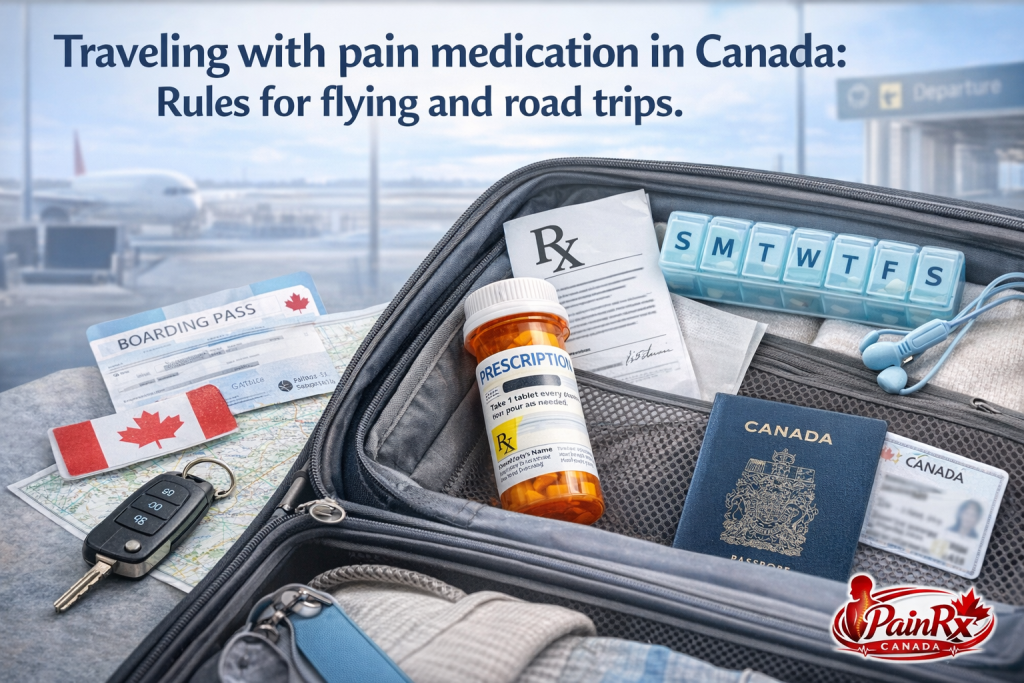
You have planned the perfect Canadian getaway. Maybe it is a flight to Vancouver for a weekend getaway. Perhaps it is a road trip through the Rocky Mountains. Your bags are packed, and your itinerary is set. Then, anxiety strikes. You look at your prescription bottles and wonder: will I have trouble at the airport? Can I keep my medication in the car? What happens if I cross a provincial border? These fears are incredibly common. Many Canadians worry about traveling with pain medication in Canada. The good news is that with the right preparation, you can travel confidently and legally. This guide covers everything you need to know for flying and road trips in 2026.
Know Your Rights: Medication is a Medical Necessity
First, let us address the most important fact. You have a legal right to carry necessary medication. The Canadian Charter of Rights and Freedoms protects your access to healthcare. Transportation security exists to keep people safe, not to confiscate legitimate prescriptions. However, you must follow the rules. Security officers have a job to do. They screen for prohibited items and suspicious activity. Your medication is not prohibited. It is a medical necessity. The key is to present it in a way that is clearly legitimate. When you are traveling with pain medication in Canada, confidence comes from preparation. Know your rights, but also respect the process.
Flying with Medication: CATSA Rules Explained
The Canadian Air Transport Security Authority (CATSA) sets the rules for flying. These rules are clear and passenger-friendly. You are allowed to bring medication in both carry-on and checked luggage. However, there are important distinctions.
Carry-on luggage is strongly recommended. Never pack essential medication in checked bags. Checked luggage can be lost, delayed, or exposed to extreme temperatures. Your pain medication needs to stay with you. CATSA allows all necessary medications in carry-on bags, even liquids over 100ml. This is an exception to the standard liquid rules. If you have liquid pain medication, simply declare it to the screening officer. They may need to test it separately. Arrive early to allow time for this process. Traveling with pain medication in Canada by air is straightforward when you keep it in your carry-on.
The Original Container Debate: Yes or No?
You have probably heard conflicting advice about prescription bottles. Some say you must keep pills in their original containers. Others say pill organizers are fine. The truth lies somewhere in between.
For domestic flights within Canada, original containers are not strictly mandatory. However, they are highly recommended. The original pharmacy label contains your name, the prescribing doctor, the drug name, and the DIN (Drug Identification Number). This label is your best proof of legitimacy. If you use a pill organizer, you risk questions about unlabeled pills. If you must use an organizer for convenience, keep the original bottles elsewhere in your carry-on. This way, you can produce them if questioned. For controlled substances like opioids, original containers are strongly advised. When traveling with pain medication in Canada, the original label is your friend.
Documentation: What to Carry Beyond the Bottle
For most domestic travel, your prescription bottle is sufficient documentation. However, for certain situations, extra paperwork provides peace of mind.
If you are carrying a controlled substance, consider asking your doctor for a letter. The letter should state your name, your diagnosis, the medication name and dosage, and the fact that it is medically necessary. It should be dated and signed. This is especially important if you are carrying large quantities or unusual medications. Also, keep a copy of your prescription receipt or pharmacy printout. This shows the medication was recently dispensed. For those traveling with pain medication in Canada, a simple doctor’s letter can prevent misunderstandings.
Traveling with Opioids and Controlled Substances
Opioids like morphine, codeine, hydromorphone, and others are controlled substances. They receive extra scrutiny. This does not mean you cannot travel with them. It means you must be meticulous.
Always keep opioids in their original pharmacy packaging. Never transfer them to unlabeled containers. Carry only the amount you need for your trip, plus a small buffer for delays. If you are staying longer, arrange for a pharmacy delivery rather than carrying months of supply. Be honest with screening officers. If asked, explain that you have prescription medication. You do not need to announce it loudly, but do not hide it either. When you are traveling with pain medication in Canada that is controlled, transparency is your best strategy.
Road Trips: Crossing Provincial Borders
Canada has no routine border stops between provinces. You can drive from Alberta to Saskatchewan without showing papers. However, this does not mean there are no rules. Police can stop you anywhere. If you are pulled over, prescription medications in plain sight could invite questions.
Keep your medication in your carry-on bag or personal item, even in the car. Do not leave bottles loose in the glove compartment or center console. If you are stopped, inform the officer if they ask about medications. Be polite and provide your prescription bottles if requested. Also, be aware of pharmacy regulations. Your prescription is valid across Canada, but dispensing rules vary slightly by province. For traveling with pain medication in Canada by road, the key is keeping medication secure and accessible only to you.
Medical Cannabis and Travel: A Special Case
Medical cannabis adds complexity to travel. While cannabis is legal in Canada, transportation rules have nuances. For flying, cannabis is subject to the same rules as other medications. You can carry it in your carry-on. However, there is a catch. Cannabis is still illegal under U.S. federal law. Never cross the international border with cannabis, even if you are flying to a U.S. destination. This includes airport transit areas. For domestic flights, it is permitted. For road trips, keep it in its original medical container with your license. Always follow provincial consumption laws. When traveling with pain medication in Canada that includes cannabis, extra caution is wise.
International Travel: Leaving Canada with Medication
This guide focuses on domestic travel. However, a brief note on international travel is important. If you leave Canada, you enter a different legal world. Every country has its own medication rules. Some countries ban certain pain medications entirely. Others require advance permits. Never assume your Canadian prescription is valid abroad.
Contact the embassy of your destination country well in advance. Ask about their rules for your specific medication. Carry a doctor’s letter, original containers, and a copy of your prescription. Research whether your medication is considered controlled in that country. For traveling with pain medication in Canada domestically, the rules are relaxed. Internationally, they are strict. Plan accordingly.
Liquid Medications and Needles: Special Items
Not all pain medication comes in pill form. Some patients use liquid medications, injectables, or transdermal patches. These require special handling.
Liquid medications over 100ml are allowed in carry-on luggage. You must declare them at screening. They will likely undergo additional testing. Bring only what you need for the flight and a reasonable buffer. For injectable medications like certain nerve pain drugs, carry your supplies securely. Needles and syringes are permitted for medical use. However, they must be accompanied by the medication they are used for. A diabetic carrying insulin and syringes is a common example. The same logic applies to pain injections. When traveling with pain medication in Canada that involves needles, keep everything together and declared.
What to Do If You Are Questioned
Despite your best preparation, you might face questions. Screening officers are trained to be vigilant. If they ask about your medication, stay calm. Explain that you have prescription medication. Offer to show your documentation. Do not become defensive or argumentative.
If an officer seems uncertain, ask to speak with a supervisor. You can also request a private screening if you feel uncomfortable. Remember that CATSA officers see medication every day. They are not looking to confiscate legitimate prescriptions. They are looking for security threats. Your pain medication is not a threat. It is healthcare. Confidence and politeness go a long way. For anyone traveling with pain medication in Canada, knowing how to handle questions reduces stress.
The Importance of Timing and Refills
Travel can disrupt your medication schedule. Time zone changes might shift your dosing times. Plan ahead for this. If you take medication on a strict schedule, set phone alarms based on your destination time. Also, ensure you have enough medication for the entire trip. Running out in a different city can be stressful. You may need to find a local pharmacy and transfer your prescription. This is possible but requires time and paperwork. Always carry a few extra days’ supply in case of delays. For traveling with pain medication in Canada, planning for refills is essential.
PainRx Canada: Your Travel Companion
At PainRx Canada, we want your travels to be pain-free in every sense. That is why we support patients with travel planning. When you order from us, we provide detailed prescription labels suitable for travel. We can also provide printouts of your prescription history if needed.
If you are planning a trip and need advice, ask our pharmacists. We can help you determine how much medication to bring. We can advise on documentation and can even help arrange deliveries to your destination if you are staying long-term. Your mobility matters to us. We want you to explore Canada without fear. Trust PainRx Canada to be your partner in traveling with pain medication in Canada.
Conclusion: Travel Confidently, Prepare Thoroughly
The fear of being stopped at the airport or pulled over with pills is understandable. However, it should not prevent you from living your life. With proper preparation, you can travel anywhere in Canada with your pain medication. Keep it in your carry-on. Use original containers. Carry a doctor’s letter for controlled substances. Be polite and transparent with officials. Know the rules for liquids and needles. Plan for time changes and refills.
Canada is a beautiful country meant to be explored. Your medical needs should not keep you home. Now you have the knowledge to travel safely and legally. Pack your bags, grab your medication, and enjoy the journey. You are ready for traveling with pain medication in Canada.
Frequently Asked Questions
1. Do I need to declare my medication at airport security?
You do not need to announce it loudly. However, keep it accessible. If an officer asks, explain it is prescription medication. For liquids over 100ml, you must declare them during screening.
2. Can I keep my pills in a weekly pill organizer?
For convenience, yes. However, this is riskier than original bottles. If you use an organizer, keep the original bottles nearby. This proves the pills are prescribed to you if questions arise.
3. What if I am pulled over while driving with opioids?
Stay calm and polite. If asked about visible medication, explain it is prescribed. Offer to show the prescription bottles. Do not volunteer unnecessary information. Keep medication out of plain sight when driving.
4. Can I travel with medical cannabis across provinces?
Yes, within Canada. Cannabis is legal federally. However, keep it in its original medical container. Carry your medical document. Never travel internationally with cannabis, including to the United States.
5. How much medication can I bring on a flight?
Bring what you need for the trip plus a few extra days. There is no specific limit for legitimate medication. However, carrying several months’ supply might invite questions. A doctor’s letter helps justify larger quantities.