

Best Hormone Treatment for Endometriosis in Canada

Best Hormone Treatment for Endometriosis in Canada: A Comparison Guide
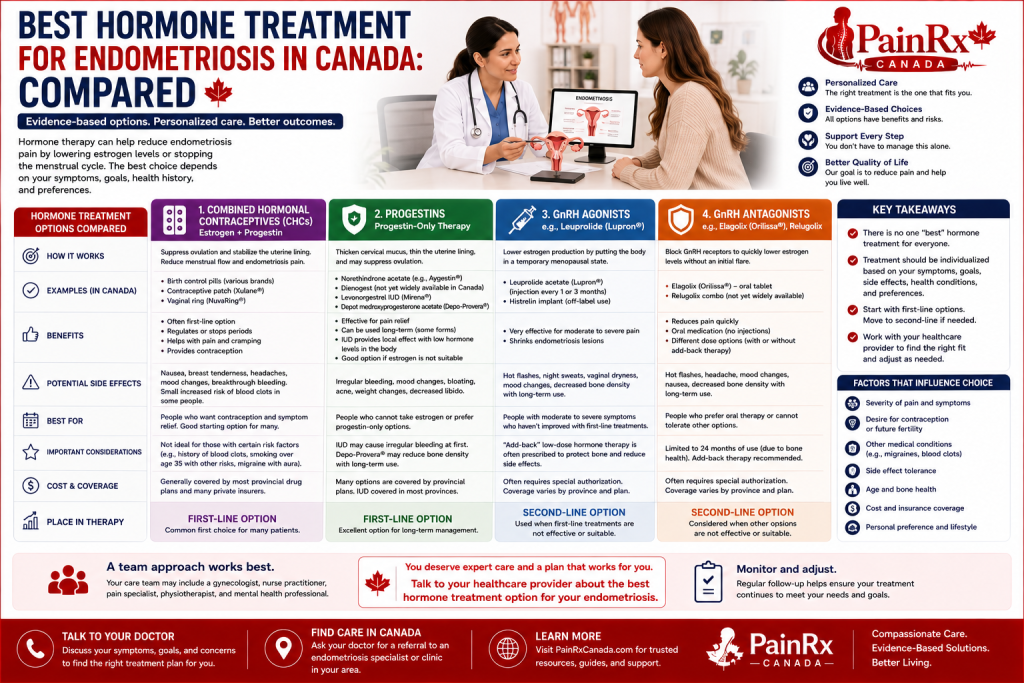
Choosing a hormonal treatment for endometriosis can feel overwhelming, given the number of options available and how differently each one works. There’s no single “best” hormone treatment that suits everyone. The right choice depends on your specific symptoms, fertility plans, and how your body responds. This guide compares the main hormonal treatment options available to Canadians, helping you understand the trade-offs between them.
This article provides general information only. It isn’t medical advice. Speak with your gynaecologist about which hormonal option suits your specific situation.
Why “Best” Depends on the Individual
Before comparing specific options, it’s worth understanding why endometriosis hormone treatment isn’t a simple ranking exercise. Every hormonal option works by reducing estrogen’s effect on endometrial tissue, either by suppressing ovulation, thinning the uterine lining, or reducing estrogen production altogether. However, each achieves this through a different mechanism, with different side effect profiles and practical considerations.
Your gynaecologist will typically weigh factors including symptom severity, whether you’re trying to conceive, your tolerance for specific side effects, and how you’ve responded to any treatments tried previously. This is why the same medication that works wonderfully for one patient might not suit another at all.
Combined Oral Contraceptives
Combined oral contraceptives, containing both estrogen and progestin, represent the most commonly prescribed starting point for endometriosis hormone treatment in Canada.
How they work: These pills suppress ovulation and thin the uterine lining, reducing the hormonal fluctuations that drive endometrial tissue growth and the associated inflammatory pain response.
Effectiveness: Many patients experience meaningful symptom reduction, particularly when taken continuously rather than in the traditional cyclic pattern with a placebo week. Continuous use, skipping withdrawal bleeds altogether, often provides better symptom control for endometriosis specifically compared to standard cyclic dosing.
Side effects and considerations: Common side effects include nausea, breast tenderness, and mood changes, though these often improve after the first few months. Combined contraceptives aren’t suitable for everyone, particularly those with certain cardiovascular risk factors, migraine with aura, or a history of blood clots.
Best suited for: Patients seeking an accessible, well-studied first-line option, particularly those not currently trying to conceive and without contraindications to estrogen-containing medications.
Progestin-Only Pills
Progestin-only pills offer an alternative for patients who can’t use estrogen-containing options, working through a somewhat different mechanism.
How they work: These pills primarily thin the uterine lining and can suppress ovulation in some patients, reducing endometrial tissue activity without the estrogen component found in combined pills.
Effectiveness: Research suggests progestin-only options provide meaningful pain relief for many endometriosis patients, though individual response varies more than with combined options.
Side effects and considerations: Irregular bleeding represents the most common complaint, particularly during the first several months of use. Some patients also report mood changes or weight fluctuations, though these effects vary considerably between individuals.
Best suited for: Patients with contraindications to estrogen, including those with a history of blood clots, certain migraine types, or specific cardiovascular risk factors.
The Hormonal IUD
The hormonal intrauterine device has become an increasingly popular option for endometriosis management across Canada, offering a distinct set of advantages compared to daily oral medications.
How it works: The hormonal IUD releases progestin directly into the uterus, thinning the uterine lining and reducing menstrual bleeding and associated pain, with minimal systemic hormone exposure compared to oral options.
Effectiveness: Many patients experience significant reduction in pain and menstrual bleeding, with effects generally improving over the first several months of use. Because it delivers hormones locally rather than throughout the entire body, some patients experience fewer systemic side effects compared to oral hormonal treatments.
Side effects and considerations: Irregular spotting is common during the initial months after insertion, typically settling over time. The insertion procedure itself can cause temporary discomfort, and in rare cases, complications like expulsion or perforation can occur.
Best suited for: Patients seeking long-term, low-maintenance symptom control, particularly those who prefer not to remember a daily pill, or who’ve experienced side effects with oral hormonal options.
GnRH Agonists
GnRH agonists represent a more intensive hormonal approach, generally reserved for moderate to severe endometriosis that hasn’t responded adequately to other treatments.
How they work: These medications significantly suppress estrogen production by affecting signalling between the brain and ovaries, essentially inducing a temporary menopause-like hormonal state.
Effectiveness: GnRH agonists often provide substantial pain relief, sometimes more pronounced than other hormonal options, making them valuable for patients with severe symptoms not controlled by first-line treatments.
Side effects and considerations: The menopause-like hormonal state produces corresponding side effects, including hot flushes, vaginal dryness, and mood changes. Extended use raises concerns about bone density loss, which is why Canadian guidelines generally limit continuous use to around six months, sometimes with “add-back” hormone therapy to offset these side effects and allow for longer treatment courses when needed.
Best suited for: Patients with severe symptoms who haven’t found adequate relief through other hormonal options, often used as a bridge before surgery or during specific treatment phases.
GnRH Antagonists
A newer category of medication, GnRH antagonists offer some advantages over traditional GnRH agonists, though they remain less widely used in Canada at this stage.
How they work: These medications work through a related but distinct mechanism compared to GnRH agonists, also reducing estrogen production, but with a different onset pattern and side effect profile.
Effectiveness: Clinical evidence suggests meaningful pain reduction for many patients, with some studies suggesting a more favourable side effect profile compared to traditional GnRH agonists.
Side effects and considerations: Similar menopause-like side effects can occur, though some patients report a somewhat milder experience compared to GnRH agonists. Cost and availability remain considerations, since these newer medications aren’t always covered as readily by provincial or private drug plans.
Best suited for: Patients considering more intensive hormonal treatment who want to discuss this newer option with their gynaecologist, particularly where cost and coverage allow.
Comparing Cost and Coverage Across Canada
Cost varies considerably between these options and across Canadian provinces. Combined and progestin-only oral contraceptives tend to be the most affordable and widely covered, both through provincial programs for eligible patients and private insurance plans.
The hormonal IUD involves a higher upfront cost but provides multi-year protection, which can make it cost-effective over time despite the initial expense. GnRH agonists and antagonists tend to carry the highest costs, and coverage varies significantly depending on your province and whether you have supplementary private insurance.
How Doctors Help Patients Choose
Your gynaecologist will typically start by considering whether you’re currently trying to conceive, since this immediately rules out most hormonal suppression options. From there, factors like your symptom severity, any contraindications to estrogen, and your personal preference regarding daily pills versus a longer-term device all factor into the conversation.
Many patients try more than one option before finding the best fit, since individual response to hormonal treatment varies considerably and isn’t always predictable in advance. This trial-and-adjustment process is normal and doesn’t indicate anything has gone wrong with your treatment plan.
When Hormonal Treatment Isn’t Enough
It’s worth acknowledging that hormonal treatment doesn’t resolve endometriosis symptoms completely for every patient. When pain persists despite appropriate hormonal treatment, or when fertility goals make hormonal suppression unsuitable, surgical options like laparoscopic excision become an important consideration, often used alongside hormonal treatment rather than as a complete replacement.
Final Thoughts
No single hormone treatment stands out as universally “best” for endometriosis, since each option carries distinct advantages, trade-offs, and suitability depending on individual circumstances. Combined and progestin-only pills offer accessible starting points, the hormonal IUD provides long-term, lower-maintenance control, and GnRH agonists or antagonists offer more intensive options for severe symptoms. Working closely with your gynaecologist to weigh these factors against your specific symptoms, fertility plans, and side effect tolerance remains the most reliable way to find the hormonal treatment that works best for you.