

How to Administer Penthrox

How to Administer Penthrox: A Canadian Healthcare Professional’s Guide
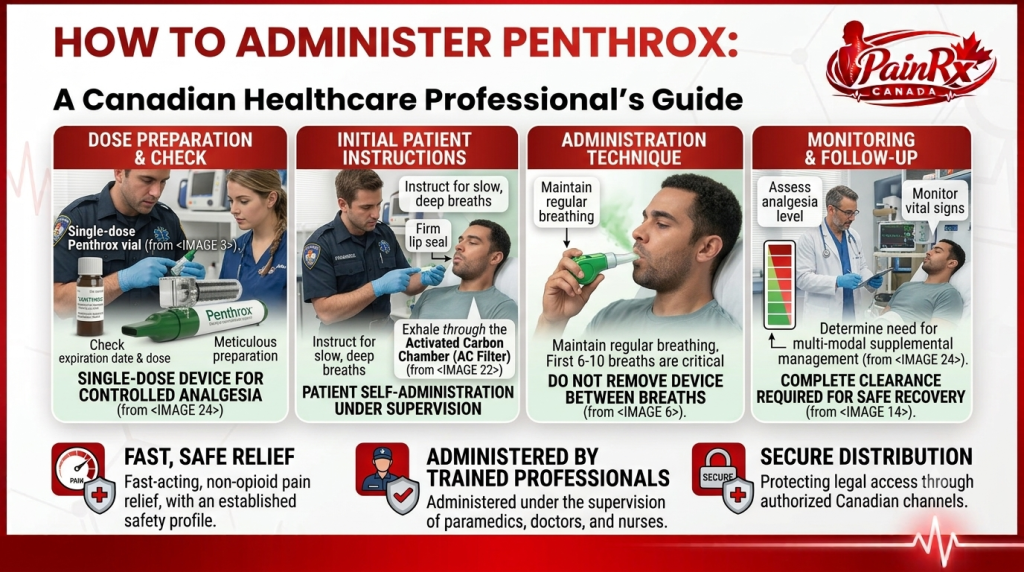
Imagine you are a paramedic responding to a serious motor vehicle accident on the Trans-Canada Highway in Manitoba. Your patient has a suspected fractured femur and is in severe pain. You need to provide rapid, effective analgesia, but gaining intravenous access is challenging in the confined space of the wrecked vehicle. You reach for the Penthrox inhaler—the “green whistle“—and within minutes, your patient’s pain begins to subside. Administering Penthrox correctly is essential for ensuring patient safety and achieving optimal pain relief.
For healthcare professionals in Canada, understanding the proper administration of Penthrox is critical. Whether you are a paramedic in British Columbia, an emergency nurse in Ontario, or a physician in Quebec, this guide will provide you with a comprehensive, step-by-step approach to administering Penthrox safely and effectively.
This guide covers everything from patient assessment and device preparation to monitoring and post-administration care. We will also address important safety considerations and frequently asked questions to support your clinical practice.
Understanding Penthrox Before Administration
Before we dive into the administration process, it is helpful to revisit what Penthrox is and how it works. The Penthrox inhaler is a small, handheld device that delivers methoxyflurane, a potent inhalational analgesic. It is designed for the self-administration of pain relief in acute, emergency situations.
Key Features of Penthrox
- Active Ingredient: Methoxyflurane (3 mL per device)
- Route of Administration: Inhalation (oral inhalation through the mouthpiece)
- Onset of Action: 2-4 minutes
- Duration of Action: 15-20 minutes per inhalation
- Maximum Treatment Duration: 60 minutes
- Patient Population: Adults and children over 18 years of age
Indications for Use
Penthrox is indicated for the short-term management of moderate to severe acute pain in conscious patients who can self-administer the medication. Common indications include:
- Fractures (broken bones)
- Dislocations
- Burns
- Soft tissue injuries
- Pain associated with medical procedures (e.g., fracture reduction, wound debridement)
Contraindications
Before administering Penthrox, it is essential to screen patients for contraindications. Penthrox is contraindicated in patients with:
- Known or suspected kidney impairment
- Known or suspected liver impairment
- History of malignant hyperthermia
- Known hypersensitivity to methoxyflurane or other halogenated hydrocarbons
- Pregnancy or breastfeeding
- Severe respiratory conditions (e.g., poorly controlled asthma, COPD)
- Patients under 18 years of age
Step-by-Step Guide: How to Administer Penthrox
Administering Penthrox involves several key steps, from patient preparation to device assembly and monitoring. Let us explore each step in detail.
Step 1: Patient Assessment and Preparation
Before administering Penthrox, a thorough patient assessment is essential. This assessment ensures patient safety and determines if Penthrox is the appropriate analgesic option.
Assess the Patient
- Medical History: Ask the patient about their medical history, including:
- Kidney or liver problems
- Respiratory conditions (asthma, COPD)
- Allergies (especially to anaesthetic agents)
- History of malignant hyperthermia
- Pregnancy or breastfeeding status
- Current medications (especially sedatives or other CNS depressants)
- Vital Signs: Check and record the patient’s:
- Heart rate
- Blood pressure
- Respiratory rate
- Oxygen saturation (SpO2)
- Level of consciousness
- Pain Assessment: Assess the patient’s pain using a validated pain scale (e.g., Numeric Rating Scale 0-10). This establishes a baseline for evaluating the effectiveness of Penthrox.
Explain the Procedure
Obtain informed consent from the patient (or their legal guardian). Explain the procedure in clear, simple language:
- “I am going to give you a medication called Penthrox. It is a pain reliever that you breathe in through this device. It will help reduce your pain within a few minutes.”
- “You will be in control of how much you take. You can breathe in when the pain is severe and stop when you feel relief.”
- “I will be monitoring your vital signs throughout the procedure.”
Step 2: Prepare the Penthrox Device
The Penthrox device comes ready for assembly. The healthcare professional prepares the device for patient use.
Device Components
| Component | Description |
|---|---|
| Inhaler Body | The main plastic housing with a mouthpiece and filling port |
| Glass Ampoule | Contains 3 mL of liquid methoxyflurane |
| Wick | Absorbent material inside the device that holds the liquid |
Device Assembly Instructions
- Remove the Inhaler from Packaging: Take the Penthrox inhaler out of its sterile packaging. Ensure the device is intact and undamaged.
- Remove the Ampoule: Take the glass ampoule from its protective sleeve. Check the expiry date on the ampoule. Do not use if the expiry date has passed.
- Snap the Ampoule:
- Hold the ampoule firmly in one hand.
- Hold the inhaler with the filling port facing up.
- Insert the ampoule into the filling port.
- Apply firm pressure to snap the ampoule. You will hear a distinct “snap” sound. Do not touch the broken glass.
- Allow the liquid methoxyflurane to flow into the device’s wick. This takes approximately 10-15 seconds.
- Remove the Ampoule: Carefully remove the snapped ampoule from the filling port and dispose of it in a sharps container. The glass is sharp and can cause injury.
- Check the Device: Ensure the device is now ready for use. The wick should be saturated with liquid.
Step 3: Instruct the Patient on Proper Use
Patient education is a critical step in the administration process. Because Penthrox is designed for self-administration, the patient must understand how to use the device correctly.
Provide Clear Instructions
- Position the Patient: Ensure the patient is sitting upright or in a semi-reclined position. This allows for optimal lung expansion.
- Demonstrate the Device: Show the patient the device and point out the mouthpiece.
- Give Instructions:
- “Place the mouthpiece in your mouth and close your lips around it. Do not bite down.”
- “Take a slow, deep breath in through your mouth. Inhale the vapours deeply into your lungs.”
- “Hold your breath for 2-3 seconds.”
- “Exhale slowly through your mouth or nose.”
- “You can take more breaths when you need pain relief. You are in control.”
- Explain the Process:
- “The pain relief will start within a few minutes.”
- “You can take a breath whenever the pain returns.”
- “I will be here to monitor you and help if you need anything.”
Step 4: Monitor the Patient During Administration
While the patient is self-administering Penthrox, close monitoring is essential to ensure safety and assess the effectiveness of the treatment.
Monitor Vital Signs
- Heart Rate: Observe for any significant changes.
- Blood Pressure: Monitor for hypotension or hypertension.
- Respiratory Rate: Watch for signs of respiratory depression.
- Oxygen Saturation (SpO2): Ensure SpO2 remains above 95%.
- Level of Consciousness: The patient should remain awake and alert.
Assess Pain Levels
- Reassess Pain: Periodically ask the patient to rate their pain on the 0-10 scale.
- Document Pain Scores: Record pain scores at regular intervals (e.g., every 5-10 minutes).
Observe for Side Effects
Be vigilant for side effects, including:
- Drowsiness: Mild drowsiness is common. If the patient becomes excessively sleepy, the treatment may need to be adjusted.
- Nausea: Some patients may experience nausea. Have an emesis basin available.
- Headache: A mild headache is a common side effect.
- Dizziness: If the patient feels dizzy, instruct them to stop inhaling and rest.
Step 5: Discontinue Use and Provide Follow-Up Care
The healthcare professional determines when to discontinue Penthrox use. This may be because the treatment duration has reached 60 minutes, the patient’s pain has subsided, or the device is empty.
Discontinuing Use
- Remove the Device: Gently remove the device from the patient’s mouth.
- Assess the Patient: Check vital signs and reassess pain levels.
- Document: Record the total treatment time, the number of inhalations (if known), and the patient’s response.
Provide Follow-Up Care
- Pain Management Plan: Discuss the ongoing pain management plan with the patient. This may include oral analgesics or other interventions.
- Discharge Instructions: Provide appropriate discharge instructions, including:
- “Do not drive or operate machinery for at least 24 hours.”
- “Rest and avoid strenuous activities.”
- “Follow up with your primary care provider as recommended.”
Dispose of the Device
- Dispose of the Device: The Penthrox inhaler is a single-use device. Dispose of it in a pharmaceutical waste container.
- Do Not Reuse: The device cannot be refilled or reused for another patient.
Important Safety Considerations
Safety is paramount when administering Penthrox. Healthcare professionals must be aware of potential risks and how to manage them.
Drug Interactions
Penthrox can interact with other medications, particularly those that cause central nervous system depression. Use caution when administering Penthrox to patients taking:
- Sedatives: Benzodiazepines, barbiturates
- Opioids: Morphine, fentanyl
- Antidepressants: Some antidepressants can interact with methoxyflurane
- Alcohol: Patients who have consumed alcohol may have increased sedation
Special Populations
- Elderly Patients: Older adults may be more sensitive to the effects of Penthrox and may require closer monitoring.
- Patients with Comorbidities: Patients with kidney, liver, or respiratory conditions may be at higher risk of complications.
- Obese Patients: Dosing may need to be adjusted for patients with high body mass index.
Emergency Management
In the event of an adverse reaction, healthcare professionals should be prepared to manage:
- Respiratory Depression: Provide supplemental oxygen and respiratory support if needed.
- Hypotension: Administer IV fluids if blood pressure drops significantly.
- Allergic Reaction: Be prepared to administer antihistamines or epinephrine if an allergic reaction occurs.
Frequently Asked Questions
To further support healthcare professionals, here are answers to the most frequently asked questions about administering Penthrox.
Can Penthrox Be Administered to Unconscious Patients?
No, Penthrox is specifically designed for self-administration by conscious patients. It is not appropriate for unconscious patients or those who cannot follow instructions to inhale.
How Many Inhalations Can a Patient Take?
The patient can take intermittent inhalations as needed for pain. The number of inhalations is not fixed; it depends on the patient’s pain level and breathing pattern. However, the total treatment time should not exceed 60 minutes.
Can Penthrox Be Used with Oxygen?
Penthrox does not require supplemental oxygen for delivery. However, patients can receive oxygen simultaneously if clinically indicated. The device does not interfere with oxygen delivery.
What Should I Do If the Patient Experiences Nausea?
Nausea is a common side effect of Penthrox. If the patient experiences nausea:
- Instruct them to stop inhaling temporarily.
- Provide an emesis basin.
- Administer anti-nausea medication if appropriate and if prescribed.
How Should I Store Penthrox?
Penthrox should be stored at room temperature (15-25°C), away from light, heat, and moisture. Always check the expiry date before use. Store the device in its original packaging until ready for use.
Can Penthrox Be Used During Pregnancy?
No, Penthrox is contraindicated during pregnancy. The safety of methoxyflurane in pregnancy has not been established. Healthcare professionals should use alternative pain relief options for pregnant patients.
Conclusion
Administering Penthrox is a straightforward process that requires careful patient assessment, proper device preparation, clear patient instructions, and vigilant monitoring. By following this step-by-step guide, healthcare professionals across Canada can provide rapid, effective, and safe pain relief to patients experiencing moderate to severe acute pain.
The Penthrox inhaler is a valuable addition to the Canadian emergency medicine toolkit. Its non-opioid nature, rapid onset of action, and patient-controlled dosing make it an ideal choice for managing pain in a variety of settings, from ambulances to emergency departments.
Understanding how to administer Penthrox correctly ensures that patients receive the maximum benefit from this innovative pain relief option while minimizing the risk of adverse effects. As with any medical procedure, ongoing training, adherence to protocols, and vigilant monitoring are essential for optimal patient outcomes.
FAQs
1. Can Penthrox be administered by a nurse without a physician’s order?
In most Canadian healthcare settings, nurses can administer Penthrox under a medical directive or standing order issued by a physician. However, specific protocols vary by institution and province. Always follow your facility’s policies and procedures.
2. How quickly should I see pain relief after the patient starts inhaling?
Pain relief typically begins within 2 to 4 minutes of the first inhalation. If the patient does not experience relief within 5-10 minutes, reassess the patient and consider alternative pain management options.
3. Can Penthrox be used for multiple patients from the same device?
No, the Penthrox inhaler is strictly for single-patient use. It cannot be refilled, cleaned, or reused for another patient. Dispose of the device after use.
4. What should I do if the ampoule breaks during preparation?
If the ampoule breaks during preparation, dispose of the broken glass carefully in a sharps container. Use a new ampoule and device. Do not attempt to use the device if the glass has shattered inside.
5. Is there a maximum dose of Penthrox?
The maximum treatment duration is 60 minutes. There is no specific maximum number of inhalations, but the total volume of methoxyflurane in the device is 3 mL. Once the liquid is depleted, the device will no longer deliver medication.