

How Does the Penthrox Inhaler Work?

How Does the Penthrox Inhaler Work? The Science Behind Canada’s Green Whistle
Imagine you are a paramedic racing to the scene of a highway collision on the 401 in Ontario. A patient has a severely fractured leg, and the pain is excruciating. You reach for a small, green plastic device, place it in the patient’s mouth, and within minutes, their pain begins to subside. How is this possible? How does such a simple-looking device provide such powerful pain relief without the need for needles or intravenous lines?
Understanding how the Penthrox inhaler works is fascinating. It is a remarkable piece of medical engineering that combines clever physics with sophisticated pharmacology. For Canadians, understanding this device can demystify emergency care and provide reassurance that our healthcare system has access to innovative, effective pain relief options.
This comprehensive guide will explain the science behind the Penthrox inhaler in clear, accessible language. We will explore the drug’s mechanism of action, the device’s design, and how these elements work together to provide rapid, non-opioid pain relief for Canadians in emergency situations.
Understanding the Penthrox Inhaler: An Overview
Before diving into the mechanics, it is helpful to understand the basic components of the Penthrox inhaler system. The device is actually quite simple, which is one of its greatest strengths.
What is the Penthrox Inhaler?
The Penthrox inhaler is a small, lightweight, handheld device designed for the self-administration of methoxyflurane, a potent inhalational analgesic. It is often called the “green whistle” because of its distinctive colour. The device is portable, disposable, and does not require any external power source, oxygen supply, or bulky machinery to operate.
What Does Penthrox Contain?
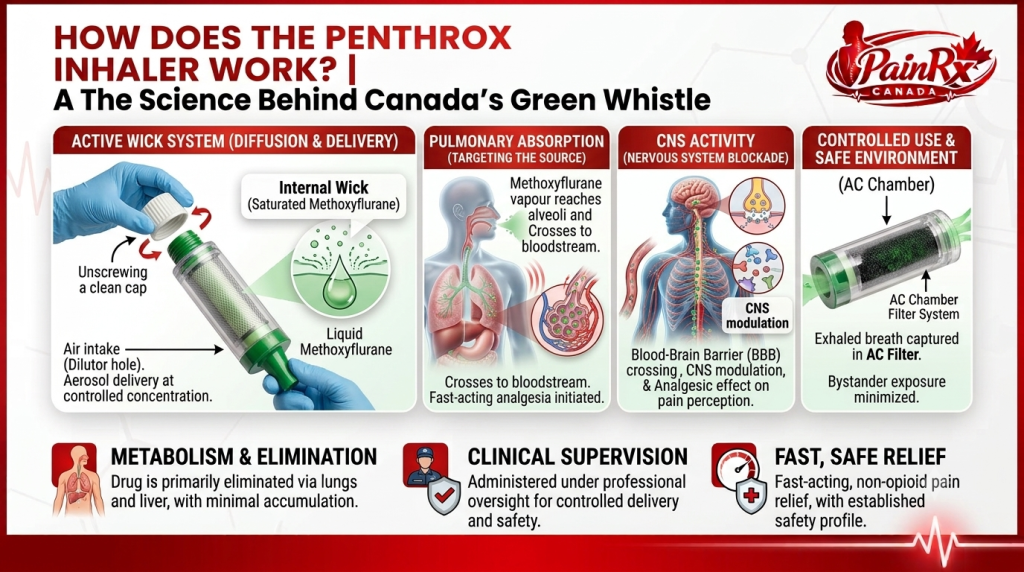
Each Penthrox inhaler contains a single dose of liquid methoxyflurane. The drug is stored in a glass ampoule that is snapped open before use. The active ingredient is then absorbed into a wick inside the device. The patient inhales through the mouthpiece, which draws air over the wick, vaporising the methoxyflurane, and the patient breathes in the vapour.
The Active Ingredient: Methoxyflurane
Methoxyflurane is a halogenated hydrocarbon that acts as a central nervous system depressant. It was first developed in the 1940s and was initially used as a general anaesthetic for surgery. However, at the low doses used in the Penthrox inhaler, it provides powerful analgesia (pain relief) without causing full unconsciousness or significant respiratory depression.
The key to understanding how Penthrox works lies in the difference between analgesia and anaesthesia. Anaesthesia is a state of controlled, temporary loss of sensation or awareness, often used for surgery. Analgesia, on the other hand, is the specific relief of pain without necessarily causing unconsciousness. Penthrox provides analgesia, allowing patients to remain awake, alert, and communicative while their pain is significantly reduced.
How Does the Penthrox Inhaler Work? The Mechanism of Action
Now, let us dive into the science of how Penthrox works. The process involves two main components: the pharmacology (how the drug acts on the body) and the physics (how the device delivers the drug).
How Methoxyflurane Acts on the Body
Methoxyflurane is an inhalation drug. When a patient breathes in the vapours, the drug rapidly absorbs through the lungs into the bloodstream. It then travels to the brain, where it acts on the central nervous system to produce its analgesic effects.
The exact mechanism is complex, but scientists believe methoxyflurane works through several pathways:
- Interaction with Neurotransmitters: Methoxyflurane is believed to interact with specific neurotransmitters in the brain that are involved in pain perception. It may inhibit the release of certain excitatory neurotransmitters while enhancing the activity of inhibitory ones.
- Modulation of Ion Channels: The drug may also affect ion channels in nerve cells, which are responsible for transmitting pain signals. By modulating these channels, methoxyflurane can reduce the transmission of pain signals from the peripheral nervous system to the brain.
- Depression of the Central Nervous System: Methoxyflurane acts as a mild central nervous system depressant. This means it reduces the overall activity of the brain and nervous system, which in turn reduces the perception of pain.
This combination of effects results in a rapid and significant reduction in pain intensity. Importantly, at the low doses used in Penthrox, the drug does not cause the significant respiratory depression or sedation associated with opioids.
The Rapid Onset of Action
One of the most significant advantages of Penthrox is its rapid onset of action. Because the drug absorbs directly through the lungs, it enters the bloodstream almost immediately. This means that pain relief typically begins within 2 to 4 minutes of the first inhalation. This is crucial in emergency situations where time is of the essence.
| Medication | Route of Administration | Time to Onset |
|---|---|---|
| Penthrox | Inhaled (through the lungs) | 2-4 minutes |
| Morphine | Intravenous (IV) | 5-10 minutes |
| Fentanyl | Intravenous (IV) | 2-5 minutes |
| Oral Pain Relievers | Oral (by mouth) | 30-60 minutes |
How the Body Clears Penthrox
The body clears methoxyflurane relatively quickly. After the patient stops inhaling, the liver metabolises (breaks down) the drug, and then the kidneys excrete it. The majority of the drug leaves the body within 4 to 6 hours. This rapid clearance explains why the effects of Penthrox are short-lived and why the device is designed for intermittent use.
How the Device Delivers the Drug: The Physics
The Penthrox inhaler delivers a precise and consistent dose of methoxyflurane vapour with each inhalation. The design is simple but highly effective.
The Components of the Device
The Penthrox inhaler consists of several key components:
- The Mouthpiece: The patient places this in their mouth to inhale the vapours.
- The Chamber: This is the main body of the device. It contains the wick and the space where vaporisation occurs.
- The Wick: This absorbent material holds the liquid methoxyflurane after the ampoule snaps open.
- The Filling Port: This is where the glass ampoule inserts and snaps.
- The Valve: This regulates the flow of air through the device.
The Vaporisation Process
The vaporisation process is the key to how the device works. When the patient inhales through the mouthpiece, air enters the device through the filling port. This air then passes over the wick that is saturated with liquid methoxyflurane. The air flow causes the liquid methoxyflurane to vaporise (turn into a gas). The patient then breathes in this vapour, which is a mixture of air and methoxyflurane.
The device delivers a consistent amount of drug with each breath. The vapour concentration depends on the volume of air drawn through the device, the surface area of the wick, and the temperature. This design ensures that the patient receives a therapeutic dose with each inhalation.
Self-Administration and Patient Control
One of the most important features of the Penthrox inhaler is that it is designed for patient-controlled analgesia. This means the patient controls how much medication they receive. They can take a breath when the pain is intense and stop when they feel relief.
This patient-controlled approach offers several advantages:
- Individualised Dosing: Each patient receives the amount of medication they need, which may vary depending on the severity of their pain.
- Reduced Risk of Overdose: Because the patient stops inhaling when they feel relief, the risk of taking too much medication is significantly reduced.
- Empowerment: The patient feels more in control of their own care, which can reduce anxiety and stress.
The Journey of Methoxyflurane Through the Body
To fully understand how Penthrox works, it is helpful to trace the journey of methoxyflurane through the body, from inhalation to elimination.
Inhalation and Absorption
The process begins when the patient inhales the methoxyflurane vapour. The vapour enters the lungs, where it passes through the alveoli—the tiny air sacs where gas exchange occurs. The methoxyflurane then rapidly absorbs into the bloodstream. Because the lungs have a massive surface area and a rich blood supply, absorption is almost instantaneous.
Distribution in the Body
Once in the bloodstream, methoxyflurane distributes throughout the body. It has a high affinity for fatty tissues, which means it can accumulate in the body’s fat stores. However, because the doses used in Penthrox are very low, this accumulation is minimal and does not cause significant problems.
The drug then crosses the blood-brain barrier—a protective barrier that surrounds the brain—to reach its site of action in the central nervous system.
Metabolism and Elimination
After its effects are exerted, the liver metabolises (breaks down) methoxyflurane. The breakdown products then leave the body through the kidneys in the urine. This is why screening for kidney and liver function is so important before administering Penthrox. In patients with impaired kidney or liver function, the drug may not clear properly, leading to accumulation and potential toxicity.
| Stage | What Happens | Location |
|---|---|---|
| Inhalation | Methoxyflurane vapour enters the lungs. | Lungs |
| Absorption | Methoxyflurane absorbs into the bloodstream through the alveoli. | Lungs |
| Distribution | Methoxyflurane travels to the brain to produce pain relief. | Bloodstream, Brain |
| Metabolism | The liver metabolises methoxyflurane. | Liver |
| Excretion | The kidneys excrete breakdown products. | Kidneys |
How Penthrox Compares to Other Pain Relief Options
Understanding how Penthrox works also involves understanding how it differs from other common pain relief options used in Canadian emergency medicine.
Penthrox vs. Opioids (Morphine, Fentanyl)
The most significant difference is that Penthrox is a non-opioid. While opioids like morphine and fentanyl work by binding to opioid receptors in the brain, Penthrox works through a completely different mechanism.
| Feature | Penthrox | Opioids |
|---|---|---|
| Mechanism of Action | Central nervous system depressant | Binds to opioid receptors |
| Risk of Addiction | Very low | High |
| Risk of Respiratory Depression | Low | High |
| Sedation | Mild | Moderate to severe |
| Administration | Inhaled (self-administered) | Usually IV or oral (healthcare-administered) |
| Needles Required | No | Often yes (for IV) |
Penthrox vs. Entonox (Nitrous Oxide)
Entonox is a mixture of nitrous oxide and oxygen, also used for pain relief in emergency settings. Both are inhaled gases, but there are key differences.
| Feature | Penthrox | Entonox |
|---|---|---|
| Active Ingredient | Methoxyflurane | Nitrous Oxide + Oxygen |
| Delivery System | Small, portable, disposable device | Requires a large cylinder and delivery system |
| Portability | Excellent | Poor |
| Onset of Action | 2-4 minutes | 1-2 minutes |
| Duration of Action | 15-20 minutes (per breath) | 2-3 minutes (after stopping inhalation) |
Frequently Asked Questions
To further assist Canadians, here are answers to the most frequently asked questions about how the Penthrox inhaler works.
How Long Does It Take for Penthrox to Start Working?
Penthrox works very quickly. The analgesic effect typically begins within 2 to 4 minutes of the first inhalation. This rapid onset is one of its greatest advantages in emergency situations.
Is Penthrox Safe for the Kidneys?
At the low doses used in the Penthrox inhaler, the risk of kidney toxicity is considered very low. However, the drug does process through the kidneys, so patients with pre-existing kidney conditions should not use it. Healthcare professionals screen patients for kidney problems before administering Penthrox.
Can I Use Penthrox If I Have Asthma?
Penthrox is generally not recommended for patients with severe or poorly controlled asthma. The drug can cause airway irritation. However, in some cases, a healthcare professional may determine that the benefits outweigh the risks. Always discuss your respiratory conditions with your healthcare provider.
Why Does Penthrox Need to Be Self-Administered?
Self-administration allows patients to control their own dosing, taking only as much as they need. This reduces the risk of overdose and allows for individualised pain management. It also empowers the patient and can reduce anxiety.
How Does the Device Deliver a Consistent Dose?
The device delivers a consistent concentration of methoxyflurane vapour with each breath. The vaporisation rate depends on the air flow, the temperature, and the surface area of the wick. The device maintains a consistent vapour concentration within a therapeutic range.
Conclusion
The Penthrox inhaler is a remarkable medical innovation that combines clever engineering with sophisticated pharmacology. Its mechanism of action is both simple and elegant: the patient inhales methoxyflurane vapour, which rapidly absorbs through the lungs into the bloodstream, travels to the brain, and reduces the perception of pain without causing significant sedation or respiratory depression.
For Canadians, the availability of Penthrox in emergency settings represents a significant advancement in pain management. It offers a fast-acting, non-invasive, and non-opioid alternative to traditional pain relief options. Understanding how this device works empowers patients and families to make informed decisions about their care and provides reassurance that Canada’s healthcare system is equipped with innovative tools to manage acute pain effectively.
Whether you are a paramedic on the front lines, a patient in an emergency department, or simply a curious citizen, understanding the science behind the green whistle is a step towards appreciating the incredible capabilities of modern medicine.
FAQs
1. Can Penthrox be used for chronic pain?
No, Penthrox is only indicated for the short-term management of moderate to severe acute pain, such as that caused by trauma or injury. It is not suitable for chronic pain conditions like arthritis, back pain, or neuropathy.
2. How does Penthrox differ from general anaesthesia?
Penthrox provides analgesia (pain relief) without causing full unconsciousness. General anaesthesia, by contrast, induces a state of controlled unconsciousness and loss of all sensation. Penthrox allows patients to remain awake, alert, and communicative.
3. Is the Penthrox inhaler reusable?
No, the Penthrox inhaler is for single-patient use only. Once a patient has used it, it must be disposed of. It cannot be refilled or reused for another patient.
4. Can Penthrox be used with other pain medications?
In some cases, Penthrox may be used in combination with other pain medications. However, this decision is made by the healthcare professional based on the patient’s condition and needs. Always discuss your complete medication history with your healthcare provider.
5. How is the Penthrox inhaler disposed of?
Used Penthrox inhalers are disposed of as pharmaceutical waste by healthcare professionals. They are placed in designated sharps or pharmaceutical waste containers and collected by licensed medical waste disposal companies for safe incineration or other appropriate disposal methods.