

How to Use Penthrox

How to Use Penthrox: A Canadian Patient’s Guide to the Green Whistle
Imagine you or a loved one has just experienced a traumatic injury—a broken bone from a fall, a dislocated shoulder from a sports accident, or severe burns from an incident at work. The pain is overwhelming, and every second feels like an eternity. When paramedics arrive or you reach the emergency department, you may hear them mention a device called Penthrox, often referred to as the “green whistle.” Understanding how this device works and how to use it properly can significantly reduce anxiety and ensure you receive the maximum benefit from this powerful pain relief tool.
In Canada, Penthrox has become an increasingly common sight in ambulances and emergency rooms. For patients, being informed about this treatment option is empowering. It allows you to participate actively in your own care and helps you understand what to expect during a painful and stressful time. This comprehensive guide is designed to walk you through everything you need to know about using Penthrox, from the moment a healthcare professional offers it to you, to the steps you can take to ensure its safe and effective use.
What is Penthrox and Why is it Used?
Before diving into the administration process, it is helpful to briefly revisit what Penthrox is and why healthcare professionals in Canada choose it. As discussed in our previous guide, Penthrox is an inhalational analgesic containing the active ingredient methoxyflurane. It is a non-opioid painkiller that is breathed in through the lungs to provide rapid relief from moderate to severe acute pain.
The device itself is small, lightweight, and portable, making it ideal for use in pre-hospital settings like ambulances, as well as in busy emergency departments. Its distinctive green colour has earned it the nickname “the green whistle.” Healthcare providers in Canada favour Penthrox for several reasons, including its rapid onset of action, its non-invasive nature (no needles required), its patient-controlled dosing, and its low risk of respiratory depression compared to opioid medications.
Understanding these benefits is the first step in appreciating why a paramedic or doctor might recommend Penthrox for your pain management. It is a tool designed to put you, the patient, in control of your own comfort.
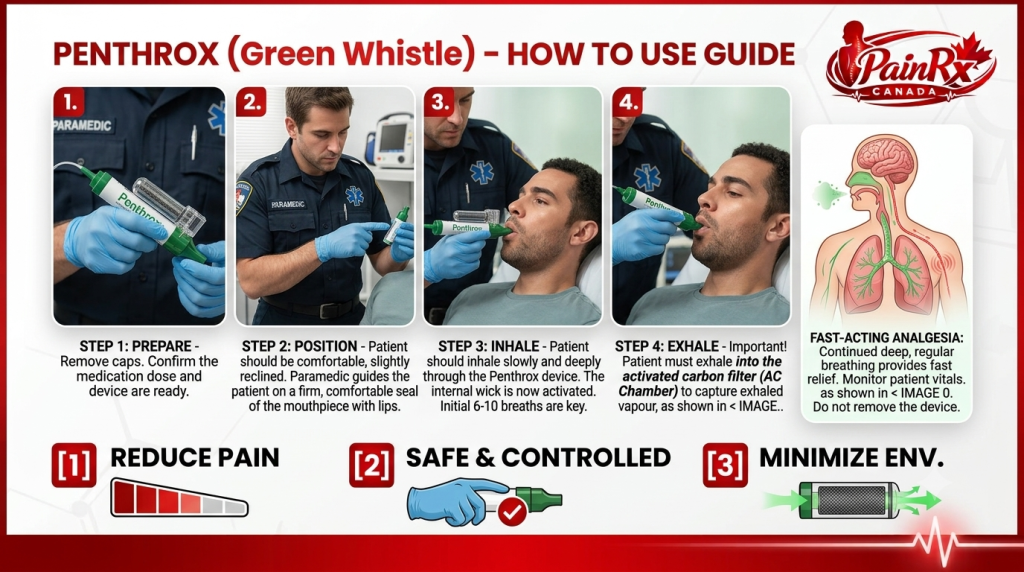
How to Use Penthrox: Step-by-Step Guide
Using Penthrox is a straightforward process, but it requires clear communication between you and your healthcare provider. The device is designed for self-administration, meaning you will be the one holding it and breathing in the vapours. This patient-controlled approach is one of its greatest advantages.
Step 1: Preparation by the Healthcare Professional
Before the device reaches your hands, a trained professional—a paramedic, nurse, or physician—will prepare it. This is not something you will need to do yourself. The preparation involves:
- Removing the Penthrox inhaler from its sterile packaging.
- Taking a small glass ampoule containing liquid methoxyflurane.
- Snapping the ampoule to release the liquid into the inhaler’s internal wick.
- Assembling the device so it is ready for use.
Once the device is prepared, the healthcare professional will hand it to you and explain how to use it. Do not hesitate to ask questions if you are unsure about any part of the process.
Step 2: Proper Positioning
Positioning is important to ensure the medication is delivered effectively. Your healthcare provider will guide you on this, but generally, you should be sitting upright or in a semi-reclined position. This allows for optimal lung expansion and helps you breathe in the vapours more easily.
Ensure your hands are steady and you have a firm grip on the device.
Step 3: Using the Device
This is the core of the administration process. The device has a mouthpiece on one end. You will be instructed to:
- Place the mouthpiece in your mouth and close your lips around it to create a seal. Do not bite down on it.
- Take a slow, deep breath through the mouth, inhaling the vapours deeply into your lungs.
- Hold your breath for a few seconds (typically 2-3 seconds) to allow the methoxyflurane to be absorbed into your bloodstream.
- Exhale slowly through the mouth or nose.
It is important to note that you are in control of the frequency. You are not required to take continuous breaths. The recommended approach is to take intermittent inhalations as needed for pain.
Step 4: Patient-Controlled Dosing
The concept of patient-controlled dosing is central to using Penthrox effectively. The device is designed so that you can take a breath of the vapours when your pain is severe and stop when you feel relief. This is a significant advantage over injections, where a fixed dose is given regardless of the patient’s current pain level.
Here is how it works in practice:
- When the pain is intense: Take 2-3 deep breaths from the device.
- When the pain begins to subside: Let the device fall away from your mouth and rest.
- If the pain returns: Take a few more breaths as needed.
By doing this, you are tailoring the dose to your specific needs. This prevents over-medication and allows you to remain alert and communicative, which is particularly important for medical assessments.
Step 5: Monitoring and Duration
While you are using Penthrox, healthcare professionals will monitor your vital signs. This includes your heart rate, blood pressure, and oxygen saturation. They will also observe you for any side effects, such as drowsiness or nausea.
The duration of use is also important. Penthrox is intended for short-term pain relief, typically for a period not exceeding 60 minutes. This is because prolonged exposure is not recommended. The healthcare provider will guide you on when to stop using the device.
Important Safety Guidelines for Patients in Canada
Using Penthrox is considered safe when administered under professional supervision. However, there are important safety guidelines that both patients and providers must follow. Health Canada has set specific parameters to ensure the responsible use of this medication.
Who Should Not Use Penthrox?
Penthrox is not suitable for everyone. Before offering you the device, a healthcare professional will conduct a thorough assessment to screen for contraindications. You should not use Penthrox if you have:
- Known or suspected kidney problems: Methoxyflurane is processed by the kidneys, and pre-existing impairment can lead to toxicity.
- Known or suspected liver problems: Liver disease can affect how the drug is metabolised.
- A history of malignant hyperthermia: This is a rare genetic condition that can be triggered by certain anaesthetic agents.
- Pregnancy or are breastfeeding: The safety of Penthrox in these populations has not been established.
- A known allergy or hypersensitivity to methoxyflurane.
- Severe respiratory conditions: Such as asthma or COPD that is not well-controlled.
Always be honest and transparent with your healthcare provider about your medical history. This information is critical for their decision-making process.
Common Side Effects and What to Do
While Penthrox is generally well-tolerated, it can cause side effects. Being aware of these helps you know what to expect and when to alert a professional.
| Common Side Effects | What to Do |
|---|---|
| Drowsiness | Rest and avoid sudden movements. Your healthcare provider will monitor you. |
| Headache | Inform your healthcare provider. They can provide supportive care. |
| Nausea | Inform your healthcare provider. They can provide anti-nausea medication if needed. |
| Dizziness | Sit or lie still until the sensation passes. Do not attempt to stand or walk without assistance. |
These side effects are typically mild and transient. They usually resolve quickly after you stop inhaling Penthrox. More serious side effects are rare but should be reported immediately, including signs of an allergic reaction such as rash, itching, or difficulty breathing.
What to Tell Your Healthcare Provider
Your safety is a priority. To help your healthcare provider make the best decision, you should tell them if:
- You have any kidney, liver, or lung conditions.
- You are pregnant, think you might be pregnant, or are breastfeeding.
- You are taking any other medications, including over-the-counter drugs or herbal supplements.
- You have ever had a bad reaction to any anaesthetic or pain medication.
Frequently Asked Questions About Using Penthrox
To further assist the Canadian public, here are answers to some of the most frequently asked questions regarding the use of Penthrox.
Can I Use Penthrox at Home?
No, Penthrox is not available for home use. It is a prescription medication that is strictly administered by healthcare professionals in emergency and hospital settings. You cannot purchase it over the counter or keep it in your home first-aid kit. Its use requires medical supervision and monitoring.
How Fast Does Penthrox Work?
Penthrox acts very quickly. The analgesic effect typically begins within 2 to 4 minutes of the first inhalation. This rapid onset is one of its greatest advantages, particularly in acute trauma situations where time is of the essence.
How Long Does the Pain Relief Last?
The pain relief from Penthrox is short-acting. The effect of a single inhalation may last for around 15 to 20 minutes. This is why the device is designed for intermittent use; you can take additional breaths as the pain returns. However, the total treatment time is generally limited to 60 minutes.
What Does Penthrox Feel Like?
Every patient’s experience is different. Many patients report a feeling of relaxation and a significant reduction in pain intensity. Some patients may feel a warm sensation or a slight light-headedness. The device has a distinctive sweet or fruity smell, which many find pleasant.
Is It Safe to Use Penthrox If I Am on Other Medications?
There is a potential for drug interactions, so it is crucial to inform your healthcare provider of all medications you are taking. In particular, you should mention if you are taking drugs that affect the central nervous system, such as sedatives or antidepressants. Your healthcare provider will assess the risks and benefits before administering Penthrox.
Can Children Use Penthrox?
In Canada, Penthrox is approved for use in adults and children over the age of 18. It is not approved for use in children under 18 years of age.
The Role of Healthcare Professionals in Administration
While the patient holds the device, the administration of Penthrox is always a collaborative effort between the patient and the healthcare team. Paramedics, nurses, and physicians play a vital role in ensuring the medication is used safely and effectively.
Paramedic Use in Pre-Hospital Settings
In the pre-hospital setting, paramedics are often the first to administer Penthrox. They are trained to:
- Assess the patient’s suitability for the drug.
- Prepare the device correctly in a moving or chaotic environment.
- Guide the patient on how to inhale properly.
- Monitor the patient’s vital signs en route to the hospital.
- Document the dose and the patient’s response.
Emergency Department Use
In the emergency department, a nurse or physician will provide the device to the patient. They will continue to monitor the patient’s pain levels and adjust the treatment plan as necessary. The device is often used as a bridge to other pain management strategies, such as oral medications or regional anaesthesia.
Where to Find Penthrox in Canada
For the general public, understanding where Penthrox is available can be helpful, especially when considering emergency preparedness.
Availability in Hospitals and Ambulances
Penthrox is increasingly available across Canada in:
- Ambulance services: Many paramedic services in provinces such as Ontario, British Columbia, Alberta, and others have incorporated Penthrox into their protocols.
- Emergency departments: Most major hospitals in Canada have Penthrox available for use in their emergency departments.
Can You Purchase Penthrox in Pharmacies?
No, Penthrox is not available for purchase in pharmacies by the public. It is a controlled medication that is restricted to healthcare facilities. You will not find it on the shelf at your local Shoppers Drug Mart or Rexall.
Conclusion
Learning how to use Penthrox is an important step for any Canadian who may find themselves in a situation requiring acute pain management. Its design empowers the patient to take control of their own comfort, while its non-opioid nature provides a safer alternative to traditional painkillers. By understanding the simple steps of administration—preparation, positioning, intermittent inhalation, and monitoring—you can approach an emergency with confidence.
It is essential to remember that Penthrox is used under the guidance of trained healthcare professionals. They are there to ensure your safety, monitor your response, and provide the best possible care. The “green whistle” is a testament to how medical innovation is improving the patient experience in Canada, offering rapid, effective, and patient-centred pain relief when it is needed most.
FAQs
1. What should I do if I feel dizzy while using Penthrox?
If you feel dizzy, immediately stop inhaling from the device. Tell your healthcare provider right away. They will assess your condition and may adjust your position or stop the treatment if necessary. Dizziness is a common side effect that often resolves quickly.
2. Can I drink water or eat before using Penthrox?
You should avoid eating or drinking large amounts immediately before or while using Penthrox, as it can sometimes cause nausea. If you are given the device, it is best to follow your healthcare provider’s instructions regarding food and drink.
3. Is it normal to feel a bit sleepy after using Penthrox?
Yes, mild drowsiness is a common side effect of Penthrox. This is part of its calming effect. However, you should still be able to remain awake and answer questions from your healthcare provider.
4. Why can’t I use Penthrox for more than an hour?
Penthrox is intended for short-term use only. Prolonged exposure (beyond 60 minutes) can increase the risk of side effects, particularly on the kidneys. This is why healthcare professionals limit its use to acute situations where rapid relief is needed.
5. What happens if the device is empty?
The device contains a fixed amount of methoxyflurane. Once the liquid has been vaporised and the wick is dry, the device will no longer produce vapours. Your healthcare provider will monitor the device’s status and will offer alternative pain relief if your pain persists.