

What Is ENDO-205?

What Is ENDO-205? The New Non-Hormonal Endometriosis Drug
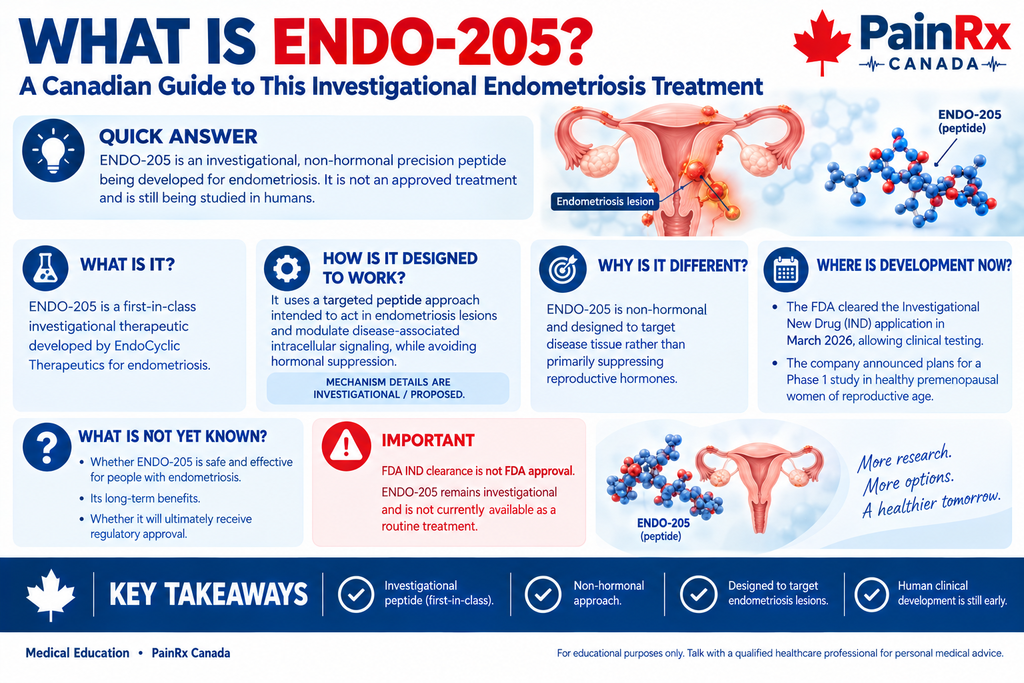
ENDO-205 has generated real buzz in the endometriosis community as a possible new kind of treatment. But what exactly is this drug? How does it work? What makes it different from everything available today? This guide breaks down the science, the development history, and the current status of ENDO-205 in plain terms.
This article gives general information only. It isn’t medical advice. ENDO-205 remains an investigational compound in early-stage human trials. No country has approved it, and it isn’t available for patient use. Talk to your doctor about endometriosis treatments available to you today.
The Basic Definition
EndoCyclic Therapeutics, a biopharmaceutical company based in Irvine, California, developed ENDO-205. They built it as a first-in-class, non-hormonal precision peptide therapy for endometriosis. Breaking that description down helps explain what sets this drug apart from existing treatments.
“Non-hormonal” means it doesn’t suppress ovulation, lower estrogen, or otherwise change a patient’s hormone levels. Nearly every current endometriosis treatment works this way. ENDO-205 doesn’t. “Precision peptide” points to the drug’s core technology. Researchers engineered this small, protein-like molecule to recognize and act on specific tissue, rather than affecting the whole body broadly.
How ENDO-205 Is Designed to Work
The core idea behind ENDO-205 involves targeting endometriosis lesions directly. It aims to act only within diseased tissue, leaving healthy tissue alone. This targeted approach differs completely from hormonal treatments. Those work throughout the entire body by changing hormone levels, rather than acting specifically at the disease site.
The company describes ENDO-205 as a treatment designed to eliminate endometriosis lesions themselves. It doesn’t just manage the symptoms they cause. If this mechanism proves effective in human trials, it would create a genuinely different treatment category. Most current options manage pain and disease activity. They don’t target the lesions directly.
What Preclinical Research Has Shown So Far
Before testing any drug in humans, developers must complete extensive lab and animal research. Scientists call this preclinical research. For ENDO-205, this work reportedly showed something promising. It eliminated endometriotic lesions and resolved related inflammation in animal models. Standard toxicology testing found no major safety concerns. Regulators require this testing before allowing any human trials to start.
One important limit matters here. Animal model results, even promising ones, never guarantee the same results in humans. This is exactly why the clinical trial process exists. It moves cautiously, from small, safety-focused human studies toward larger trials that test real-world effectiveness.
The Company Behind ENDO-205
EndoCyclic Therapeutics calls itself a biopharmaceutical company focused on precision peptide treatments and diagnostics for complex diseases. The company’s pipeline includes both ENDO-205 and FemLUNA. FemLUNA is an investigational imaging tool. It’s designed to help detect endometriosis, including smaller superficial lesions. Doctors could use it as a possible alternative to invasive laparoscopic surgery for diagnosis.
This dual focus on treatment and better diagnosis reflects a broader view within endometriosis research. Both areas need real improvement, especially given how long many patients currently wait for an accurate diagnosis.
Government and Research Funding History
ENDO-205’s development has drawn notable government research support. Multiple grants backed the program, coming from the National Institutes of Health, specifically through the Eunice Kennedy Shriver National Institute of Child Health and Human Development. The NIH’s Small Business Innovation Research program also recognized the project as a success story.
In 2025, ENDO-205 received an NIH Commercialization Readiness Pilot grant. It reportedly earned a perfect overall impact score, a rare distinction within this funding program. This kind of government research backing doesn’t guarantee eventual approval. Still, it reflects real scientific scrutiny and confidence from the research funding community, beyond the company’s own claims.
The FDA Clearance Explained
In March 2026, the FDA cleared EndoCyclic Therapeutics’ application to test ENDO-205 in humans. This clearance lets the company begin human testing for the first time. They’ll start with a Phase 1 study in healthy pre-menopausal women of reproductive age.
Detailed coverage of the clearance reports something notable. The FDA reviewed the application in under thirty days, the standard minimum review period. They didn’t request extra information or delay the decision. Industry observers noted this as a fairly smooth regulatory path for this stage of development.
It’s worth understanding what this clearance doesn’t mean. It doesn’t confirm the drug works in humans. It doesn’t point to any timeline for potential approval or market availability either. That timeline typically stays years away, even for drug candidates that eventually succeed.
How ENDO-205 Compares to Current Endometriosis Treatments
Nearly all current endometriosis treatments work by changing the body’s hormone levels. Combined oral contraceptives and hormonal IUDs suppress ovulation and thin the uterine lining. GnRH agonists and antagonists sharply reduce estrogen production. This essentially creates a temporary menopause-like state. Even surgery, while it directly removes visible lesions, doesn’t address the wider disease process. Doctors often combine it with hormonal therapy afterward too.
ENDO-205’s proposed approach targets lesions directly, without hormonal manipulation. If it succeeds through clinical trials, this would create a genuinely different category. This matters most for patients who can’t tolerate hormonal side effects, or who are trying to conceive. Hormonal treatments generally prevent pregnancy during use.
Why Researchers Emphasize the Word “Investigational”
Throughout coverage of ENDO-205, you’ll notice careful language. Writers describe it as “investigational,” not as an established treatment. This distinction matters enormously. It reflects standard, responsible practice in how legitimate drug development gets discussed.
Most drug candidates that enter human trials never reach market approval. This holds true even for candidates with promising early data. Some fail due to safety concerns that only show up in human testing. Others fail to show enough effectiveness once tested in larger patient groups. None of this makes ENDO-205 unusual. It’s simply how drug development works. That’s exactly why responsible coverage avoids treating any investigational compound as a guaranteed future treatment.
What “First-in-Class” Actually Means
You’ll often see ENDO-205 described as “first-in-class.” This term carries a specific meaning in drug development. It points to a drug using a new, previously unused approach to treat a condition, rather than a variation on an existing treatment method.
For endometriosis specifically, a non-hormonal, lesion-targeting therapy would create a genuinely new category as first-in-class. This sets it apart from the hormonal suppression approach that has dominated treatment for decades. This label reflects the drug’s design and proposed mechanism. It doesn’t yet confirm real-world effectiveness in patients, though.
Current Status and What Comes Next
Right now, following its IND clearance, ENDO-205 sits at the very start of human testing. The Phase 1 trial will mainly check safety in healthy volunteers. It won’t test effectiveness in patients who actually have endometriosis yet. If this phase goes well, later trial phases would test the drug specifically in endometriosis patients. Researchers would then track both safety and effectiveness over a longer timeline.
Want to follow ENDO-205’s progress? Watch for updates directly from EndoCyclic Therapeutics. Also follow coverage from trusted medical and biotech news sources. Skip informal or speculative claims about the drug’s timeline or eventual availability.
Frequently Asked Questions
Is ENDO-205 a hormone treatment?
No. This is exactly what sets it apart from nearly all current endometriosis treatments. Developers designed ENDO-205 to work without changing hormone levels. Instead, it targets endometriosis lesions directly.
Has ENDO-205 been tested in humans yet?
Following its FDA IND clearance, ENDO-205 is entering its first human trial. This Phase 1 study focuses on safety in healthy volunteers. Researchers haven’t tested it specifically in patients with endometriosis yet.
What does “peptide therapeutic” mean?
A peptide is a small chain of amino acids, essentially a small protein-like molecule. Peptide therapeutics get engineered to interact very specifically with particular biological targets. This partly explains how ENDO-205 is designed to act selectively on endometriosis tissue.
Is ENDO-205 meant to cure endometriosis?
Some coverage of ENDO-205 describes it as a potential “curative” approach, since it aims to eliminate lesions rather than just manage symptoms. However, this remains an unproven, investigational claim. Human clinical trials haven’t confirmed it yet.
Who is developing ENDO-205?
EndoCyclic Therapeutics, a biopharmaceutical company based in Irvine, California, developed ENDO-205 as its lead drug program. Their pipeline also includes a related diagnostic imaging agent called FemLUNA.
Can I participate in ENDO-205 clinical trials?
EndoCyclic Therapeutics and their clinical trial sites manage trial participation details, including eligibility and enrollment, directly. Check official clinical trial registries or the company’s own communications for current enrollment information. Don’t rely on secondhand information.
Final Thoughts
ENDO-205 offers a genuinely new approach to endometriosis treatment. Developers designed it to target lesions directly, skipping the hormonal manipulation that defines nearly every current treatment option. Notable NIH research funding and recent FDA clearance to begin human trials back this drug candidate. Together, these have sparked real excitement within the endometriosis community. Still, it remains an early-stage, investigational compound. Years of clinical testing lie ahead before researchers can confirm its safety and effectiveness in humans, let alone before it could reach patients.