

When Will ENDO-205 Be Available in Canada?

When Will ENDO-205 Be Available in Canada?
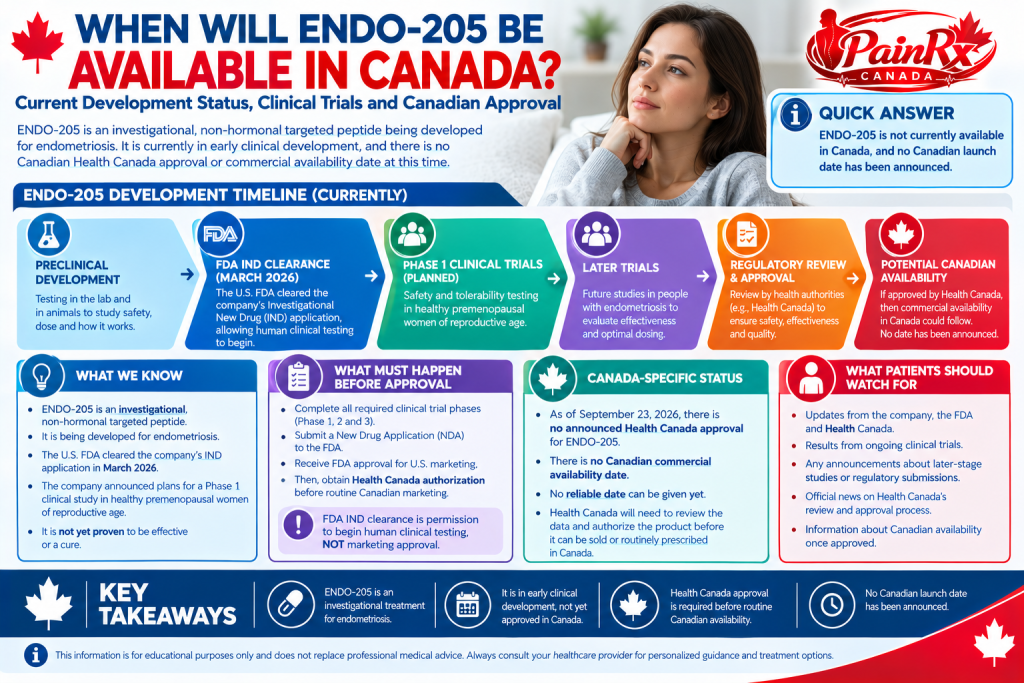
News of a new non-hormonal drug for endometriosis has sparked real excitement. That makes sense, given how few treatment options exist for this condition. Canadians living with endometriosis naturally want to know when ENDO-205 might reach them. This guide explains what ENDO-205 is. It also covers where it stands in development right now, and what a realistic Canadian timeline looks like.
This article gives general information only. It isn’t medical advice. Drug development timelines carry real uncertainty. Most drug candidates that enter trials never reach market approval. Talk to your doctor about endometriosis treatments available to you today.
What ENDO-205 Actually Is
EndoCyclic Therapeutics, based in Irvine, California, developed ENDO-205 as a first-in-class, non-hormonal precision peptide therapy for endometriosis. Nearly every current endometriosis treatment works by suppressing hormones. ENDO-205 takes a completely different path.
The drug targets endometriosis lesions directly. It aims to act only within diseased tissue. Researchers designed it to eliminate the lesions themselves, rather than just managing the hormonal environment that lets them grow. This matters a great deal for patients who can’t use hormonal treatments, or simply don’t want to. Side effects, fertility plans, and treatments that haven’t worked well all factor into that choice.
Why This News Generated So Much Interest
Current endometriosis treatments fall into a narrow group. Birth control pills, hormonal IUDs, GnRH agonists, and progestins all work the same basic way. They alter hormone levels rather than address the disease directly. These treatments help manage pain for many patients. But they bring real trade-offs too, including side effects, fertility limits during use, and incomplete relief for some patients.
Researchers now know endometriosis involves more than hormones alone. Immune system problems and nervous system changes both contribute to the pain. A treatment that targets these mechanisms directly, rather than working around them, offers a genuinely different strategy. Nothing currently available does this.
The FDA Clearance: What It Actually Means
In March 2026, the FDA cleared EndoCyclic Therapeutics’ application to test ENDO-205 in humans for the first time. This clearance matters. But it’s worth understanding exactly what it does, and doesn’t, show.
An IND clearance means regulators reviewed the company’s safety data, including animal studies. They found enough evidence to justify human testing. It doesn’t mean the drug works in people. It doesn’t mean the drug will ever reach the market. This marks the very start of a long process. It isn’t a sign that availability is coming soon.
The company plans to start a Phase 1 study in healthy pre-menopausal women of reproductive age. Phase 1 sits at the earliest stage of human testing. It focuses mainly on safety, not on whether the drug actually works.
Why Drug Development Takes So Long
Understanding the typical trial process helps set fair expectations. Will ENDO-205 ever reach patients? Phase 1 trials, like the one ENDO-205 is entering now, mainly test safety in a small group of people. A successful Phase 1 leads to Phase 2. This phase tests effectiveness and dosing in a larger group of patients who actually have the condition.
Phase 3 comes next. It involves much larger patient groups. Researchers confirm effectiveness and watch for less common side effects. This usually runs as the longest, most expensive phase. Only after all three phases succeed can a company apply for approval, typically first through the FDA in the United States.
Across the industry, this whole process, from Phase 1 through approval, usually spans many years. Here’s the harder truth: most drug candidates that enter trials never reach the market at all. Safety concerns, weak results, or other issues stop most of them somewhere along the way.
Why Canada Specifically Takes Additional Time
Say ENDO-205 completes US trials and wins FDA approval. Even then, this doesn’t automatically mean Canadian availability. Health Canada works as a fully independent regulator, separate from the FDA. It doesn’t just defer to American decisions.
Drug companies typically need to file a separate application just for Canada. This involves its own timeline and requirements. Companies often focus on their biggest markets first. This means smaller markets like Canada sometimes wait extra time after US approval, before a Canadian submission even happens, let alone approval.
A Realistic Timeline for Canadian Availability
ENDO-205 only entered Phase 1 testing in early 2026. Each later trial phase typically takes several years on its own. Health Canada’s separate review adds even more time after any eventual US approval. Given all this, Canadian availability realistically sits years away, at minimum. This assumes the drug clears every stage of development too. History shows that isn’t guaranteed for any single drug candidate.
This isn’t meant to dim real excitement about a promising new approach. It’s meant to set fair expectations. Canadians living with endometriosis today can then make informed choices about current treatment, rather than waiting on a timeline that remains genuinely unclear.
What Else Is Being Developed Beyond ENDO-205
ENDO-205 isn’t the only non-hormonal option in development for endometriosis. That’s good reason for extra optimism about the wider treatment landscape over time. Researchers also study brain stimulation approaches that target the pain-processing changes linked to endometriosis pain. Other teams explore immune-targeting therapies aimed at correcting the immune problems linked to lesion growth. Still others work on anti-inflammatory and blood-vessel-blocking drugs, since lesions rely on new blood vessel growth and inflammatory signals to survive.
This wider pipeline shows growing interest from scientists and drug companies alike in treating endometriosis beyond hormone suppression. Still, most of these approaches, ENDO-205 included, remain in early stages.
What Canadians Can Access Right Now
While you wait for possible future treatments, you have real options today. Talk to your gynecologist about hormonal treatments like combined birth control pills, the hormonal IUD, and GnRH agonists or antagonists. Surgical options like laparoscopic excision help patients who haven’t found enough relief through medication alone.
Non-medication approaches matter too. Pelvic floor physiotherapy and psychological support for chronic pain both play a real role in managing endometriosis within Canada’s healthcare system today.
How to Stay Informed About ENDO-205’s Progress
Want to track ENDO-205’s progress? Your gynecologist or a specialized endometriosis clinic will usually learn about major trial results early. They’ll also hear about any Canadian regulatory filings well before this becomes widely known news. Follow trusted medical news sources too, rather than relying on informal social media claims about drug availability. This helps you get accurate, current facts instead of guesswork.
Frequently Asked Questions
Is ENDO-205 approved anywhere in the world right now?
No. ENDO-205 hasn’t won approval anywhere yet. It only received clearance to start human testing in the United States. That’s a very early stage in drug development.
How long does it typically take for a new drug to reach Canadian patients after starting trials?
This varies a lot and isn’t predictable for any single drug. Successful drugs often take many years to move through all trial phases and win approval in multiple countries. Many candidates never reach approval at all.
Will ENDO-205 replace hormonal treatments for endometriosis if it’s approved?
It’s too early to know. Even with eventual approval, new treatments usually become one more option, not a full replacement for existing ones. Effectiveness also varies between patients, regardless of treatment type.
Should I wait for ENDO-205 instead of starting treatment now?
This is a personal choice to discuss with your doctor. Given the real uncertainty and likely long wait involved, most doctors would suggest treating current symptoms now, rather than delaying care for a treatment that may sit years away, if it arrives at all.
Is ENDO-205 the only non-hormonal option being researched for endometriosis?
No. Several other non-hormonal approaches sit in various stages of research too. This includes brain stimulation and immune-targeting therapies.
Final Thoughts
ENDO-205 offers a genuinely new, non-hormonal path for endometriosis treatment. It sparked real excitement after winning FDA clearance to begin human trials. Still, this clearance marks just the start of a typically long, uncertain drug development process. Canadian availability realistically sits years away. It depends on the drug clearing multiple trial phases, plus a separate Health Canada review after that. For Canadians living with endometriosis today, talking with a gynecologist about current treatment options remains the most practical path forward. Keep an eye on this promising area of research too, even though it’s still quite early.