
Is 2 mg of Dilaudid Equal to a Specific Amount of Oxycodone?

Is 2 mg of Dilaudid Equal to a Specific Amount of Oxycodone? Why This Isn’t a Simple Answer
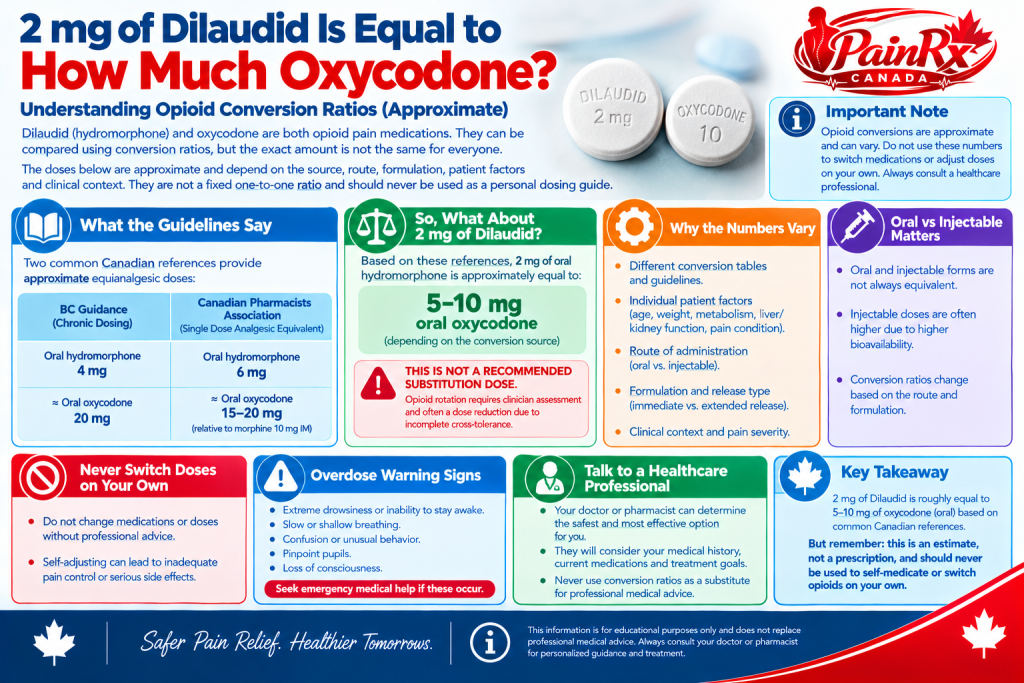
People searching for a direct milligram conversion between Dilaudid (hydromorphone) and oxycodone are usually trying to understand their pain medication better, whether they’re switching prescriptions, comparing what a doctor has recommended, or trying to make sense of a hospital discharge plan. It’s a completely understandable question. However, the honest and responsible answer isn’t a single number you can multiply your way to. This guide explains why opioid conversion is far more complex than a fixed ratio, and what you should actually do if you need this information for your own care.
This article provides general information only. It isn’t medical advice and doesn’t provide dosing calculations. Opioid conversion carries serious risks, including fatal overdose, when done without direct medical supervision. Only a doctor or pharmacist with your complete medical history should calculate an opioid dose conversion for you.
Why This Article Won’t Give You a Direct Conversion Number
You may have seen simplified conversion charts online claiming a fixed ratio between hydromorphone and oxycodone. These charts exist, and they’re part of the problem, not a solution. A single ratio applied without clinical context can produce a dangerously inaccurate dose for a real person, and opioid conversion errors represent a well-documented, serious source of medication harm, even among trained healthcare professionals using standard reference tables.
The reason is straightforward: a mathematically “equivalent” dose on paper doesn’t always translate into a safe dose for a specific individual. Several factors that a simple ratio can’t account for significantly change what an actually safe and effective dose looks like for any given patient.
What “Equianalgesic” Actually Means
Healthcare professionals use the term equianalgesic to describe doses of different opioids that theoretically produce similar pain relief. Pharmacology references do publish equianalgesic tables, and prescribers use them as a starting reference point, but critically, never as a final answer.
These tables exist to support clinical decision-making by trained professionals, not to serve as a public conversion calculator. Using an equianalgesic table correctly requires understanding pharmacology, patient-specific risk factors, and a concept called incomplete cross-tolerance, which is one of the most important and most commonly misunderstood pieces of this puzzle.
Why Incomplete Cross-Tolerance Matters So Much
If someone has been taking one opioid regularly, their body develops a degree of tolerance to that specific medication. When switching to a different opioid, even at a theoretically “equivalent” calculated dose, that tolerance doesn’t fully transfer. This phenomenon called incomplete cross-tolerance.
Because of this, prescribers typically reduce the calculated equivalent dose of a new opioid by a significant percentage, often twenty-five to fifty percent, when switching a patient between medications. This safety reduction exists specifically because the “equivalent” dose calculated from a standard table can actually be too strong for that individual in their new medication, given their body hasn’t built the same tolerance to it. Skipping this adjustment is a recognized cause of serious opioid overdose during medication switches.
Individual Factors That Change the Real Answer
Beyond incomplete cross-tolerance, several other factors mean that a conversion appropriate for one person could be genuinely dangerous for another, even at an identical calculated dose.
Liver and kidney function significantly affect how each specific opioid gets metabolized and cleared from the body. Hydromorphone and oxycodone aren’t processed identically, so impairment in either organ can shift the real-world relationship between the two medications for that individual.
Age affects drug metabolism broadly, with older adults often requiring more conservative dosing across the board, independent of any specific conversion calculation.
Route of administration changes the math considerably. A conversion between two oral medications differs from a conversion involving an intravenous formulation, since the body absorbs and processes each route differently.
Other medications a person takes can interact with opioid metabolism, again shifting what a genuinely safe dose looks like beyond what a simple ratio would suggest.
Individual variation in opioid receptor sensitivity and metabolism means that even accounting for every factor above, two people with seemingly identical profiles can still respond differently to the same calculated dose.
Why Hospitals Treat This as a Formal, Careful Process
Because of these risks, hospitals and pain specialists treat opioid conversion as a deliberate clinical process, not a quick calculation. This typically involves consulting established equianalgesic references, applying an appropriate safety reduction for incomplete cross-tolerance, considering the individual patient factors above, and then closely monitoring the patient after the switch, watching for both inadequate pain control and signs of oversedation or respiratory depression.
This careful, monitored approach exists precisely because the stakes are high. Both underdosing, which leaves pain poorly managed, and overdosing, which risks life-threatening respiratory depression, are genuine possibilities when a conversion isn’t handled with this level of care.
What to Do If You Need to Understand Your Own Conversion
If you’re asking this question because a doctor has switched, or is planning to switch, your medication from Dilaudid to oxycodone or vice versa, the right step is to ask your prescriber directly to walk you through their reasoning. A good prescriber can explain why they chose the specific dose they did, including how they accounted for your individual factors.
If you’re comparing medications out of general curiosity, or trying to understand a past prescription, a pharmacist represents an excellent, accessible resource. Pharmacists have detailed training in exactly this kind of pharmacological comparison and can explain the relevant factors for your specific situation without requiring a full doctor’s appointment.
Why You Should Never Convert Doses Yourself
It’s worth stating this plainly: never attempt to switch between opioid medications, or adjust your dose based on an online conversion chart, without direct guidance from your prescriber. This applies even if you find a chart from what looks like a credible source, since the missing piece is never the math itself, but the individual clinical judgment required to apply it safely.
Self-directed opioid switching or dose adjustment significantly increases the risk of both inadequate pain control and life-threatening overdose. If your current pain medication doesn’t seem to be working well, the safe path forward is contacting your prescriber to discuss your options, not calculating an alternative dose independently.
Signs Your Pain Management Plan May Need Adjustment
If you’re considering whether a medication switch might be right for you, certain signs are worth raising with your doctor rather than addressing through self-directed changes. Consistently inadequate pain relief despite taking your medication as prescribed deserves a conversation about whether your current plan, dose, or medication choice needs adjustment.
Side effects that significantly affect your quality of life, such as excessive sedation, nausea, or constipation that hasn’t responded to standard management, are also worth discussing, since a different opioid sometimes produces a better side effect profile for a specific individual, even at a comparable level of pain control.
Recognizing an Overdose
Regardless of which opioid you’re taking, understanding overdose signs matters. Watch for slow, shallow, or stopped breathing, along with extreme drowsiness or an inability to wake up. Pinpoint pupils and bluish or grayish lips, skin, or fingertips also signal a possible overdose emergency.
Call 911 immediately if you suspect an overdose. Naloxone can temporarily reverse an opioid overdose and is available without a prescription at many pharmacies. Keeping naloxone accessible if you or someone in your household takes an opioid medication represents a genuinely worthwhile safety precaution, regardless of which specific opioid is involved.
Frequently Asked Questions
Why won’t you just give me the conversion number?
Because a number without clinical context can be genuinely dangerous. Real conversions require adjusting for incomplete cross-tolerance and individual patient factors that a general article can’t assess for you specifically. This is precisely why the process requires a prescriber’s judgment, not a fixed formula.
My doctor already switched my medication. How do I know the new dose is right?
Trust your prescriber’s clinical judgment, since they’ve accounted for your specific health profile, but stay alert to how you feel after the switch. Report both inadequate pain control and any signs of excessive sedation promptly, since dose adjustments sometimes happen after an initial switch based on your response.
Are online opioid conversion calculators accurate?
They can provide a rough starting reference point similar to what a clinician might consult, but they don’t account for your individual risk factors or apply the safety reductions a prescriber would build in. They shouldn’t be used to self-adjust medication.
Is oxycodone stronger or weaker than Dilaudid?
Hydromorphone is generally considered more potent than oxycodone on a milligram-for-milligram basis, meaning less hydromorphone is needed to achieve comparable pain relief. However, “potency” alone doesn’t determine which medication is right for a given patient or situation.
What should I do if I’m prescribed a new opioid and I’m nervous about the dose?
Ask your prescriber directly how they determined your dose and what signs to watch for as you start the new medication. This conversation is a reasonable and important part of starting any new opioid prescription.
Final Thoughts
Converting between Dilaudid and oxycodone doesn’t come down to a simple, fixed ratio you can calculate on your own, despite what simplified charts online might suggest. Real opioid conversion requires accounting for incomplete cross-tolerance, individual health factors, and route of administration, all of which meaningfully affect what a genuinely safe dose looks like for a specific person. If you need to understand a medication switch involving these drugs, the right step is always a direct conversation with your prescriber or pharmacist, who can apply the clinical judgment this process genuinely requires.