

Chronic Pain Scale

Chronic Pain Scale: How Doctors Measure and Track Pain
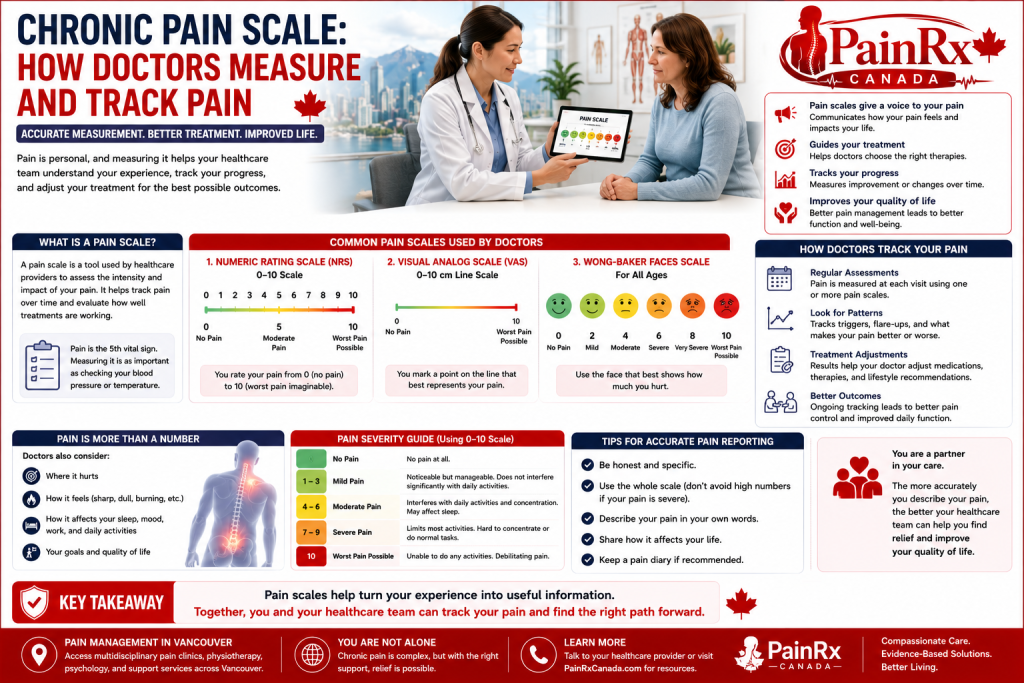
Describing pain accurately to a doctor can feel surprisingly difficult. “It hurts a lot” doesn’t give a clinician much to work with, particularly when tracking whether a treatment is actually helping over time. This is where pain scales come in. These structured tools help translate a deeply personal, subjective experience into something clinicians can measure, compare, and track. This guide explains the most commonly used chronic pain scales, how they work, and how to use them effectively in your own care.
Why Pain Scales Matter
Pain is inherently subjective. There’s no blood test or scan that objectively measures how much something hurts. This creates a genuine challenge for healthcare providers trying to assess pain severity, monitor changes over time, and determine whether a treatment is working.
Pain scales address this challenge by providing a consistent framework for patients to communicate their pain in a standardized way. While no scale perfectly captures the full complexity of chronic pain, these tools give clinicians a practical, comparable measure to track alongside other clinical information.
The Numeric Rating Scale (NRS)
The Numeric Rating Scale is likely the most familiar pain scale, widely used across hospitals, clinics, and pain diaries. It asks patients to rate their pain on a scale from 0 to 10, where 0 represents no pain at all and 10 represents the worst pain imaginable.
This scale’s simplicity makes it easy to use quickly, whether during a brief clinical check-in or for daily self-tracking at home. However, its simplicity is also a limitation. A rating of “6” doesn’t convey what type of pain someone is experiencing, where it’s located, or how it’s affecting their daily function. Because of this, the NRS works best as one part of a broader pain assessment, rather than a complete picture on its own.
The Visual Analogue Scale (VAS)
The Visual Analogue Scale takes a similar concept to the NRS but presents it differently. Instead of choosing a number, patients mark a point along a continuous line, typically 10 centimetres long, running from “no pain” to “worst possible pain.”
Clinicians then measure the distance to calculate a numeric score. Some patients find this format more intuitive than selecting a specific number, since it allows for more nuanced positioning between whole numbers. The VAS is particularly common in clinical research settings, where its slightly more precise measurement can help detect smaller changes in pain over time.
The Wong-Baker FACES Pain Scale
Originally developed for use with children, the Wong-Baker FACES scale uses a series of facial expressions, ranging from a smiling face representing no pain to a crying face representing severe pain. Patients select the face that best matches how they feel.
While designed initially for paediatric use, this scale has found broader application, particularly for patients who find numeric scales difficult to relate to, or in situations where language barriers make verbal communication challenging. Its intuitive, visual format makes it accessible across a wide range of ages and communication abilities.
The McGill Pain Questionnaire
Unlike the simpler scales above, the McGill Pain Questionnaire takes a more comprehensive approach, recognizing that pain involves more than just intensity. This tool asks patients to select from a list of descriptive words, grouped into categories like sensory qualities (throbbing, burning, stabbing), emotional qualities (exhausting, sickening), and overall intensity.
This richer approach helps capture the qualitative experience of pain, not just its severity. For chronic pain conditions in particular, where the character of pain often provides diagnostic clues, this level of detail can offer valuable information beyond a simple numeric rating. The trade-off is that it takes considerably longer to complete than a simple 0-10 scale.
The Brief Pain Inventory (BPI)
The Brief Pain Inventory goes a step further by assessing not just pain intensity, but also how pain interferes with daily function. Patients rate their pain at its worst, least, average, and current level, then rate how much pain interferes with activities like walking, sleeping, mood, and relationships with others.
This functional focus makes the BPI particularly valuable for chronic pain management, where the goal often centres on improving daily function and quality of life, not simply reducing a number on a 0-10 scale. Many multidisciplinary pain clinics use tools like the BPI specifically because they capture this broader picture.
Why a Single Number Doesn’t Tell the Whole Story
It’s worth understanding a key limitation shared by simpler pain scales like the NRS and VAS. A pain rating of “7” means something different for every individual, shaped by their personal pain history, psychological state, and even cultural background. This variability means comparing pain scores between different people has real limits.
However, tracking your own pain scores over time remains genuinely useful, since it can reveal patterns and trends specific to you. A gradual shift from consistently rating pain at 7 or 8 down to consistently rating it at 4 or 5 provides meaningful information about treatment progress, even accounting for the subjective nature of the scale itself.
Using Pain Scales Effectively in Your Own Care
Getting the most value from pain scales involves more than simply picking a number when asked. A few practices can help make these tools more useful for your own chronic pain management.
Track consistently over time, ideally using the same scale repeatedly, rather than switching between different tools. This consistency makes trends more meaningful and easier to identify.
Note context alongside your rating, including what you were doing, what treatments you’d recently used, and any triggers you noticed. A number alone loses much of its value without this surrounding context.
Consider tracking multiple dimensions, not just intensity. Recording how pain affects your sleep, mood, and daily activities, similar to what tools like the Brief Pain Inventory measure, often provides a more complete and clinically useful picture than intensity alone.
Bring your tracking to appointments, whether through a simple notebook, phone app, or printed pain diary. This concrete record helps your doctor assess patterns more accurately than relying on memory during a brief appointment.
Beyond the Numbers: Functional Assessment
Increasingly, chronic pain specialists emphasize that pain scales work best alongside functional assessments, meaning direct evaluation of what a person can and can’t do, rather than relying on pain intensity ratings alone. Two patients with identical pain scores might have very different levels of function, depending on factors like fitness, coping strategies, and psychological resilience.
This is why many multidisciplinary pain clinics incorporate broader assessment tools alongside standard pain scales, looking at sleep quality, mood, physical function, and overall quality of life as complementary measures of treatment progress.
Final Thoughts
Pain scales offer an imperfect but genuinely useful way to communicate and track a fundamentally subjective experience. From the simple 0-10 Numeric Rating Scale to more comprehensive tools like the McGill Pain Questionnaire and Brief Pain Inventory, each serves a different purpose depending on the clinical context. For anyone managing chronic pain, understanding these tools, and using them consistently to track your own patterns over time, can provide valuable insight into your condition and support more informed conversations with your healthcare team.