
Brand Name vs. Generic Drugs: Are They Really The Same?

Brand Name vs. Generic Drugs: Are they really the same? (2026 Guide)
You receive a prescription from your doctor. At the pharmacy, the pharmacist offers you a choice. “Would you like the brand name or generic?” You glance at the prices. The generic costs a fraction of the brand. A wave of uncertainty washes over you. Is it really the same? Will it work as well? The question of brand name vs generic drugs are they the same is one of the most common in all of medicine. It touches on trust, money, and health. This article provides the facts so you can make an informed choice.
The Billion-Dollar Question
The difference in cost between brand name and generic drugs is staggering. Brand name drugs can cost hundreds or even thousands of dollars per month. Generics often cost pennies per pill. For patients with chronic conditions, this difference can mean choosing between medication and other necessities.
Given this cost gap, skepticism is understandable. We are conditioned to believe that you get what you pay for. Surely a drug that costs a fraction of the price must be inferior in some way. However, pharmaceutical economics work differently than other industries. Understanding this requires examining how drugs are developed and approved.
The question brand name vs generic drugs are they the same has real financial implications. The answer affects your wallet and your health.
How Brand Name Drugs Are Born
Every brand name drug begins as a discovery. A pharmaceutical company invests years and hundreds of millions of dollars in research. They test thousands of compounds. They conduct preclinical studies in labs. Run clinical trials in humans. They file mountains of paperwork with Health Canada.
If successful, they receive approval to sell the drug exclusively. Patents and exclusivity periods protect this investment. For years, usually 10 to 20, no other company can sell the same drug. During this time, the company recoups its investment and makes profits. This system incentivizes innovation.
When the patent expires, other companies can enter the market. They do not need to repeat the original research. They do not need to prove the drug works from scratch. Instead, they must prove their version is equivalent to the original. This is where generics are born. Understanding this process clarifies brand name vs generic drugs are they the same.
How Generic Drugs Are Approved
Generic drug manufacturers face a different pathway to approval. They must submit an Abbreviated New Drug Submission to Health Canada. “Abbreviated” does not mean they skip safety steps. It means they do not need to repeat the original clinical trials proving efficacy.
Instead, generic manufacturers must prove bioequivalence. This means their drug delivers the same amount of active ingredient into the bloodstream at the same rate as the brand name drug. They conduct studies with healthy volunteers. Measure drug levels in blood over time. They apply strict statistical standards.
Health Canada requires that generics be within 80 to 125 percent of the brand’s levels. This range may sound wide, but it is actually the same variation seen between different batches of the same brand name drug. In practice, most generics fall much closer to the brand average.
This rigorous approval process is central to brand name vs generic drugs are they the same. Health Canada does not compromise on safety or effectiveness.
The Active Ingredient: Identical by Law
The active ingredient in a generic drug must be identical to the brand name drug. Same chemical compound. Dose. Same strength. Same route of administration. This is not optional. It is the law.
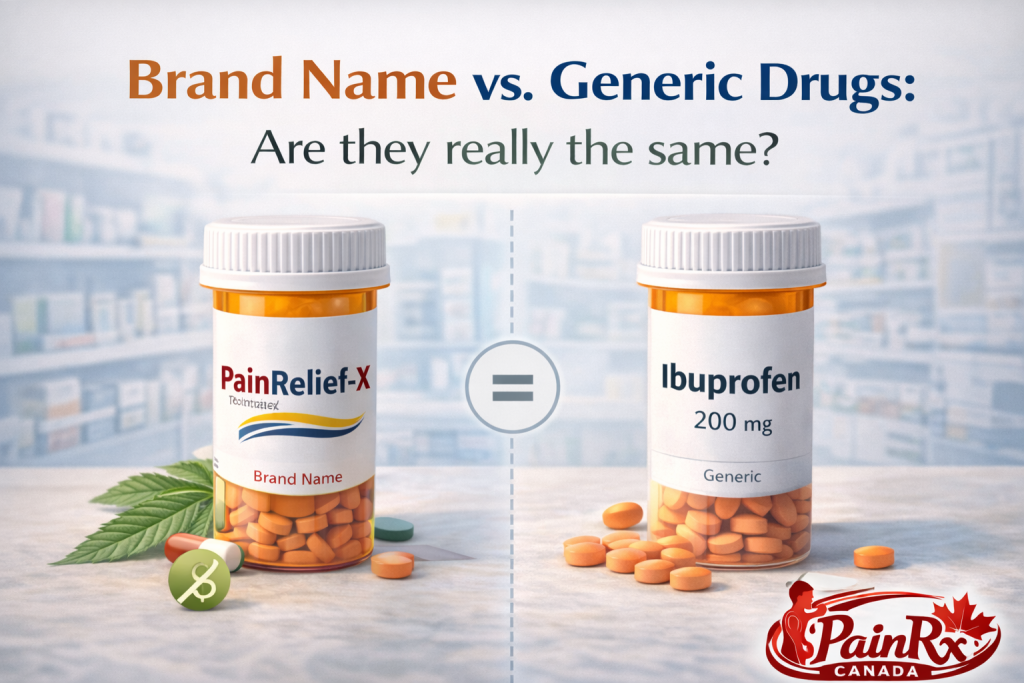
For example, generic ibuprofen contains exactly the same ibuprofen molecule as Advil. Generic metformin contains the same metformin as Glucophage. The chemical structure is indistinguishable. Your body cannot tell the difference at the molecular level.
This identity of active ingredient is fundamental. When asking brand name vs generic drugs are they the same, the active ingredient is always the same. The drug works the same way in your body.
Inactive Ingredients: The Real Difference
If the active ingredient is identical, what accounts for the different appearance of generics? The answer lies in inactive ingredients. These are also called excipients.
Inactive ingredients include fillers, binders, dyes, and preservatives. They make the pill hold together, give it color, or help it dissolve. Different manufacturers use different inactive ingredients. This is why generic pills look different from brand name pills.
For the vast majority of patients, inactive ingredients make no difference. They do not affect how the drug works. However, a small number of people may be sensitive to specific inactive ingredients. For example, someone allergic to a particular dye might react to a generic but not the brand. Someone with celiac disease might need to check for gluten in fillers.
These cases are rare. For most people, inactive ingredients are irrelevant to brand name vs generic drugs are they the same.
Bioequivalence: The Key Standard
Bioequivalence is the scientific foundation of generic approval. It ensures that the generic drug performs the same way in your body.
When you swallow a pill, it must dissolve, be absorbed into your bloodstream, and reach its target. The rate and extent of absorption matter. A drug that absorbs too slowly may not work. A drug that absorbs too quickly may cause side effects.
Generic manufacturers prove their product matches the brand’s absorption profile. They measure the maximum concentration (Cmax) and the total exposure (AUC). These numbers must fall within the accepted range.
Studies consistently show that generics meet these standards. A massive review by the FDA found that the average difference in absorption between brand and generic was only 3.5 percent. This is clinically insignificant. The science supports brand name vs generic drugs are they the same.
Quality Control and Manufacturing Standards
Generic manufacturers must follow the same Good Manufacturing Practices as brand name companies. Health Canada inspects their facilities. They must maintain strict quality control.
Every batch of generic drugs is tested for purity, potency, and consistency. They must meet the same specifications as brand name drugs. There is no lower standard for generics.
Occasional recalls happen for both brand and generic drugs. This is normal in pharmaceutical manufacturing. When problems occur, Health Canada acts swiftly. The system monitors both equally.
Quality concerns should not drive brand name vs generic drugs are they the same. Both are held to the same high standards.
The Narrow Therapeutic Index Exception
There is one area where extra caution applies. Some drugs have a narrow therapeutic index (NTI). This means the difference between an effective dose and a toxic dose is small. Small changes in blood levels could matter.
Examples include warfarin (a blood thinner), levothyroxine (thyroid hormone), and certain seizure medications. For these drugs, some doctors and patients prefer to stay with one manufacturer. They want to avoid any variability.
However, even for NTI drugs, Health Canada applies stricter standards. The bioequivalence range is narrower. Many patients switch between brands safely. But if you take an NTI drug, discuss switching with your doctor and pharmacist.
For most pain medications, this is not a concern. The exception does not change the general answer to brand name vs generic drugs are they the same.
Patient Perception and the Placebo Effect
Interestingly, patient beliefs about generics can influence their experience. Studies show that people who believe generics are weaker may report less relief from them. This is the nocebo effect, the opposite of placebo.
If you expect a generic to work less well, your brain may create that experience. This does not mean the drug is chemically different. It means your expectations shape your perception.
Being informed helps counter this. Knowing the science behind generics builds confidence. When you trust your medication, it works better. This psychological factor matters in brand name vs generic drugs are they the same.
Cost Savings: The Compelling Reason
The financial argument for generics is overwhelming. Generic drugs save the Canadian healthcare system billions of dollars annually. They save patients countless out-of-pocket expenses.
When a brand name drug loses patent protection, prices drop dramatically. Sometimes by 80 or 90 percent. This makes essential medications accessible to more people. It allows patients to afford their treatments long-term.
Insurance plans encourage generic use. Most provinces have mandatory generic substitution policies unless the doctor specifically prescribes the brand. This keeps healthcare costs sustainable.
The savings are real and significant. They are a powerful reason to embrace generics once you understand brand name vs generic drugs are they the same.
When Doctors Prescribe Brand Name Only
Sometimes a doctor writes “no substitution” on a prescription. This means they want the brand name specifically. Why would they do this?
In rare cases, a patient has had an allergic reaction to a generic’s inactive ingredients. In other cases, a patient has stabilized on a specific brand of an NTI drug. Sometimes, it is simply doctor preference or habit.
If your doctor specifies brand only, ask why. There may be a valid medical reason. However, many times the doctor is open to generics. A conversation can clarify. Always follow your doctor’s instructions, but do not be afraid to ask questions.
This nuance adds depth to brand name vs generic drugs are they the same.
Pharmacy Practice in Canada
In Canada, pharmacists have specific obligations regarding generics. Unless the doctor specifies “no substitution,” pharmacists must offer the lowest-cost interchangeable option. This is often the generic.
Many provinces have formularies that list interchangeable products. Pharmacists use these lists to select appropriate generics. They also check with patients, especially for first-time prescriptions.
If you have concerns, your pharmacist can explain. They can show you the bioequivalence data. They can reassure you about quality. Pharmacists are your allies in understanding brand name vs generic drugs are they the same.
Common Concerns Addressed
Let us address specific concerns patients raise.
“Generics caused side effects I never had with brand.” This can happen. Inactive ingredients differ. If you react, report it. Your pharmacist can try a different generic or request the brand.
“My generic pill looks different this month.” Pharmacies may stock generics from different manufacturers. This is normal. All meet Health Canada standards.
“The generic does not seem as strong.” Perception can be misleading. Blood levels are the same. Give it time. If concerns persist, discuss with your pharmacist.
“My insurance only covers generic.” This is common and appropriate. Generics work, and they save the system money.
These concerns are normal. Addressing them openly builds trust in brand name vs generic drugs are they the same.
Pain Medications and Generics
Most pain medications are available as generics. Ibuprofen, naproxen, acetaminophen, codeine, tramadol, and many others have generic versions. They work identically to brand names.
For example, generic ibuprofen works exactly like Advil. Generic naproxen works exactly like Aleve. Generic tramadol works exactly like generic tramadol from any manufacturer.
If you take pain medication, you can confidently use generics. They provide the same relief at a fraction of the cost. This is a key message in brand name vs generic drugs are they the same.
The Environmental Argument
Generics also benefit the environment. More competition means more manufacturers. More manufacturers mean more efficient production. Lower prices mean less waste of expired medications people cannot afford.
Additionally, when patients can afford their medications, they are less likely to seek emergency care. This reduces the environmental footprint of healthcare. Every step counts.
The environmental angle adds another dimension to brand name vs generic drugs are they the same.
Global Perspective
Canada’s generic drug standards align with international norms. Health Canada is respected worldwide. Other countries with similar standards include the United States, the European Union, Australia, and Japan.
If a generic is approved in Canada, it meets rigorous standards. You can trust it. This global perspective reinforces confidence in brand name vs generic drugs are they the same.
PainRx Canada: Your Generic Medication Partner
At PainRx Canada, we proudly offer generic medications. We do so because we believe in their quality and value. We also offer brand name options when patients prefer them or when doctors specify.
Our pharmacists explain the equivalence of generics. We answer your concerns. We help you save money without compromising care and we monitor for any issues and address them promptly.
When you order from us, you receive medication that meets Health Canada’s highest standards. Whether you choose brand or generic, you receive quality. However, we encourage generics because they make care affordable.
The question of brand name vs generic drugs are they the same is one we answer every day. We are happy to answer it for you.
Conclusion: Same Medicine, Lower Price
So, are brand name and generic drugs really the same? The answer is yes, with a few small caveats. The active ingredient is identical. The dose is identical. The bioequivalence is proven. The manufacturing standards are the same. The safety and effectiveness are equivalent.
The differences lie in appearance, inactive ingredients, and price. For the vast majority of patients, these differences do not matter. The generic works just as well.
If you have specific concerns, discuss them with your pharmacist. If you have rare sensitivities, alternatives exist. But for most people, choosing generic is a smart, safe, and economical choice.
Now you know the facts. The next time your pharmacist offers a generic, you can say yes with confidence.
Frequently Asked Questions
1. Why do generic drugs look different from brand name drugs?
Generic drugs contain different inactive ingredients like fillers, binders, and dyes. These give the pill its color and shape. The active ingredient remains identical. Appearance differences do not affect how the drug works.
2. Are generic drugs tested on patients before approval?
Generic manufacturers conduct bioequivalence studies on healthy volunteers. They do not repeat large clinical trials because the active ingredient is already proven safe and effective. Bioequivalence studies ensure the generic performs the same in the body.
3. Can I switch between different generic brands?
Yes, in most cases. All approved generics meet Health Canada standards. If you notice a difference after switching, report it to your pharmacist. They can help determine if it is related to the medication or another factor.
4. Why does my insurance only cover generic?
Insurance plans encourage generic use because they cost less while providing the same benefit. This keeps premiums lower for everyone. If your doctor believes you need the brand for medical reasons, they can submit a request for coverage.
5. Are there any pain medications I should avoid in generic form?
Most pain medications are safe and effective as generics. The only potential exceptions are narrow therapeutic index drugs, but these are rarely pain medications. For standard pain relievers like ibuprofen, naproxen, acetaminophen, codeine, and tramadol, generics work identically.